

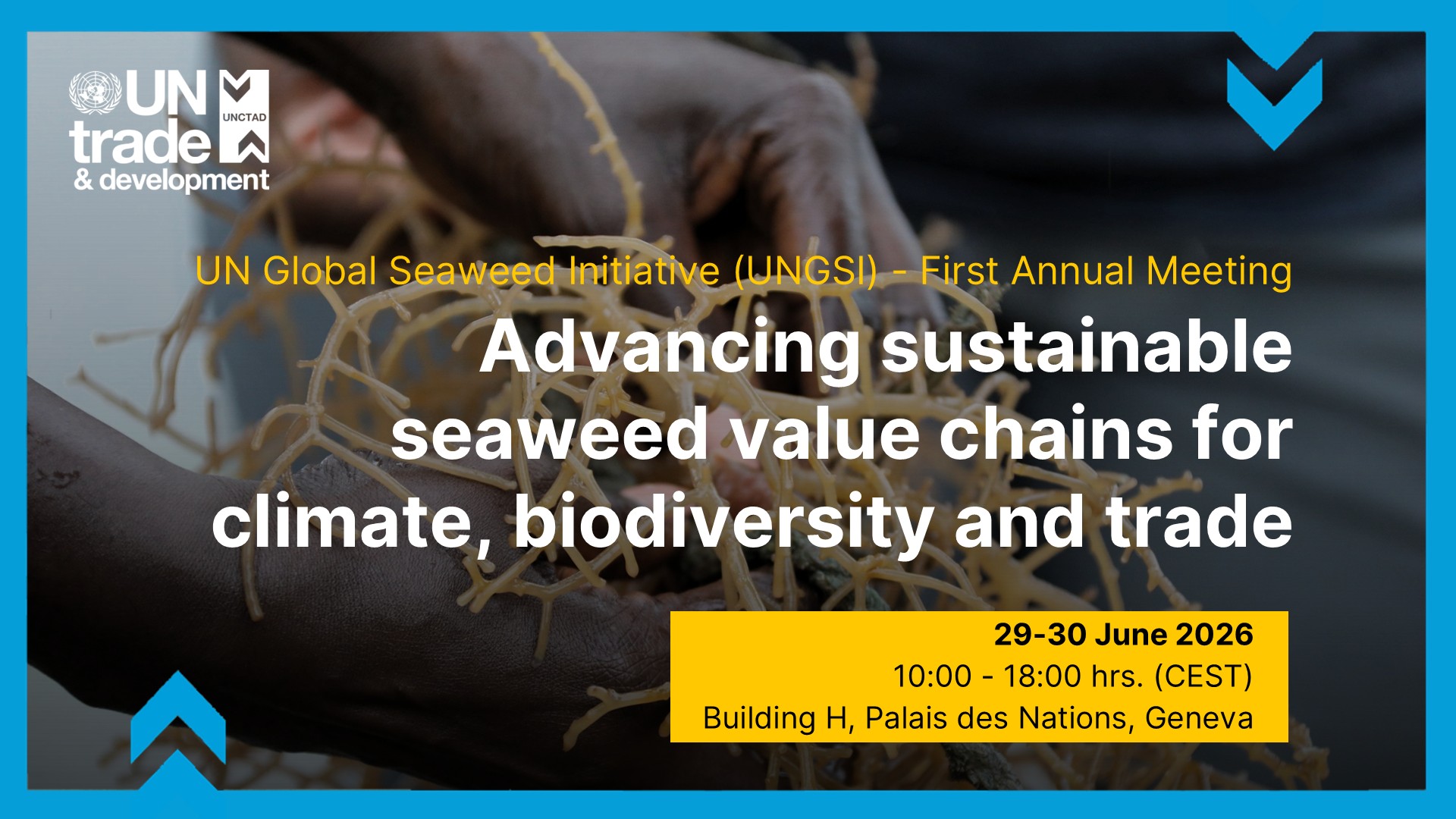
The first Annual Meeting of the UN Global Seaweed Initiative (UNGSI), co-chaired by France and Madagascar and hosted by UN Trade and Development (UNCTAD), took place in Geneva on 29 and 30 June 2026. It brought together Member States, United Nations entities, development banks, researchers, private-sector actors, civil society and producer representatives.
The public day examined four priority areas: integration into national planning; production and commercialization; trade, regulations and standards; and public, private and blended finance. Participants highlighted seaweed’s potential for climate action, biodiversity, food security, trade diversification, coastal livelihoods and sustainable alternatives to plastics, and identified persistent constraints: limited access to quality seed, processing and testing infrastructure, fragmented regulations, insufficient market information and a lack of investment-ready projects.
During the internal session, members and partners reviewed governance, implementation priorities, upcoming events and fundraising proposals. They aim to activate national working groups, strengthen communication and stakeholder engagement, prepare an implementation action matrix and refine the funding pipeline.
The meeting welcomed Ghana and the Bolivarian Republic of Venezuela as new members, and United Nations University and the International Trade Centre as new supporting partners. Members reaffirmed that UNGSI should remain practical, inclusive, science-based and action-oriented.
Advancing sustainable seaweed value chains for climate, biodiversity and trade
The UN Global Seaweed Initiative (UNGSI) is a multi-stakeholder platform aimed at advancing sustainable and inclusive seaweed value chains, contributing to climate action, biodiversity conservation, and sustainable ocean-based economic development.
The Initiative originated from a recommendation of the 5th UN Ocean Forum, was further announced in the context of the 3rd United Nations Ocean Conference, formally launched at the UN General Assembly 2025, and its initial Plan of Action for multiple benefits from seaweed was consolidated at COP30.
UNGSI currently brings together eight member States (Belize, Brazil, Chile, France, Ghana, Indonesia, Madagascar, Senegal, Republic of Korea and the Bolivarian Republic of Venezuela) and it is currently co-Chaired by France and Madagascar".
It is supported by UN Trade and Development (UNCTAD), UN Global Compact (UNGC), United Nations Industrial Development Organization (UNIDO), UN Food and Agriculture Organization (FAO), and UNESCO Intergovernmental Oceanographic Commission (UNESCO-IOC) and Global Seaweed Coalition (GSC).
Despite its high potential, the seaweed sector faces persistent challenges across its value chain, including:
- Limited integration into policy frameworks (NDCs, NBSAPs)
- Constraints in sustainable production systems
- Fragmented regulatory frameworks and standards, including sustainable production, food security and trade
- Lack of Access to finance and investment mechanisms
- Research gaps and limited species diversification
Objectives of the event
- Advance dialogue among Member States on priority actions
- Address key bottlenecks across the seaweed value chain
- Strengthen coordination among partners and stakeholders
- Improve governance arrangements for the continuation of the UNGSI including the definition of the role and composition of the Secretariat.
- Identify concrete pathways for implementation and financing
Video Messages
Édipo Araújo, Minister of Fisheries and Aquaculture of Brazil
Édipo Araújo reaffirmed Brazil’s commitment to the UN Global Seaweed Initiative and to a sustainable and inclusive blue economy. He described seaweed aquaculture as a unique opportunity to combine environmental conservation, food security, innovation and socioeconomic development for coastal communities. While Brazil and Latin America contribute little to global production today, he underlined the region’s significant potential for sustainable growth, and pledged Brazil’s full commitment to strengthening and implementing the Initiative.
Eduardo Sfoglia, Head Advisor for International Affairs, Ministry of Fisheries and Aquaculture, Brazil
Eduardo Sfoglia presented how Brazil has embedded seaweed farming in its national climate plan and Nationally Determined Contributions, and how it can provide alternative livelihoods for coastal communities. He recalled the Plan to Accelerate the Multiple Benefits of Algae Aquaculture, presented by UNGSI partners at COP30 in Belém, and called on members to help mobilize multilateral climate funds and champion concrete seaweed-farming projects as climate solutions.
Chantal Line Carpentier, Head, Trade, Environment, Climate Change and Sustainable Development, UNCTAD
Chantal Line Carpentier positioned seaweed as a strategic pillar of the sustainable ocean economy and named the main constraints: fragmented standards, gaps in processing, certification and traceability, limited finance, and the absence of shared carbon-measurement methods. She outlined UNGSI priorities for 2026–2027: mobilizing resources, integrating seaweed into national plans, strengthening trade regulation, standards and traceability including through Codex Alimentarius, addressing production constraints in developing countries, and reinforcing governance and inclusiveness.
