
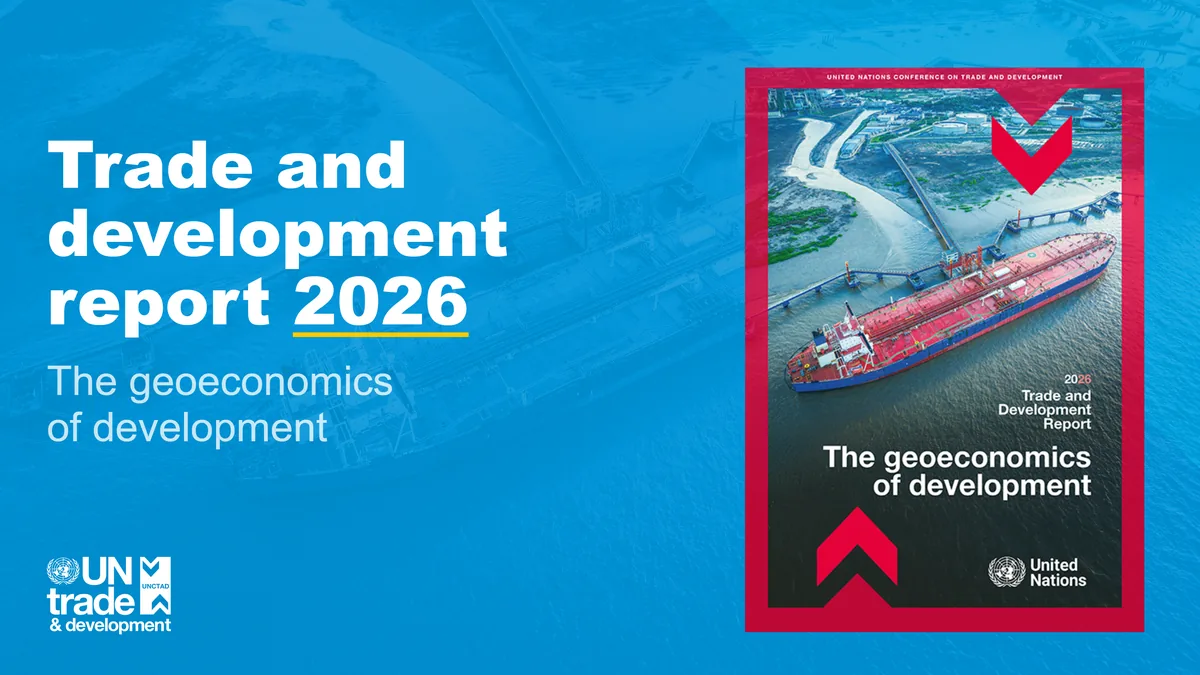
El Informe sobre Comercio y Desarrollo 2026: La geoeconomía del desarrollo contiene un examen de cómo la reorganización en curso de la economía mundial, en la que las políticas industriales, financieras, comerciales y tecnológicas sirven como instrumentos de competencia geoeconómica, está remodelando las condiciones para el desarrollo.
El crecimiento global disminuyó en 2026 desde su nivel del 2,9% en 2025, sin embargo, los indicadores de comercio e inversión sugieren una economía mundial que ha mantenido su posición a través de la incertidumbre política y la volatilidad comercial, impulsada por el auge de la inteligencia artificial. No obstante, las cifras totales ocultas ocultan divergencias, fragmentaciones y crecientes fragilidades financieras.
El crecimiento en el mundo en desarrollo se está bifurcando, ya que las economías dependientes de las importaciones absorben choques energéticos y financieros con mucho menos margen fiscal, en medio de un tercer año consecutivo de caída en la asistencia al desarrollo. El rendimiento agregado del comercio oculta una reconfiguración continua de los patrones comerciales, en los que el acceso al mercado se vuelve más diferenciado y dependiente de las políticas.
En medio de la carrera geoeconómica, muchos países de África y América Latina están cada vez más excluidos de las oportunidades de desarrollo: por ejemplo, mientras que África extrae la mayor parte del cobalto del mundo, retiene menos del 1% del valor en cadenas de suministro verdes. Al mismo tiempo, el actual giro geoeconómico está abriendo espacio para perfiles sectoriales y consolidación regional por el creciente poder de los países del Sur global.
Moderador:
- Anastasia Nesvetailova, Jefa, Rama de Macroeconomía y Políticas de Desarrollo, GDS, UNCTAD
Panelistas:
- Creon Butler, Director, Programa de Economía Global y Finanzas, Chatham House, Reino Unido.
- Profesor Özgür Orhangazi, Universidad Kadir Has, Estambul, Turquía.
- Davaasuren Gerelmaa, Embajador Extraordinario y Plenipotenciario, Representante Permanente de Mongolia ante la Oficina de las Naciones Unidas en Ginebra.
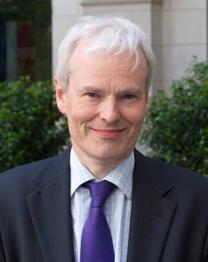
Creon Butler leads the Global Economy and Finance Programme at Chatham House. He joined the institute in 2019, since when he has written and published on a wide range of global economic policy issues, including the interaction between macroeconomic policy and climate change, sovereign debt distress, the challenge of funding global health priorities, and the long-term implications for the international economic system of the pandemic and the war in Ukraine.
Prior to joining Chatham House, Mr Butler served as Director for International Economic Affairs in the UK Cabinet Office’s National Security Secretariat and as the UK’s G7/G20 Sous-Sherpa, advising the Prime Minister on international economic policy from 2016 to 2019. Earlier, he was Director in the European and Global Issues Secretariat at the Cabinet Office, where he played a leading role in the design and delivery of the UK’s Global Anti-Corruption Summit in 2016.
Mr Butler has held a number of senior positions across the UK public sector, including Senior Adviser for International and EU Affairs at HM Treasury, Minister and Deputy High Commissioner at the British High Commission in New Delhi, and Chief Economic Adviser and Director of Economic Policy at the Foreign and Commonwealth Office. He also served in several senior roles at the Bank of England, including as Head of the Monetary Instruments and Markets Division and Principal Private Secretary to the Deputy Governor.
He holds both an MSc in Econometrics and Mathematical Economics and a BSc in Economics from the London School of Economics and Political Science (LSE).

Her Excellency Ms. Davaasuren Gerelmaa is a senior diplomat with extensive experience in multilateral diplomacy, international cooperation, and policy coordination. She currently serves as Mongolia's Ambassador and Permanent Representative to the United Nations Office at Geneva, where she represents her country across a wide range of international organisations and development agendas.
Ambassador Gerelmaa has held key positions within the Ministry of Foreign Affairs of Mongolia, including roles in multilateral affairs and human security, and has contributed to Mongolia's engagement with the United Nations, WTO, and regional forums.
A committed advocate for digital transformation and trade facilitation, she serves as a member of the ASYCUDA Advisory Board, where she actively supports the strategic direction of UNCTAD's digital customs reform initiatives. Her leadership reflects Mongolia's long-standing commitment to international cooperation, digital innovation, and inclusive development.
Ambassador Gerelmaa holds advanced academic qualifications in international relations and public policy.
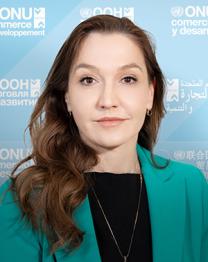
Anastasia Nesvetailova (BSc Econ; MSc IPE; PhD IPE) is the Head of the Macroeconomic and Development Policies Branch of UN Trade and Development (UNCTAD) in Geneva. She leads the team responsible for the flagship Trade and Development Report.
Before joining UNCTAD Anastasia has been a Professor of International Political Economy at City, University of London, and held visiting fellowships at the University of California, the Levy Institute of Bard College, the Danish Institute of International Studies and CERIS-ULB School in Brussels.
Anastasia’s main research has focused on the political economy of finance. She has published widely on issues of financial instability, financial innovation and governance, including three monographs (Fragile Finance: Debt, Speculation and Crisis in the Age of Global Credit , 2007; Financial Alchemy in Crisis: The End of Liquidity Illusion, 2010; and Sabotage: The Business of Finance, 2020, with R. Palan), as well as numerous academic and policy articles on the global financial system.
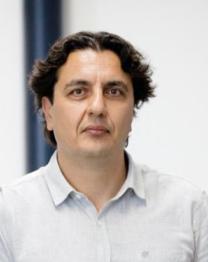
Prof. Dr. Ozgur Orhangazi is a political economist and macroeconomist whose research focuses on political economy, macroeconomic analysis, and the dynamics of economic development and financial systems. He is currently a faculty member at Kadir Has University, where he has served since 2011, and was Head of the Department from 2017 to 2023. Prior to joining Kadir Has University, he was a faculty member at Roosevelt University from 2006 to 2011.
Throughout his academic career, Professor Orhangazi has held numerous international visiting appointments, reflecting his broad engagement with the global economics community. He has served as a Visiting Scholar at Kindai (Kinki) University in Fukuoka, Japan (2024), the Berlin School of Economics and Law (2023), Université Paris 13 (2018), the University of Seoul (2018), and the Political Economy Research Institute (2017). Between 2020 and 2023, he was a member of the Graduate Faculty at the University of Missouri-Kansas City. Earlier in his career, he was an invited researcher at the Central Bank of Venezuela in 2009.
Professor Orhangazi's academic foundations were established at the University of Massachusetts Amherst, where he earned both his Master's and PhD degrees in Economics. During this period, he served as a Teaching Assistant (1999-2003) and Teaching Associate (2003-2004), before joining the Political Economy Research Institute as a Research Assistant from 2004 to 2006. He completed his undergraduate studies in Economics at Middle East Technical University.
An active scholar and educator, Professor Orhangazi has contributed extensively to research and teaching in heterodox economics, political economy, and macroeconomic policy, with particular interest in the relationships between finance, growth, development, and economic transformation in both advanced and developing economies. His work is widely recognized for its critical examination of contemporary economic structures and policy challenges.
