

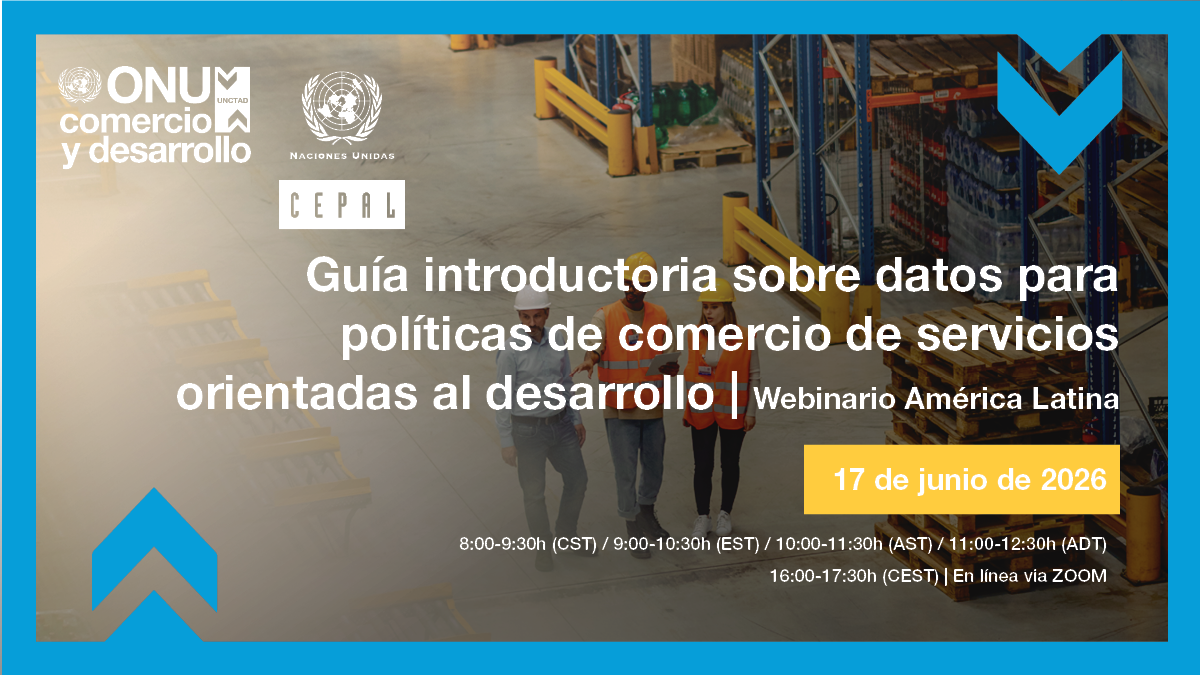
Los países siguen enfrentando brechas en la recopilación, interpretación y uso de datos sobre el comercio de servicios para diseñar políticas comerciales eficaces para el desarrollo. En seguimiento a una recomendación del “grupo de trabajo informal de la UNCTAD sobre datos para políticas de comercio de servicios orientadas al desarrollo”, la UNCTAD elaboró la Guía introductoria sobre datos para políticas de comercio de servicios orientadas al desarrollo para responder a estos desafíos.
La Guía introductoria ofrece una herramienta integral sobre cómo identificar y utilizar datos de fuentes nacionales, regionales e internacionales. Ayuda a identificar las brechas en los datos y las necesidades de fortalecimiento de capacidades. La Guía introductoria presenta los fundamentos conceptuales para medir y comprender los datos del comercio de servicios, proporciona una visión general completa de los principales conjuntos de datos sobre el comercio de servicios y los conjuntos de datos complementarios, y concluye con recomendaciones para mejorar los datos sobre el comercio de servicios.
La UNCTAD y la Comisión Económica para América Latina y el Caribe (CEPAL) coorganizan este webinario para discutir cómo se puede aplicar la Guía introductoria en el contexto de las políticas latinoamericanas, teniendo en cuenta las prioridades y realidades regionales.
Objetivo
El objetivo de este webinario es apoyar el uso eficaz de los datos del comercio de servicios en la formulación de políticas y recabar opiniones que sirvan de base para el apoyo de las Naciones Unidas, con el fin de diseñar futuras versiones de la guía y su implementación.
Este webinario busca:
- Compartir los mensajes clave y las ideas principales de la Guía, relevantes para la formulación de políticas.
- Demostrar cómo se puede aplicar la Guía en contextos políticos reales.
- Fomentar el diálogo sobre la mejora de los datos del comercio de servicios y su uso en las políticas.
- Recopilar opiniones para futuras actualizaciones y otro tipo de apoyo.
Para alcanzar estos objetivos, el webinario:
- Presenta el contenido de la Guía, sus mensajes principales y su relevancia para políticas.
- Invita a expertos de América Latina a compartir ejemplos relevantes que ilustren la pertinencia de los datos del comercio de servicios y de la Guía para la formulación de políticas.
- Invita a delegados de los Estados miembros y otros participantes a debatir perspectivas sobre el uso de la Guía y el trabajo futuro en este ámbito.
Participantes
El webinario está diseñado para apoyar a una amplia gama de partes interesadas que pueden utilizar la Guía introductoria en América Latina. El webinario está abierto a usuarios de datos y análisis del comercio de servicios, como tomadores de decisiones de política y funcionarios de ministerios de comercio y sectores relacionados con los servicios, diplomáticos, negociadores comerciales, expertos en promoción del comercio de servicios, expertos en inteligencia de mercado de servicios, coaliciones de servicios y empresas del sector. El webinario también está dirigido a investigadores, académicos, funcionarios de organizaciones regionales e internacionales y otros analistas que utilizan datos del comercio de servicios. Asimismo, el webinario también es del interés de estadísticos y otros participantes que recopilan, procesan y comunican datos del comercio de servicios, incluyendo de oficinas nacionales de estadística y bancos centrales. El webinario se imparte en español. La participación es en línea a través de Zoom.
Documentos
Los documentos de esta página (declaraciones y presentaciones) estarán disponibles hasta el 24 diciembre de 2026. Se publican en el idioma y formato en que se reciben. Las opiniones expresadas son las del autor y no reflejan necesariamente las de la UNCTAD.
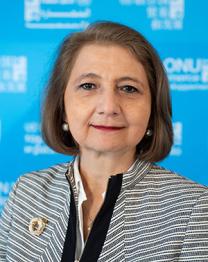
Luz Maria de la Mora is the Director of UNCTAD's Division on International Trade and Commodities. As a former Vice-Minister for International Trade and decades of government and private sector positions, Ms. de la Mora developed a career in international trade policy, negotiation, operations, and trade promotion.
During her tenure as Vice-Minister for International Trade of Mexico from 2018 to 2022, Ms. de la Mora led Mexico's trade and investment policy, overseeing fourteen free trade agreements with 51 countries. To bolster Mexico's development, she steered discussions in the World Trade Organization, the United States-Mexico-Canada Trade Agreement, Comprehensive and Progressive Agreement for Trans-Pacific Partnership, and Pacific Alliance, among others. She also coordinated policy dialogues and handled private sector consultations.
Ms. de la Mora holds a PhD in Political Science from Yale University, USA, a Master's degree in International Affairs from Carleton University, Canada, and a Bachelor's degree in International Relations from El Colegio de México, Mexico.
She is fluent in English and Spanish, and proficient in French.

Bruno Antunes works on economic affairs at the United Nations Trade and Development (UNCTAD), and previously at the United Nations Economic Commission for Latin America and the Caribbean (ECLAC).
Applies policy analyses and delivers technical assistance and capacity building on trade in services to promote sustainable and inclusive economic development. Focuses on the role of services in diversification and structural transformation.
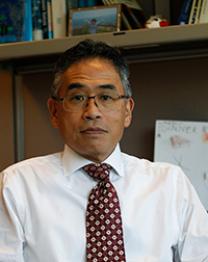
Keiji Inoue is currently interim Chief of the International Trade and Integration Division at the Economic Commission for Latin America and the Caribbean (ECLAC) in Santiago, Chile. He started his career at the United Nations in 1995 as fiscal policy expert at the Economic Development Division at ECLAC. From 2002, he was the macroeconomic analyst for Latin America and the Caribbean in the Development Policy Analysis Division at the Department for Economic and Social Affairs at the UN headquarters in New York; and later became the coordinator of the Secretary-General’s Millennium Development Goals Task Force analyzing and monitoring MDG 8, the Global Partnership for Development, along with over 30 UN agencies and the international financial institutions. He holds an MA in International Economics and Development Studies from Sophia University, Japan and a BA from Tufts University, USA.

Nanno Mulder is Head of the International Trade Unit in ECLAC’s International Trade and Integration Division. His main areas of research and technical assistance are global value chains in general and digital services in particular, e-commerce, and sustainable trade, with a focus on three key areas: the internationalisation of SMEs, gender gaps, and the circular economy. Mr Mulder worked as an economist at the Organisation for Economic Co-operation and Development (OECD) in the Latin America team of the Economics Department (2002–2005) and as a researcher at the French Centre for Prospective and International Studies (CEPII) (1996–2002). He holds a Master’s degree and a PhD in Economics from the University of Groningen, the Netherlands. Mr Mulder is also co-founder and president of the Latin American network for research and policy on services, REDLAS.
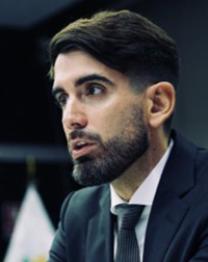
Javier Pérez Ibáñez is an Economic Affairs Officer in the International Trade and Integration Division of ECLAC. His work focuses on international trade, productive development, and trade in services. He holds a PhD in Economic Development and has researched topics related to global value chains, industrial policy, and productive transformation in Latin America.

Romina Gayá is an economist and international consultant specializing in trade in services, the knowledge economy and internationalization strategies. For more than 20 years, she has advised governments, companies and international organizations on public policy, measurement, export promotion and the competitive development of services. She is a Professor of International Economics at the University of Bologna and UADE.

Rodrigo Céspedes is an industrial engineer with years of experience in public policy and program management. At Chile's Ministry of Finance, he serves as Project Manager of the Global Services Export Program, financed by the IDB, where he manages interinstitutional coordination and results-based reporting systems.

Rigoberto Torres Mora is Director of the Organizational Data Analysis Department at the Central Bank of Costa Rica. With more than four decades of experience in international accounts, balance of payments and macroeconomic statistics, he has served as an international consultant, university lecturer and expert in a United Nations working group. He holds a PhD in Economic and Business Sciences and is the author of the book International Accounts: Methodological, Conceptual and Analytical Aspects.

Ilena Carolina Rosario Rodríguez holds a Law Degree from Universidad Iberoamericana, a Master's Degree in International Law from the Higher Institute of Law and Economics at the University of Barcelona, and a specialization in Trade Policy from the World Trade Organization and in Constitutional Law from the University of Castilla-La Mancha. She has over 14 years of experience in the areas of Foreign Trade, Trade Disciplines, Dispute Settlement, Investment, Services, and Public Policy; particularly in negotiation in international forums, modernization and harmonization of international trade rules, and the design and implementation of public policies. She has received training in Community Law and Regional Economic Integration, Trade and Development, and Dispute Settlement. She has been an international panellist and invited speaker at various organizations such as the WTO, UNCTAD, ECLAC, and UNCITRAL. She teaches at the master's and undergraduate levels at UNIBE and APEC universities. He has published several works, most notably "Trade in Services in International Trade Agreements" and "Professional Services in the EPA," works that served as the basis for her most relevant project: The first National Strategy for the Export of Modern Services.
