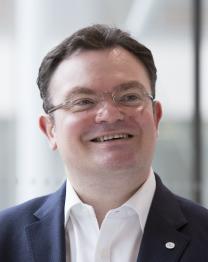

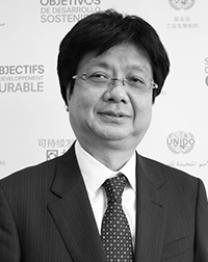
Mr. Hiroshi Kuniyoshi is the Deputy to the Director-General and the Managing Director of External Relations and Policy Research at the United Nations Industrial Development Organization (UNIDO) since April 2017.
In April 1984, he joined the Government of Japan's Ministry of International Trade and Industry (now known as METI), where he planned and implemented a variety of industrial and technology policies.
In August 2006, Mr. Kuniyoshi was appointed Professor at Tokyo Institute of Technology, where he conducted research and education in policy studies related to industry, technology and innovation.
In September 2012, he was appointed Executive Director of the New Energy and Industrial Technology Development Organization (NEDO), one of Japan's largest public organizations in research and development. At NEDO, he was in charge of global collaborative projects for the development of low-carbon technologies such as renewable energy, battery storage and smart grids.
In January 2016, he was appointed Head of the UNIDO Investment and Technology Promotion Office, Tokyo, (UNIDO ITPO Tokyo), where he worked closely with Japanese industries in areas related to technology transfer and investments to developing countries.
Mr. Hiroshi Kuniyoshi holds a Master's degree in International Relations from the University of Cambridge and a Ph.D. in Energy Science from the Kyoto University.
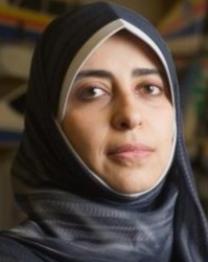
Prof. Heba Kurdi is a distinguished Professor of Distributed Artificial Intelligence at King Saud University, a Fellow at MIT's School of Engineering, and a Senior Member of the IEEE. She is also the founder of Mata Logistics, a smart logistics start-up and was named among the Top 100 Saudi Pioneer Women 2025. Prof. Kurdi earned her PhD from the School of Engineering and Design at Brunel University.
Following her doctorate, she was awarded a scholarship from Aramco to conduct postdoctoral research at MIT's Department of Aeronautics and Astronautics. She later joined MIT's Department of Mechanical Engineering as a research fellow, where she remains actively affiliated. With over 120 publications and eight patents, Prof. Kurdi is recognized among the top 2% of highly cited scientists worldwide, as per the Stanford system. She has held numerous leadership roles, including Chairman of the Cyber Security Master Program at King Saud University, Vice Chair of the Department of Computer Sciences, Vice Dean of the College of Computer and Information Sciences, and Vice Dean of the Career and Entrepreneurship Centre at Al-Imam Muhammad Ibn Saud Islamic University.
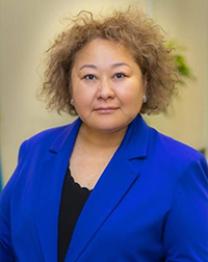
Zhanel Kushukova was appointed Deputy Minister of Trade and Integration of the Republic of Kazakhstan in July 2019.
Before that, she worked in the Ministry of Industry and Trade; the Ministry of Economy and Trade; and the Ministry of National Economy of the Republic of Kazakhstan. She was a member of the Kazakhstan negotiating group for accession to the WTO, and participated in the development of the legal and contractual framework of the Eurasian Economic Union.
Previous positions include:
- Leading expert on domestic market protection at the Anti-Dumping Control Committee of the Ministry of Economy and Trade of the Republic of Kazakhstan (2001-2002)
- Leading Specialist, Customs and Tariff Policy Division, Department of Trade, International Cooperation and Export Control, Ministry of Industry and Trade of the Republic of Kazakhstan (2002-2004)
- Head of the Customs and Tariff Regulation Division, Deputy Head of the Administration, Head of the Administration of the Department for WTO Accession (2004-2008)
- Director of the Foreign Trade Policy Development Department of the Ministry of Industry and Trade of the Republic of Kazakhstan (2008-2010)
- Director of the Foreign Trade Policy Development Department, Ministry of National Economy of the Republic of Kazakhstan (2010-2019)
Ms. Kushukova graduated from the Kozybayev North Kazakhstan State University with a degree in economics.


Rik Kutsch Lojenga has been the Executive Director of UEBT since its creation in 2008. He is a global expert on ethical sourcing of ingredients from biodiversity in support of the objectives of the Convention on Biological Diversity.
In his role at UEBT he leads the non-profit association in its work to set good practices for how companies and their suppliers source specialty ingredients for the beauty, food, natural pharmaceuticals, flavours & fragrances, herbs and spices sectors, among others. The organisation is internationally recognised for its work with companies on ethical sourcing of ingredients from biodiversity.
Before UEBT, Rik spent more than a decade with the United Nations Conference on Trade and Development (UNCTAD), where he was involved in the creation of the BioTrade Initiative and helped to conceptualise the idea of UEBT. He has also served as the Board Chair of ISEAL, the umbrella group for sustainability standards.
Rik grew up in the Netherlands, where he earned a master’s degree in business and environmental economics.

Dr. Michael Kwet is a Visiting Fellow of the Information Society Project at Yale Law School. He received his Ph.D. in Sociology from Rhodes University in South Africa. He is the author of Digital Colonialism: US Empire and the New Imperialism in the Global South, and is among the most cited scholars on the topic of digital colonialism.
He has been published at The New York Times, Al Jazeera, VICE News, Wired, Slate, Mail & Guardian and Counterpunch, and has appeared on BBC World News Radio, NPR and The Real News.
Dr. Kwet is the editor of the forthcoming book, The Cambridge Handbook of Race and Surveillance on Cambridge University Press, author of the short book, People’s Tech for People’s Power: A Guide to Digital Self-Defense and Empowerment and is also host of the Tech Empire Podcast and founder of the People’s Tech Campaign.
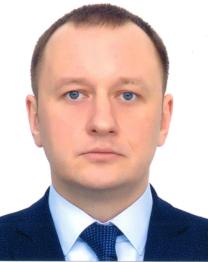


Gabriel Labbate is the Head of the Climate Mitigation Unit and Global Team Leader of the UN-REDD Programme at UNEP. He has more than 20 years of experience in the interphase of environment, poverty, and human development.
He has worked on environmental valuation, quantitative poverty analysis, cost-benefit analysis of REDD+, and the integration of social issues into land use and biodiversity conservation policies.
Gabriel´s current work focuses on using carbon markets to support high-integrity nature-based solutions to climate change. Gabriel represents UNEP at ICAO/CORSIA and is a member of the UN Task Force on Voluntary Carbon Markets. He is also a Co-Chair of the Expert Panel of the Integrity Council for the Voluntary Carbon Market (IC-VCM).
Gabriel holds a degree in Biology from the University of Buenos Aires, Argentina, a master’s degree in Economics from New York University, and a Ph.D. in Environmental Studies from the University of California, Santa Cruz.