
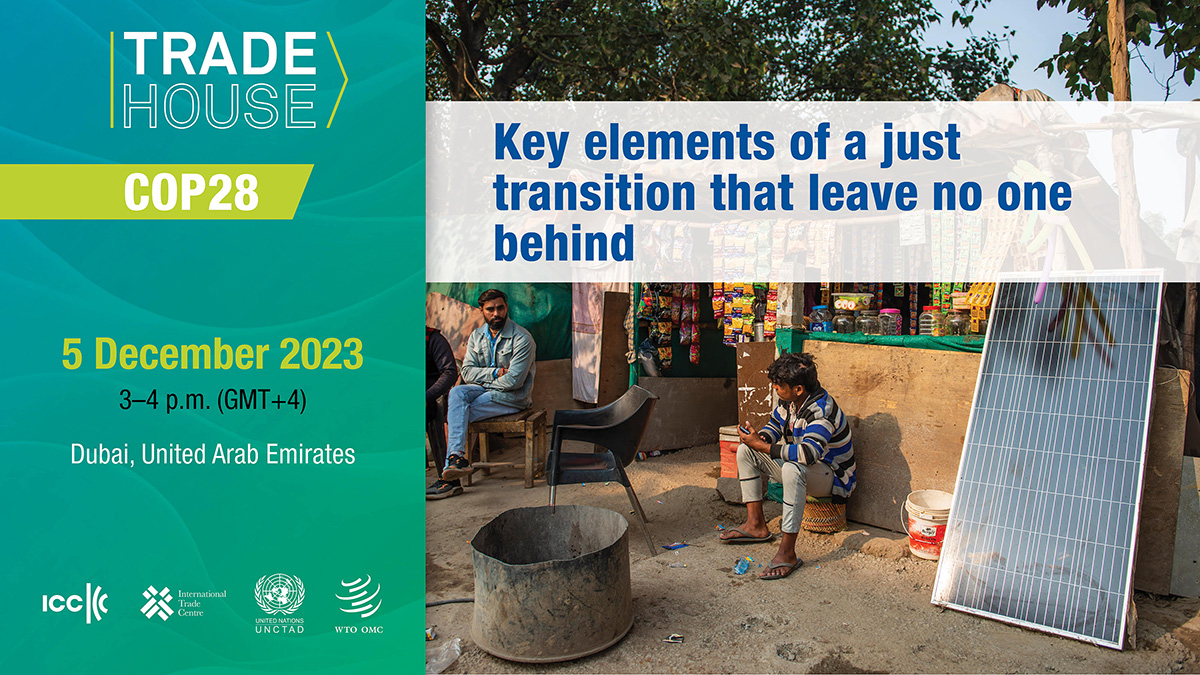
Trade House event at COP28: Key elements of a just transition that leave no one behind
Just transition is being proposed to address the injustice stemming from the fact that "[C]limate change creates a double inequality whereas developed countries are responsible for the bulk of the negative consequences of climate change, but remain the least affected by them, while the countries least responsible for climate change are most adversely affected by it.". In addition, trade-related policies put in place by developed economies can limit developed countries' market access, trade revenues, and ability to mobilise domestic resources. Trade rules and policies that, for instance, restrict access to the necessary technology can slow or limit developing countries' transition from fossil-intensive energy systems and deliver low-carbon industrialisation. The energy transition will also require investing about 1.5 times today's global GDP until 2050 in renewable energy generation, energy efficiency, and energy infrastructure.
But just transition is more than energy transition. Given the centrality of fossil fuels to the global economy and the deep integration of almost all sectors and communities in the carbon value chain, decarbonisation entails the systemic transformation of the whole economy and society. A just transition requires maximising co-benefits while minimising trade-offs between environmental, and social and development objectives, as embodied in the SDGs. Also, the preamble of the Paris Agreement includes the imperative of a just transition of the workforce and the creation of decent work and quality. However, no internationally agreed definition exists, and the focus of discussions has varied greatly.
This session will explore the:
- Main constraints developing countries face
- Capacities they need
- Multilateral dimensions of the just transition
- What are the key elements to unlock just transitions?
- Tansparency, governance, stakeholder engagement, and integrity issues in climate action, energy transition, and NDCs
This event will be live streamed
Programme
Moderator: Ms. Chantal Line Carpentier, UNCTAD
Panelists:
- Mr. Richard Kozul-Wright, UNCTAD
- Ms. Camilla Roman, Policy Specialist, Priority Action Programme on Just Transition, ILO
- Mr. Simon Hess, Head, Monitoring & Evaluation, Enhanced Integrated Framework (EIF)
- Indonesia Representative (tbc)
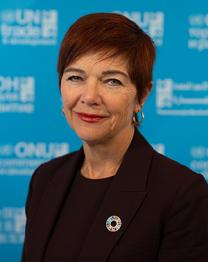
Dr. Carpentier, from Quebec, Canada, is Head of Trade, Environment, Climate change, and Sustainable Development Branch of UNCTAD’s Division on International Trade and Commodities (DTIC). Her work with governments and partners foster green, blue, circular, and impact economies that supported by trade, are key to addressing the triple planetary crisis: climate change, pollution and biodiversity loss. She came to Geneva after leading the UNCTAD New York office, representing the SG and coordinating UNCTAD’s support to inter-governmental negotiations of the UN General Assembly (2015-2023).
She held several other positions. At the UN Department of Economic and Social Affairs, she facilitated the engagement of NGOs, women and youth’s groups, business, local authorities, etc. in the SDGs negotiations and the UN Rio+20 Conference (2011-2015). She also supported the Commission on Sustainable Development research and negotiations on sustainable agriculture and sustainable consumption and production (2007-2011).
Prior to joining the UN, she Headed the North American Free Trade Agreement Commission for Environmental Cooperation’s, Environment, Economy and Trade Division (2000-2007), was Agro-environmental policy analyst for Winrock International (1998-2000) and post-Doctoral fellow/Brazil office manager for the International Food Policy Research Institute (1996-1998).
She has a PhD. in Agro-Environmental Economics from Virginia Tech, as well as a MSc. and BSc. in Agro- Economics from McGill University and is an ironman and ultramarathoner. She is a Yale World Fellow, received the 2023 Schwab Foundation for Social Entrepreneurship public intrapreneur award, and is a UNEP Who’s Who of Women and the Environment.

Richard Kozul-Wright is the director of UNCTAD’s globalization and development strategies division.
He has worked at the UN in both New York and Geneva and published widely on economic issues, including in the Economic Journal, the Cambridge Journal of Economics, the Journal of Development Studies, and the Oxford Review of Economic Policy.
He has co-written books such as The Resistible Rise of Market Fundamentalism with Paul Rayment and co-edited volumes of Transnational Corporations and the Global Economy, Economic Insecurity and Development, Securing Peace, Climate Protection and Development and Industrial Policy.
He also co-edited Transforming Economies: Making Industrial Policy Work for Growth, Jobs and Development with the International Labour Organization.
He holds a PhD degree in economics from the University of Cambridge in the UK.
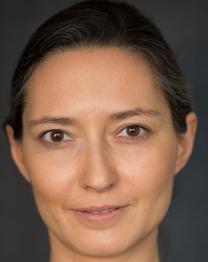
Camilla is a policy specialist in the ILO’s global Green Jobs programme. She coordinates technical assistance on a Just Transition towards sustainable economies, leading the development of policy tools and the design and implementation of projects and partnerships. She has previously managed capacity building programmes on policies for better productivity and working conditions in Small and Medium Enterprises with the ILO Enterprises department.
Before joining the ILO’s HQ, Camilla was the Deputy Programme Manager of ILO-IFC Better Factories Cambodia (Better Work), and focused on advancing responsible labour practices in the garment and footwear supply chain. Earlier on, she coordinated Greener Business Asia, a project supporting sustainable enterprise development in Thailand and the Philippines, and the Green Jobs initiative in India.
Camilla holds a doctorate from the University of Oxford with a thesis on learning and innovation in SME clusters and industrial districts.
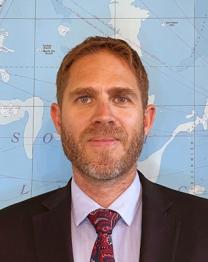
Simon is the Head of Monitoring and Evaluation for the EIF and the focal point in the EIF for thematic issues related to the 2030 Development Agenda, Agriculture and SPS/TBT issues.
Bringing more than 15 years' experience in trade and development across Africa, Asia and the Pacific, Simon has worked as an advisor with the Government of Lao PDR and as a director of an international development firm based in the UK and South Africa. Having spent most of his life in Africa, studying in South Africa and Canada, Simon has a Masters' degree in Economics focused around award winning research on industrial development and trade. Amongst other areas, Simon has worked on regional integration, sustainability certification, and practical trade support.
He continues research in areas such as the future direction for Aid for Trade.
