
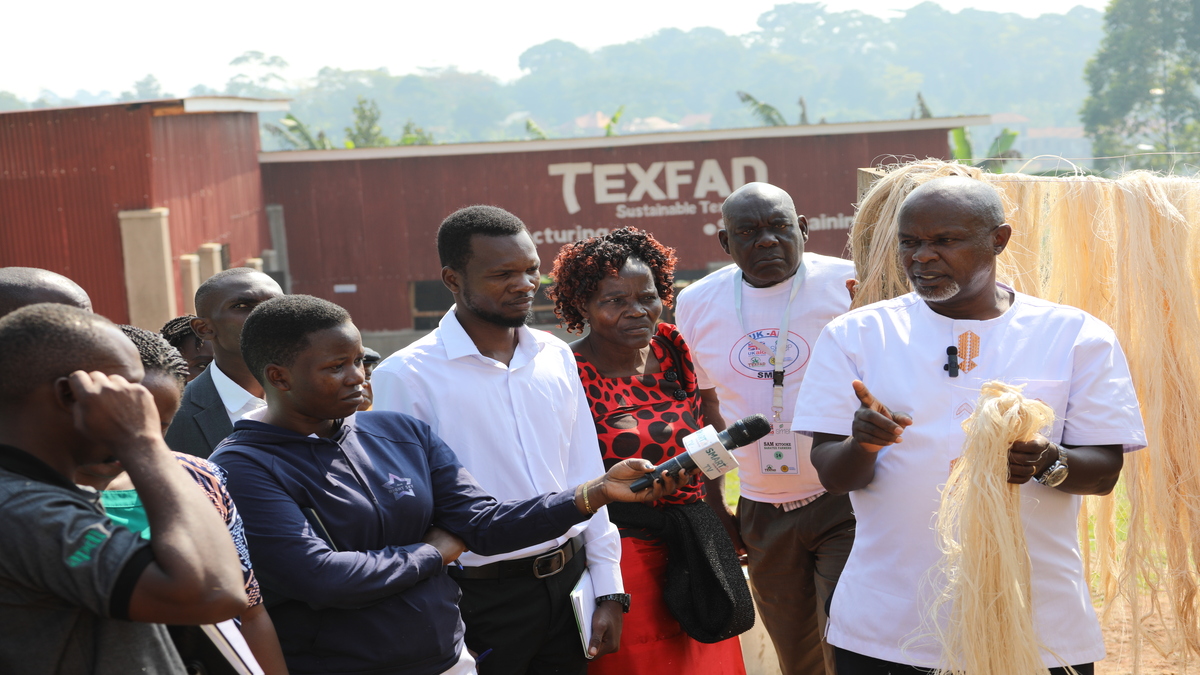
The 2nd East Africa Regional Sustainable Natural Fibres Symposium 2026 will bring together public institutions, businesses, researchers, financiers, standards bodies, producers and technology developers to advance an African-led agenda for sustainable natural and alternative fibres.
Hosted by the Uganda Industrial Research Institute (UIRI) in partnership with the East Africa Alternative Fibres Forum (EAAFF) and national and regional partners, the symposium reflects the growing ownership of this agenda by institutions and innovators in the region. It will provide a platform for participants to identify shared priorities, showcase locally developed solutions and build the partnerships needed to move from promising applications to competitive, investable and regionally connected value chains.
Held under the theme “Towards a Coordinated African Alternative Natural Fibre Platform,” the symposium will focus on circular industrialization, investment, business partnerships, trade, standards and regional cooperation. It will bring particular attention to the potential for converting agricultural residues and other locally available biomass into higher-value products, while strengthening the productive capacities needed to retain more value, knowledge, skills and employment within East Africa.
The event builds on the first regional symposium, held in Nairobi in 2025, which brought together producers, buyers and enabling institutions to map the natural-fibre ecosystem, explore financing and market opportunities, and open dialogue on regional industry coordination. The second symposium will take this process forward through stronger national leadership, practical regional collaboration and a clearer focus on industrial scale-up.
From agricultural residues to regional industries
Across East Africa, residues including banana pseudostems, pineapple leaves and sisal waste are frequently discarded, left to decompose or burnt. Yet these materials can provide inputs for textiles, homeware, paper, sanitary products, hair extensions, packaging and other applications. Their productive use can reduce waste and pollution while creating new sources of income and opportunities for enterprise development.
Capturing this opportunity requires more than the production of raw fibre. Competitive value chains depend on reliable collection and aggregation systems, appropriate machinery, product design, testing facilities, consistent quality, entrepreneurial capabilities, access to finance and connections to domestic, regional and international markets.
The symposium will therefore consider how East African countries can build the productive capacities required to process local feedstocks into value-added materials and finished products. The objective is to help ensure that the region does not remain principally a supplier of unprocessed biomass or fibre, but develops the technological, institutional and commercial capabilities needed to retain a greater share of value locally.
Standards as infrastructure for markets
Standards, certification and conformity assessment will be central to the discussions. As alternative fibres enter applications such as clothing, hair extensions, household products, sanitary items, packaging and other consumer goods, producers and purchasers need confidence in material composition, performance, safety, durability and environmental claims.
Clear and credible standards can help innovative businesses demonstrate product quality, reduce uncertainty for investors and buyers, support access to public procurement and export markets, and protect markets against misleading or unsubstantiated sustainability claims. Cooperation among national standards bodies can also reduce unnecessary regulatory fragmentation and support the development of regional markets.
The participation of the Uganda Bureau of Standards and other technical institutions will connect product innovation with the quality infrastructure needed for commercialization and scale. The event flyer lists the Uganda Bureau of Standards, universities, enterprises and other organizations among the symposium partners.
Linking natural fibres to the transition beyond plastics
Natural fibres can contribute to the transition away from plastic-intensive products in selected applications, including packaging, textiles, household goods and sanitary products. The symposium will connect East Africa’s emerging fibre industries with related work by UN Trade and Development (UNCTAD) and the Sustainable Manufacturing and Environmental Pollution (SMEP) Programme on non-plastic substitutes and environmentally sound production.
These links include emerging work towards a West Africa Plastic Substitutes Initiative (WAPAI), covering standards and certification, trade conditions and regional cooperation. Exchanges between East and West Africa can help identify practical approaches to material substitution while opening opportunities for African producers and manufacturers.
Standards, markets and regional value addition
Standards, certification and conformity assessment will be central to the symposium. Reliable standards can help producers demonstrate product safety, quality, performance and environmental integrity, while giving buyers and investors greater confidence in emerging materials.
Regional cooperation can also help connect producers, processors, researchers, manufacturers and buyers across borders. The objective is to build the productive capacities required to transform locally available biomass into higher-value products, retaining more processing, knowledge, employment and economic value within the region.
Objectives
The symposium will seek to:
- consolidate a nationally owned and regionally connected platform for sustainable natural fibres;
- showcase technologies, enterprises, products and research from Uganda and the wider region;
- identify commercially promising value chains and investment opportunities;
- advance cooperation on standards, certification and conformity assessment;
- strengthen links among producers, processors, manufacturers, researchers, investors and buyers; and
- agree practical next steps towards a coordinated African alternative natural-fibre platform.
The symposium will bring together government institutions, standards bodies, research and technology organizations, universities, producers, manufacturers, financial institutions, buyers, business associations and development partners. Participation is in person only and requires approval by organizers.
Institutional announcements by partners can be found here: UIRI, EAAFF, NDISI.
