
Small and medium-sized enterprises (SMEs) are central to the economy of the Central African Republic, particularly in agriculture, wood processing and mining, yet they remain weakly integrated into regional value chains because of constraints in productivity, quality, market access and financing. The country’s National Development Plan 2024–2028 identifies SME development, local transformation and regional integration as key levers of economic diversification, an ambition reinforced by the opportunities offered by the African Continental Free Trade Area (AfCFTA).
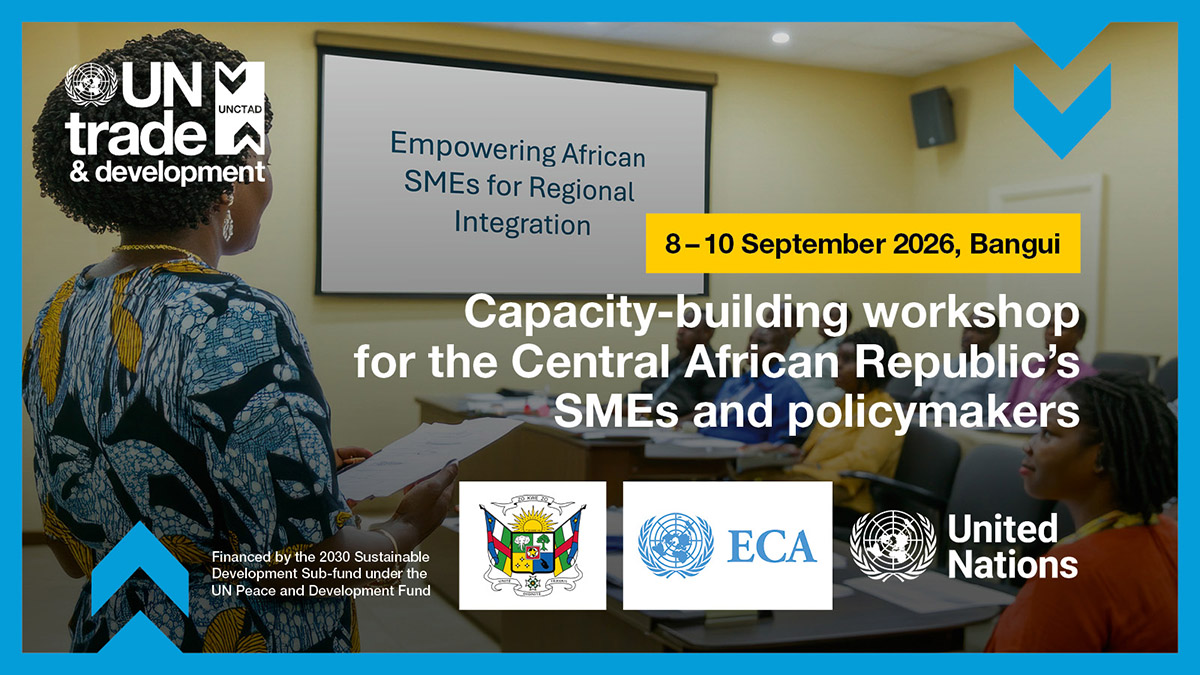
As part of the four-year project “Enhancing the capacity of African vulnerable countries in adopting policy incentives and innovative instruments for SMEs’ participation in RVCs” (2024–2028), UNCTAD, the United Nations Economic Commission for Africa (ECA) Subregional Office for Central Africa, the Resident Coordinator’s Office, in collaboration with the Ministry of Trade and Industry, are organizing two parallel capacity-building activities in Bangui: a three-day workshop for Central African SMEs and a two-day training for policymakers on the use of intra-regional trade statistics tools.
The workshop will strengthen the practical capacities of about 20 SMEs, from the mining and agri-food sectors, in entrepreneurship, market identification, export preparation and commercialization. In parallel, about 15 representatives from technical ministries, research centers and universities will be trained to use UNCTAD’s trade and value-chain analysis tools. Both activities combine technical presentations, case studies, group work and practical simulations.
