Biodiversity loss continues at an alarming pace, despite the progress under the draft global review of implementation of the Kunming–Montreal Global Biodiversity Framework (KMGBF). Accelerated and cross-sector action is needed to halt and reverse biodiversity loss by 2030. While initiatives such as UNCTAD’s BioTrade Initiative and Sustainable Manufacturing and Environmental Pollution (SMEP) Programme, the Bioeconomy Challenge, and the G20 Principles on Bioeconomy have demonstrated trade's positive role, this potential remains underutilized and often confined to wildlife trade.
International trade can pressure biodiversity through land-use change, overexploitation, invasive alien species, and pollution. Yet, when supported by appropriate policies, governance frameworks and business models, trade can incentivize sustainable use of biodiversity, fair and equitable benefit-sharing resource efficiency, reduce pollution, innovation and export diversification. Equally, biodiversity is crucial for international trade. Trade in biodiversity-based products represented around 17.3% (US$3,8 trillion) of global trade in 2024, underscoring how healthy ecosystems underpin global production and livelihoods.
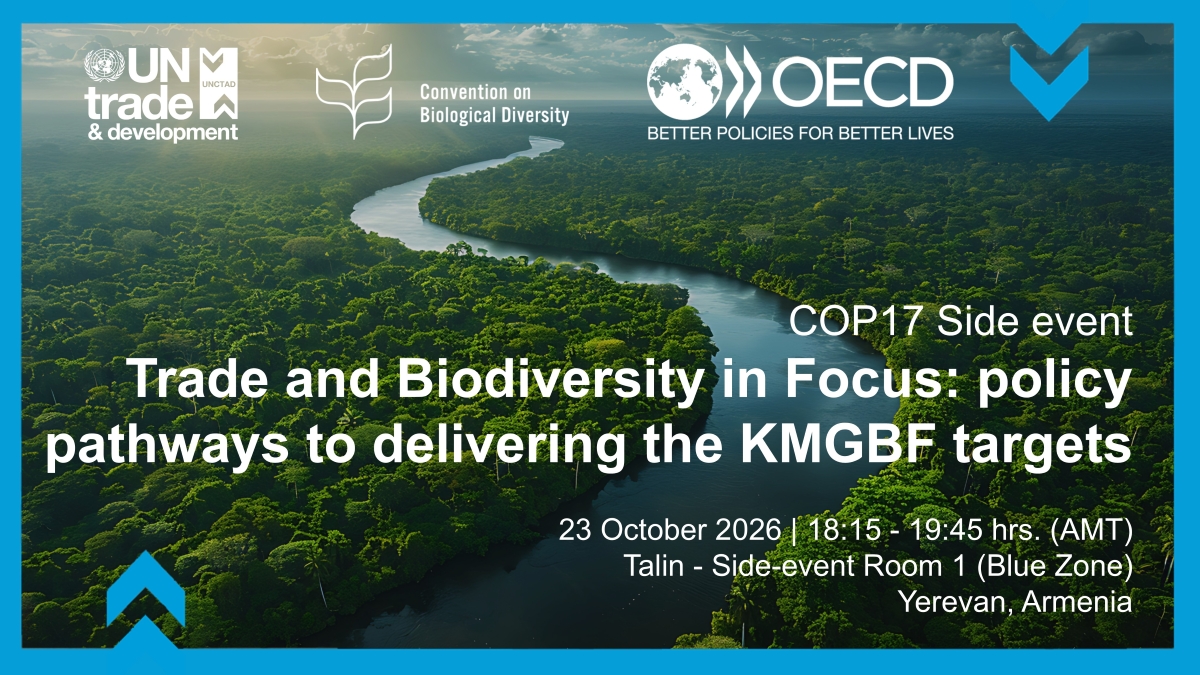
Building on the CBD COP16 Trade Day, the trade-biodiversity webinar under the CBD’s Communities of Practice Webinar series and ongoing work of the Bioeconomy Challenge’s Market Development Working Group, this side event will strengthen understanding of how trade policies can support KMGBF implementation and inform COP17 deliberations. It aims to move from evidence to action: identifying lessons learned, good practices, critical pathways to scale proven trade and biodiversity solutions.
This event is organized with the financial support of the SMEP Programme funded, by the United Kingdom and implemented in partnership with UNCTAD, and the OECD through financial assistance of the European Union.
Objectives
- Present key findings from UNCTAD trade and biodiversity work, including SMEP programme experiences on biodiversity gains from avoided pollution and the upcoming Global Trade Update on trade and biodiversity;
- Take stock of evidence, data, tools and approaches on the trade–biodiversity linkages, including insights from OECD work on trade and biodiversity, and the Environmental Outlook on the Triple Planetary Crisis;
- Identify key opportunities and risks at the trade-biodiversity nexus, including in the transition towards sustainable and inclusive bioeconomies and across biodiversity-climate linkages;
- Explore policy and trade pathways and international cooperation to better align trade and biodiversity with KMGBF implementation, while supporting sustainable development; and
- Foster dialogue among actors along the value chains, from governments, international organizations, private sector, academia, Indigenous Peoples and local communities, and civil society, on their role in harnessing trade in support of biodiversity conservation, sustainable use and equitable benefit-sharing.
Expected outcomes
Co-organized by UNCTAD, the CBD Secretariat and the OECD, this event will translate lessons learned into action by strengthening the evidence base on the trade-biodiversity linkages, facilitate exchange of good practices, and supporting coherent policy approaches linking trade, biodiversity and the bioeconomy in support of KMGBF implementation. Discussions are expected to inform CBD COP17 deliberations, including the global review of the KMGBF implementation progress, and identify areas for enhanced international and trade cooperation.
Provisional programme
- Welcome remarks, CBD Secretariat
- Aligning trade and biodiversity objectives: lessons from practice and opportunities for action, Lorena Jaramillo, UN Trade and Development
- Insights from OECD’s work on trade and biodiversity, and the Environmental Outlook on the Triple Planetary Crisis, Shunta Yamaguchi, OECD
- Roundtable discussions: Taking action for nature: scaling up trade's contribution to biodiversity
- Natalie Feltman, Director Bioprospecting and Biodiversity Economy, Biodiversity and Conservation Branch, Department of Forestry, Fisheries and the Environment, South Africa
- Alicia Barker-Åström, Trade Policy Adviser, Department for EU Trade Policy, National Board of Trade, Sweden
- Private sector representative
- Q&A
- Closing remarks: key takeaways and opportunities for future collaboration
Moderation: Marianne Kettunen, Independ expert.
Audience
Open to CBD COP17 participants with access to the Blue Zone of CBD COP17.
