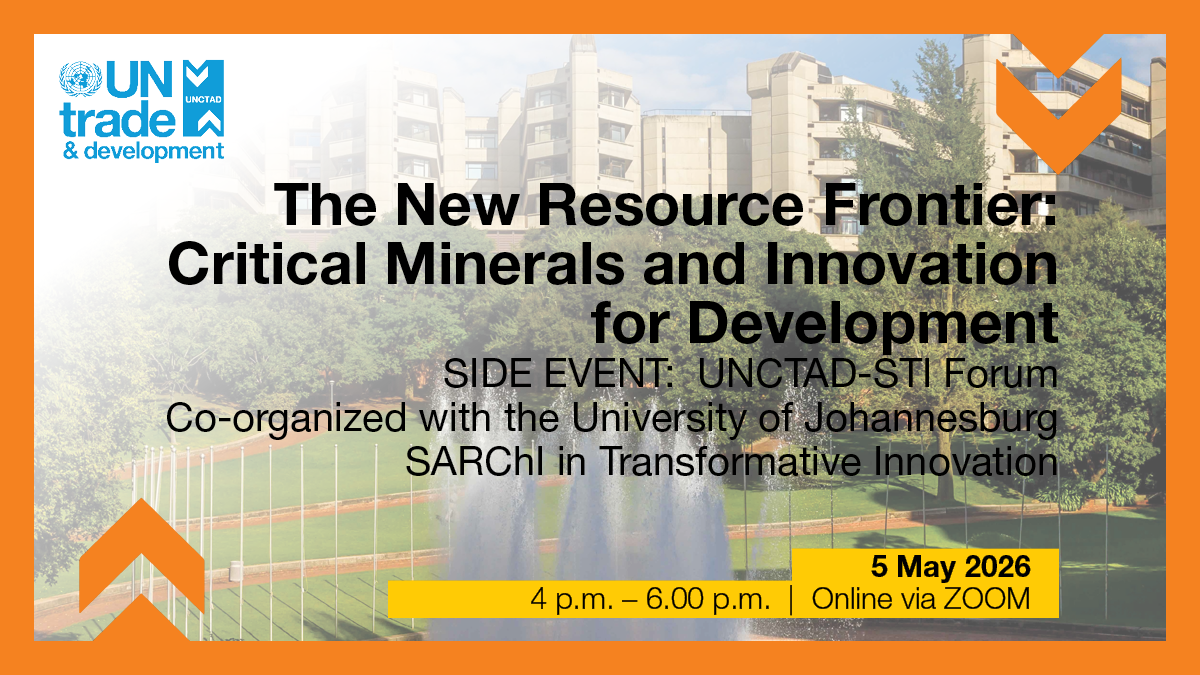
STI Forum 2026 - Side Event - The New Resource Frontier: Critical Minerals and Innovation for Development
co-organisers: University of Johannesburg; UNCTAD
5 May 2026, 10:00 AM EDT / 3:00 PM BST/ 4:00 PM CEST/ 5:00 PM EAT
The global transition toward low-carbon and digital technologies is generating an unprecedented surge in demand for critical minerals such as lithium, cobalt, nickel, copper, and platinum group metals. For many mineral-rich developing countries, particularly in Africa, this moment presents a strategic opportunity to leverage natural resource endowments for industrialisation, technological upgrading, and sustainable development.
This side event examines how Science, Technology and Innovation (STI) can play a transformative role in reshaping critical mineral value chains. It shifts the focus beyond extraction toward building integrated, sustainable, and inclusive value chains – including beneficiation, processing, manufacturing, skills development, and innovation ecosystems.
The discussion will engage with three interrelated questions:
- How can mineral-rich countries move beyond extraction toward value addition and capability building?
What forms of governance and policy coordination are required to ensure that critical minerals contribute to inclusive and sustainable development? - How can global governance frameworks better align resource use with development priorities, including through emerging debates on end-use, allocation, and technological directionality?
The session will draw on ongoing work by United Nations Conference on Trade and Development as secretariat to the UN Task Force on Critical Energy Transition Minerals, alongside perspectives from United Nations Technology Bank for the Least Developed Countries, academic experts, and policy practitioners. Particular attention will be given to the role of trade & industrial policy, and innovation systems in enabling structural transformation.
Panelists:
- Clovis Freire – Chief of Extractive Commodities Section, United Nations Conference on Trade and Development
- Anabel Marín – Research Fellow, Institute of Development Studies (IDS), UK
- Deodat Maharaj – Managing Director, United Nations Technology Bank for the Least Developed Countries
- Erika Kraemer-Mbula – Professor of Economics, University of Johannesburg, Chair in Transformative Innovation
- Policy representative (TBC)
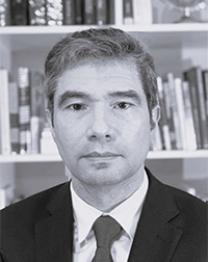
Clovis Freire Junior is Chief of Extractive Commodities Section, of the Division on International Trade and Commodities of UNCTAD in Geneva. He is an Economist specialized in economic diversification and strategies for building productive capacities in developing countries. His work supports the structural transformation and sustainable development of commodity-dependent developing countries.
He has over 20 years of work experience in the United Nations in programmes related to commodity dependence, least developed countries, technology and innovation for development, and disaster risk reduction. He holds a degree in Computer Engineering from the Technological Institute of Aeronautics (ITA), Brazil, a Master’s degree in Computer Sciences from the University de Brasília (UnB), an MBA in Strategic Management of Information Systems from the Fundação Getúlio Vargas (FGV), Brazil, and a PhD in Economics from the Maastricht University, in Maastricht, the Netherlands.

Dr. Anabel Marín is a Research Fellow and Leader of the Business, Markets & State Cluster at the Institute of Development Studies (IDS) and a researcher at CONICET in Argentina (currently on leave). She holds a PhD in Science and Technology Policy from the University of Sussex, a Master’s in Development from the University of General Sarmiento, and a degree in Economics from Córdoba University.
Her research focuses on the political economy of natural resources, sustainability transitions, and green industrial policy, combining academic leadership with high-level policy engagement in Latin America, Europe, and Africa. She has led multi-country research and impact projects funded by organisations such as ESRC, the Global Consortium for Sustainability Outcomes, and the Conservation Food and Health Foundation, and has advised institutions including the World Bank, ECLAC, IDB, UNCTAD, UNESCO, and UNIDO.
Her recent publications include a contribution to the Oxford Research Encyclopedia of Climate Science on sustainable development in Latin America (Marin, Möhle & Aneise, 2025), as well as articles on civic resistance, governance, and green industrial policy in the IDS Bulletin (2025), IDS Working Paper (2025), and Environmental Research Letters (2025). In 2025, she was awarded the Premio RAÍCES by the Argentine Ministry of Science, Technology and Innovation for her contributions to science and international cooperation.
