The global transition towards renewable energy, digitalization and low-carbon development is driving unprecedented demand for critical energy transition minerals (CETMs), including lithium, cobalt, copper, nickel and rare earth elements. As these minerals become increasingly strategic for international trade, industrial development and global value chains, governments are adopting trade and industrial policies aimed at capturing greater value from their mineral resources and advancing economic diversification.
At the same time, the benefits and costs associated with the expansion of mineral production and trade are not distributed equally between women and men. Women often remain underrepresented in formal employment, leadership positions and entrepreneurial opportunities in mineral value chains, while also experiencing distinct social, economic and environmental impacts.
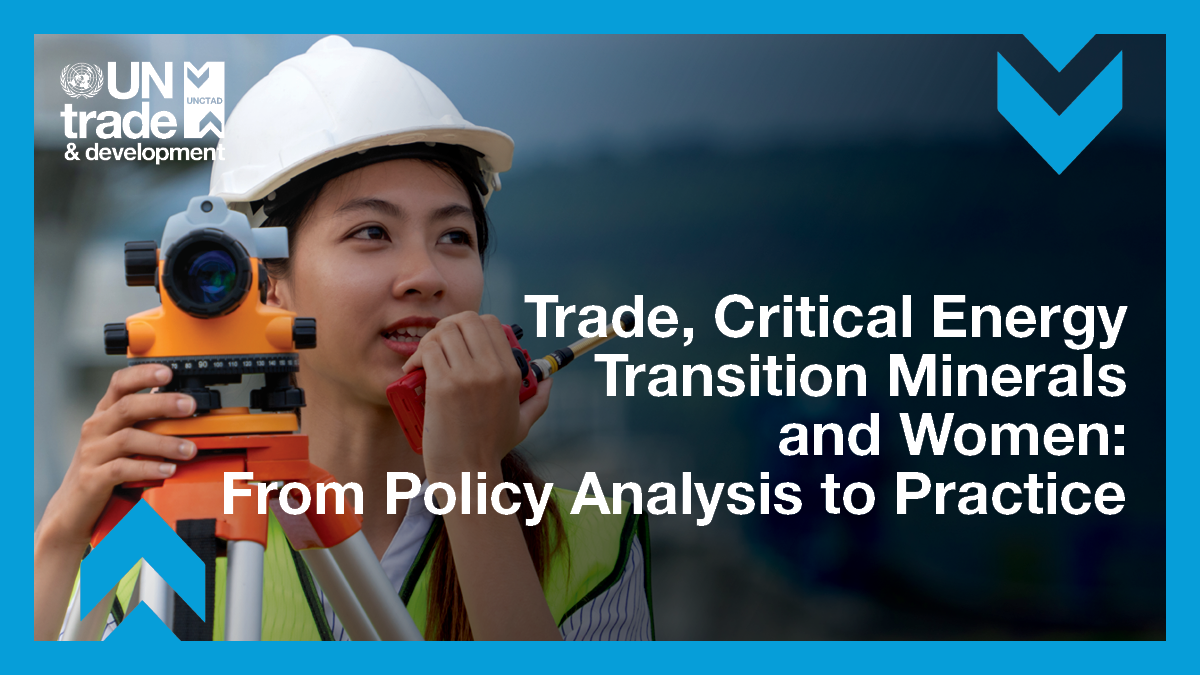
To strengthen understanding of these issues, the UNCTAD Trade, Gender and Development Programme has developed the online course Trade, Critical Energy Transition Minerals and Women. The course examines the intersections between trade, gender, critical minerals and development and equips participants with analytical and policy tools to support gender-responsive policymaking.
The proposed webinar will complement the online course by providing an interactive space for participants and invited experts to move from policy analysis to practice. Rather than revisiting the course content, the discussion will focus on experiences from different national and regional contexts, good practices for strengthening the participation and inclusion of women and girls in critical-mineral value chains, and priority actions needed to advance gender-responsive policies and practices.
The webinar will also contribute to UNCTAD's broader work on evidence-based research, multi-stakeholder dialogue and capacity-building on the gender dimensions of critical mineral value chains.
