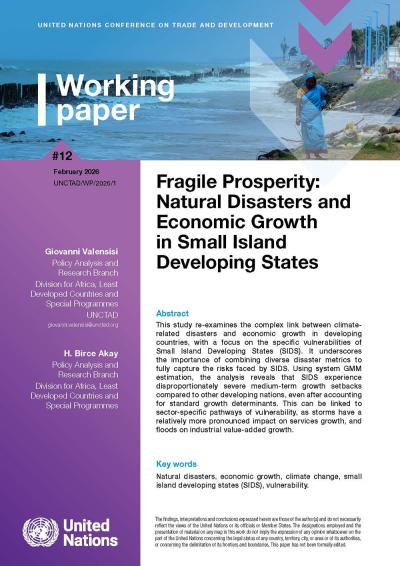
This study re-examines the complex link between climate related disasters and economic growth in developing countries, with a focus on the specific vulnerabilities of Small Island Developing States (SIDS). It underscores the importance of combining diverse disaster metrics to fully capture the risks faced by SIDS.
Using system GMM (Generalized Method of Moments) estimation, the analysis reveals that SIDS experience disproportionately severe medium-term growth setbacks compared to other developing nations, even after accounting for standard growth determinants.
This can be linked to sector-specific pathways of vulnerability, as storms have a relatively more pronounced impact on services growth, and floods on industrial value-added growth.
Key findings
Using system GMM estimation, our analysis reveals that, even after accounting for standard growth determinants, SIDS experience disproportionately severe medium-term growth setbacks compared to other developing nations.
Our study shows that the interplay between disaster patterns and sectoral dynamics plays a fundamental role in shaping related economic shocks on the country's medium-term growth trajectory.
In the case of SIDS, whose economies are poorly diversified and highly dependent on volatile services exports (notably through tourism), economic diversification emerges as a key avenue to mitigate the exposure to shocks and build endogenous resilience.
Organization of the Paper
- Sections 2 and 3 review the relevant literature and discuss methodological issues, particularly concerning the measurement of natural disasters and the specific vulnerabilities of SIDS.
- Section 4 presents the econometric specification, while Section 5 discusses the results.
- Finally, Sections 6 and 7 offer robustness checks and draw conclusions, respectively.
Disclaimer: The findings, interpretations and conclusions expressed herein are those of the author(s) and do not necessarily reflect the views of the United Nations or its officials or Member States. The designations employed and the presentation of material on any map in this work do not imply the expression of any opinion whatsoever on the part of the United Nations concerning the legal status of any country, territory, city, or area or of its authorities, or concerning the delimitation of its frontiers and boundaries. This paper has not been formally edited.