


Zambia is a major producer of copper – a critical input for renewable energy systems, electric vehicles and grid infrastructure. Yet dependence on primary commodities has delivered limited job creation, high exposure to price volatility and vulnerability to external shocks.
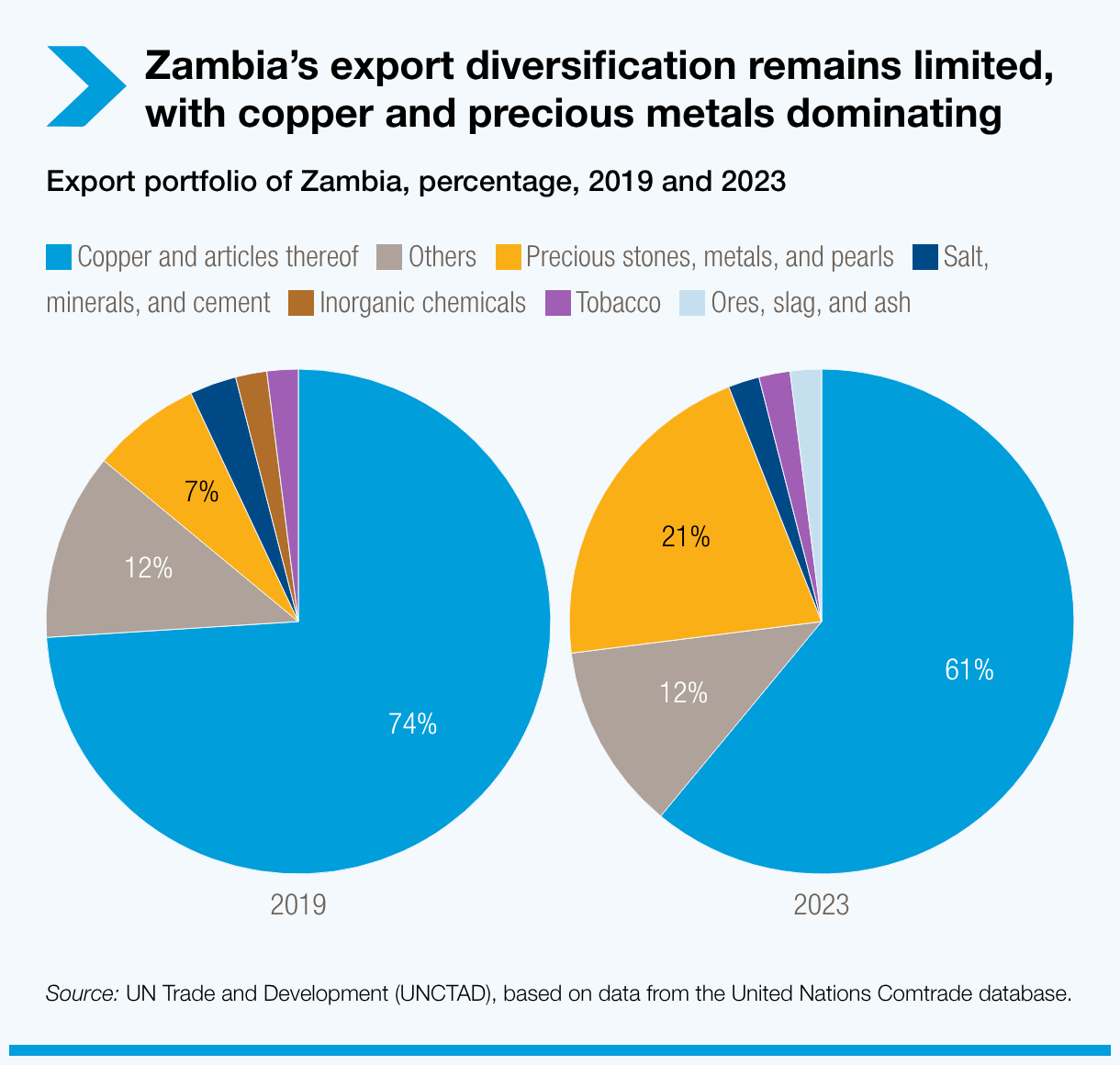
UN Trade and Development (UNCTAD) presents an evidence-based roadmap to help Zambia move beyond raw mineral exports by building value addition and diversification around critical energy transition minerals. The report identifies concrete product opportunities, estimates their investment and employment potential and proposes targeted policy instruments to turn potential into production.
From copper exports to industrial clusters
Zambia’s economic complexity has remained persistently low, at around -0.4 over the past decade, below the global average of 0. Although the country exports more products than before, this has not translated into more knowledge-intensive activities. Moving into more complex, related products is essential to build resilience and competitiveness.
The assessment identifies 412 potential products across chemicals, iron and steel, machinery, plastics, paper, electrical equipment, copper articles and food processing. These are products Zambia can realistically produce, based on economic complexity analysis, trade data and validation with industry experts.
The analysis highlights a dense cluster of opportunities in metals, engineering and industrial inputs. Copper articles, iron and steel products, machinery and industrial chemicals build directly on Zambia’s mining base. Critical minerals can serve as anchors for fabrication, component manufacturing and industrial services – not just export commodities.
$1.21 billion in investment – 115,000 potential jobs
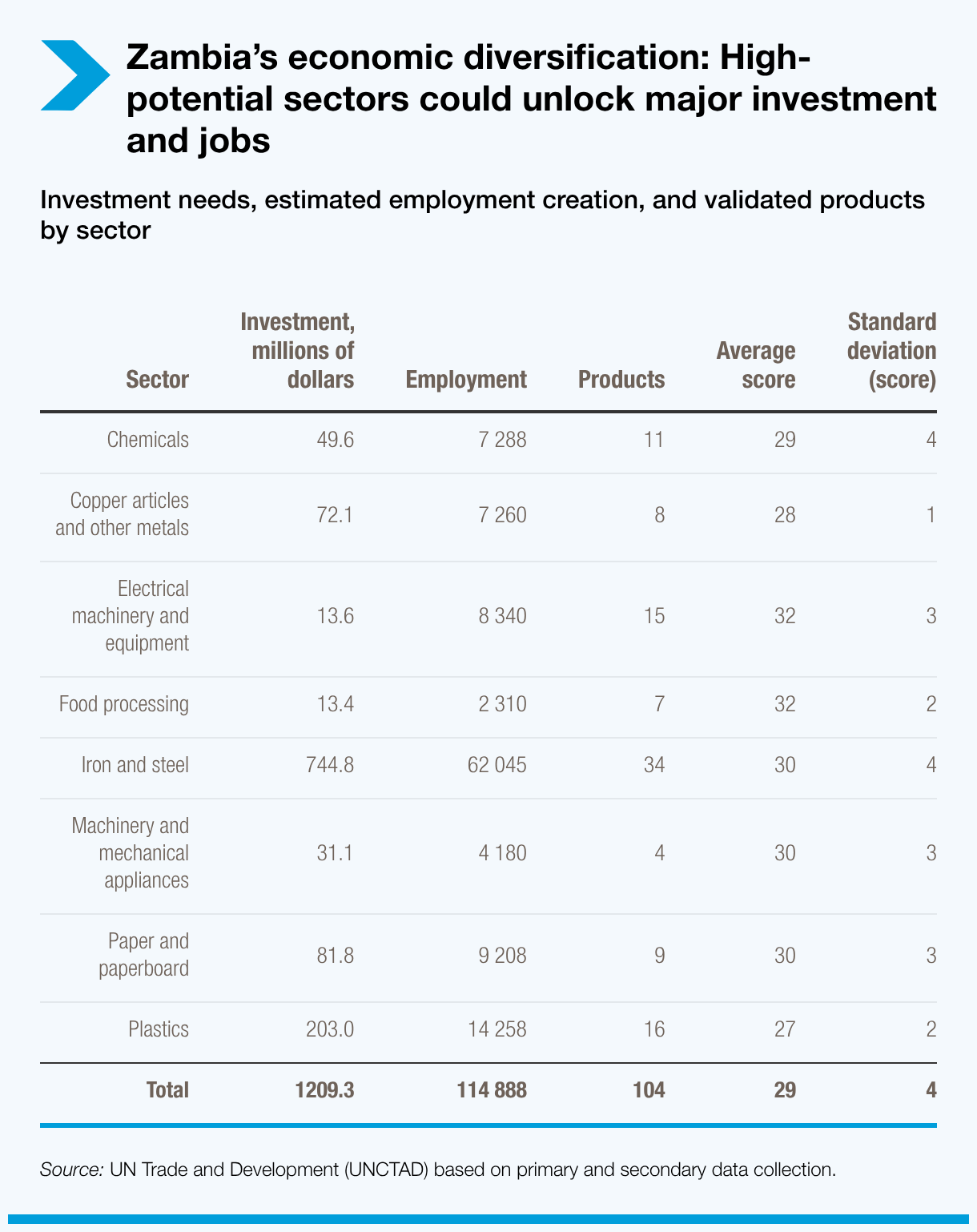
A subset of validated products would require an estimated $1.21 billion in capital investment and could generate around 115,000 jobs across the economy. Iron and steel account for roughly $745 million in investment and more than 62,000 jobs.
Other high-potential sectors include:
- Plastics, with $203 million in investment and over 14,000 jobs.
- Paper and paperboard could attract $82 million and create more than 9,000 jobs.
- Electrical machinery and equipment would require $14 million and generate over 8,000 jobs.
- Chemicals would need $50 million and create more than 7,000 jobs.
- Food processing stands out for its high labour absorption, generating more than 2,300 jobs with a relatively modest $13 million investment.
Regionally, export potential within the Southern African Development Community (SADC) totals $199.2 million, with key markets in South Africa, the United Republic of Tanzania and Angola. Additional continental opportunities are identified in Egypt, Ethiopia and Morocco. Diversification must therefore be trade-facing from the outset.
Binding constraints – and how to address them
Diversification is constrained by overlapping bottlenecks in finance, infrastructure and technology. Capital-intensive sectors such as chemicals, electrical equipment and iron and steel face acute financing challenges, including high collateral requirements and limited access to long-term investment finance. Small and medium-sized enterprises in food processing and machinery also report severe constraints.
Skills gaps are especially pronounced in plastics, where 93.8% of potential products cite skills as a constraint. In chemicals, 45.5% do so. Zambia has a solid institutional framework for vocational training. However, firm-level evidence shows a misalignment between training outcomes and modern production needs.
The report calls for a coherent policy framework built on three principles:
- Structural grounding: Focus on products that build on Zambia’s existing capabilities and strengths.
- Coherence: Align finance, skills, infrastructure and trade policies so they reinforce each other.
- Problem-driven design: Target real bottlenecks identified by firms, rather than applying generic solutions.
Policy instruments span seven domains, including skills development, R&D and technology transfer, investment and finance, enterprise support and trade, infrastructure, strategic procurement and green industrial policy.
Turning mining into a platform for industrial deepening
Zambia’s mining sector already generates demand for machinery, fabricated metals, chemicals and services, much of which is currently met through imports. By leveraging procurement frameworks and supplier development programmes, this demand can be channelled to domestic firms.
Mining can shift from an enclave activity to a platform for industrial deepening, transforming resource wealth into broader productive capacity.
The report concludes that Zambia already possesses many of the foundations required to move beyond primary commodity dependence. The central task is to activate and align these foundations around focused diversification pathways that build on critical minerals while extending beyond them. With coordinated action, diversification can move from aspiration to delivery.