

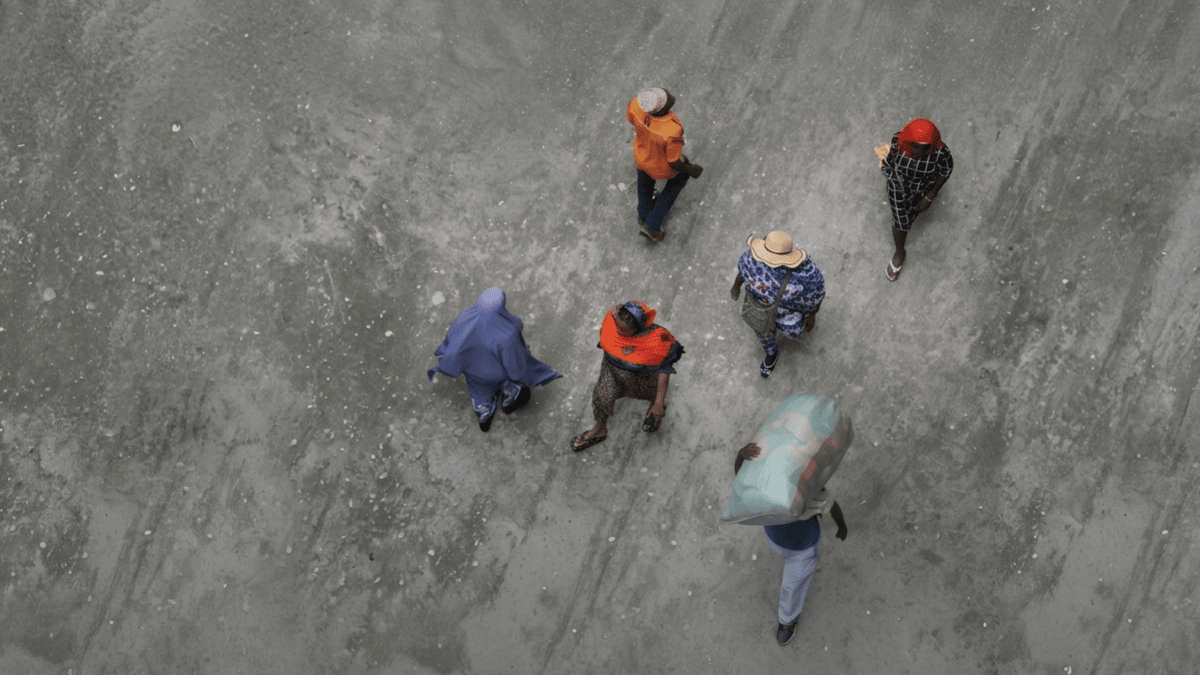
Second-hand clothes bale being carried in Kariakoo market, United Republic of Tanzania.
International trade in used textiles plays an important role in supporting textile circularity by extending the life of garments, reducing pressure on disposal systems, and supplying affordable clothing to consumers in many developing countries. At the same time, concerns about textile waste, pollution and limited waste-management capacity in some importing countries have brought renewed attention to how used textiles and textile waste should be addressed under the Basel Convention.
As Parties and observers consider the possible reframing of textile waste under the Convention, there is a need for evidence-based discussions that distinguish clearly between reusable textiles, recyclable materials and waste requiring environmentally sound management. This distinction is particularly important for developing countries, where second-hand clothing markets can support livelihoods, affordable consumption, repair and reuse systems, while also requiring stronger approaches to residual waste and recycling.
This side event, organized by the Bureau of International Recycling (BIR) in partnership with UN Trade and Development (UNCTAD), will bring together experts and practitioners to discuss the trade, environmental and development implications of potential regulatory changes affecting used textiles and textile waste. The session will explore how policy frameworks can support circularity and waste prevention while avoiding unintended impacts on functioning reuse and recycling systems.
The event will also mark the launch of a new technical report prepared under the Sustainable Manufacturing and Environmental Pollution (SMEP) Programme, funded by the United Kingdom’s Foreign, Commonwealth and Development Office and implemented in partnership with UNCTAD. The report, “Trade in secondhand clothing: Analysis of markets in Uganda, the United Republic of Tanzania and the United States of America”, provides new empirical evidence on upstream and downstream dynamics in the second-hand clothing value chain.
Based on field research in Uganda and the United Republic of Tanzania, and analysis of the United States as an important source market, the report finds that around 96% of analyzed imported second-hand clothing items were rewearable, while 2.9–3.2% were classified as rags and 1.1 - 1.3% as textile waste. These findings add evidence to ongoing discussions on how to regulate textile waste while preserving the environmental and socioeconomic benefits of reuse.
The discussion will consider:
- the role of international trade in used textiles in advancing circular economy objectives;
- the socioeconomic and environmental implications of potential changes to the control status of textile waste;
- the importance of clear definitions, traceability and quality standards;
- the need for policy solutions that are co-designed with developing countries and grounded in market realities;
- and opportunities to strengthen reuse, repair, recycling and environmentally sound management of residual textile waste.
By bringing practical experience and new evidence to the Basel Convention context, the side event aims to support constructive discussions on waste minimization, environmentally sound management and the prevention of harmful transboundary movements, while recognizing the development role of well-managed second-hand clothing markets.
Programme Timetable
| Time | Programme |
|---|---|
| 18:30 | Welcome Bianca Mannini, Senior Policy Officer, BIR |
| 18:35 | Keynote Dr. Chantal Line Carpentier, Head of Trade, Environment, Climate and Sustainable Development, UNCTAD |
| 18:50 | Presentation Mathias Gustavsson, Senior Researcher, IVL Swedish Environmental Research Institute Used textiles under the Basel Convention: implications for the Kenyan mitumba market |
| 19:00 | Panel discussion Jessica Franken, Vice President, Government & External Affairs at the Secondary Materials and Recycled Textiles Association (SMART) Marlvin Owusu, Executive Officer, Ghana Used Clothing Dealers' Association (GUCDA) Sheikh Muhammad Iqbal, Ex-CEO, Pakistan Textile Council Teresiah Wairimu Njenga, Chairperson, Mitumba Consortium Association of Kenya (MCAK) |
| 19:30 | Close |
