Agri-food systems in the Latin America Region are pillars of food security, employment and export growth, and their scope encompasses sectors such as packaging, distribution and waste management, which are highly exposed to environmental pressures and changing regulations. The transition from a linear model of extracting, producing, consuming and discarding towards circular models is therefore a technical and institutional imperative, aimed at eliminating waste at the design stage, keeping products and materials in use, and regenerating natural systems. In this regard, the bioeconomy offers a way to diversify production, add value to agricultural, agro-industrial, fisheries and aquaculture discarded materials and waste, and reduce dependence on fossil-based inputs.
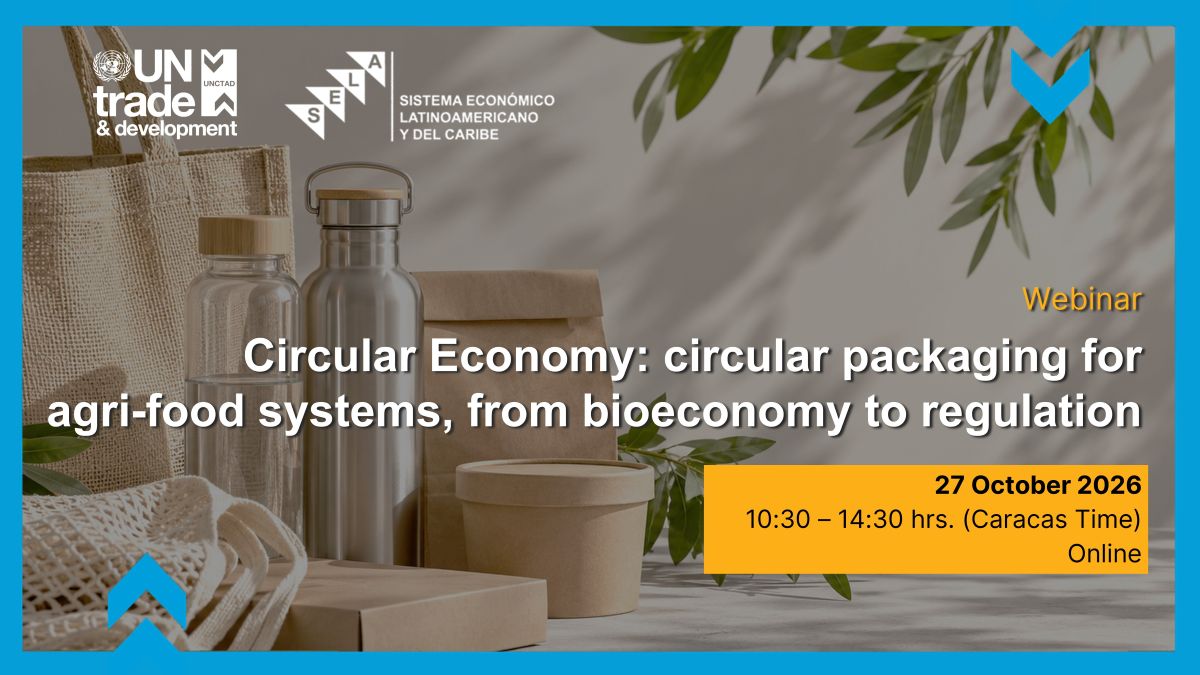
Circular packaging represents a strategic entry point for linking bioeconomy, sustainable production and regulation, as it prioritises the reduction of unnecessary materials, eco-design, compostability where appropriate, and waste recovery, without compromising its logistical and health-related functionality. Several Un Agencies have highlighted the need to accelerate the transition towards management models based on prevention, recovery, and recycling. Almost a decade later, this acceleration has yet to be materialized.
The commercial dimension lends a sense of urgency to this agenda. In 2023, global exports of plastic goods reached approximately US$1.13 trillion, accounting for around 5% of world trade in goods (UNCTAD, 2025), against a backdrop of regulatory changes in the main destination markets.
The Matrix on government action to promote a circular economy, developed by UNCTAD as part of the Sustainable Manufacturing and Environmental Pollution (SMEP) programme, in collaboration with SELA, constitutes a key technical tool for monitoring and evaluating the actions taken by governments in the region with regard to their roles in relation to production, products and processes. (UNCTAD, 2025). UNCTAD has also under its Ocean and Blue Economy programme identified the potential for marine-based biomaterials to promote plastic substitution.
Regulatory compliance alone does not guarantee productive transformation; bridging this gap requires coordinated decisions between governments, the private sector and cooperation agencies, so that early alignment with international requirements translates into the differentiation of exportable goods and the development of emerging value chains in packaging design, recycling and biomaterials. In short, the challenge lies in moving from a fragmented response to external regulatory pressure towards a regional agenda of its own for innovation in circular packaging.
