



Over one in eight dollars earned from trade in goods comes from information communications technologies, with 80% produced in Asia. Growth is driven by surging trade in electronic components.
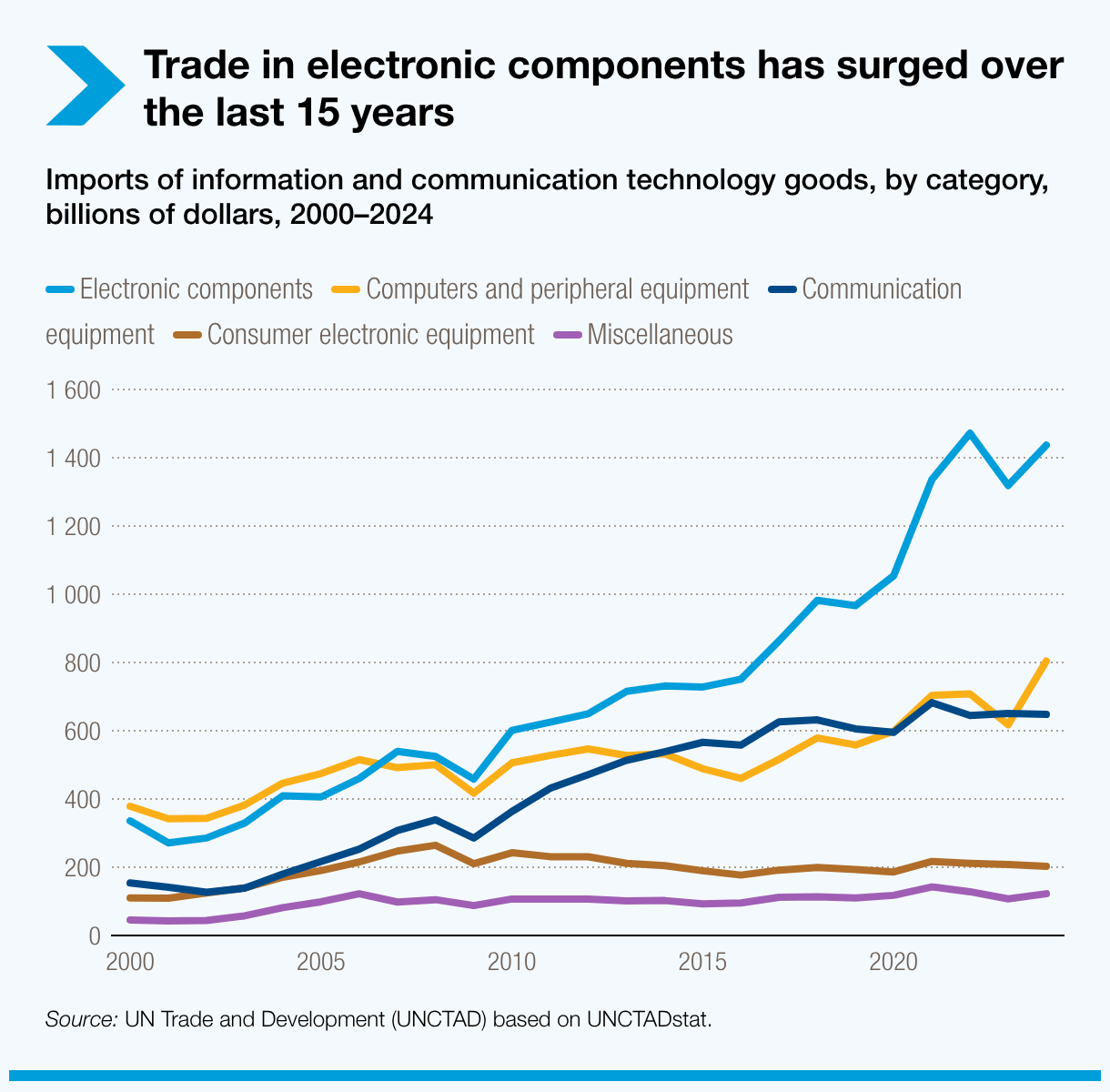
Information and communications technology (ICT) products accounted for more than12% of total global merchandise exports in 2024. This means more than one in every eight dollars earned from trade in goods came from computers, telecommunications equipment, electronic components and other digital-enabling hardware.
Growth has been driven by electronic components – including chips, circuit boards and sensors. Trade in these components has surged over the last 15 years, despite a brief dip in 2023. By contrast, trade in consumer electronic equipment and other ICT products has stagnated.
Electronic components are the invisible backbone of the digital economy. They make smartphones, cloud computing, electric cars and renewable energy systems possible, and their production is a source of added value during the manufacturing process.
ICT goods production remains highly concentrated
Countries that can produce electronic components are better positioned to secure skilled jobs, technology spillovers and more resilient export revenues. Asia is the global hub for ICT goods, accounting for nearly 80% of global exports in 2024.
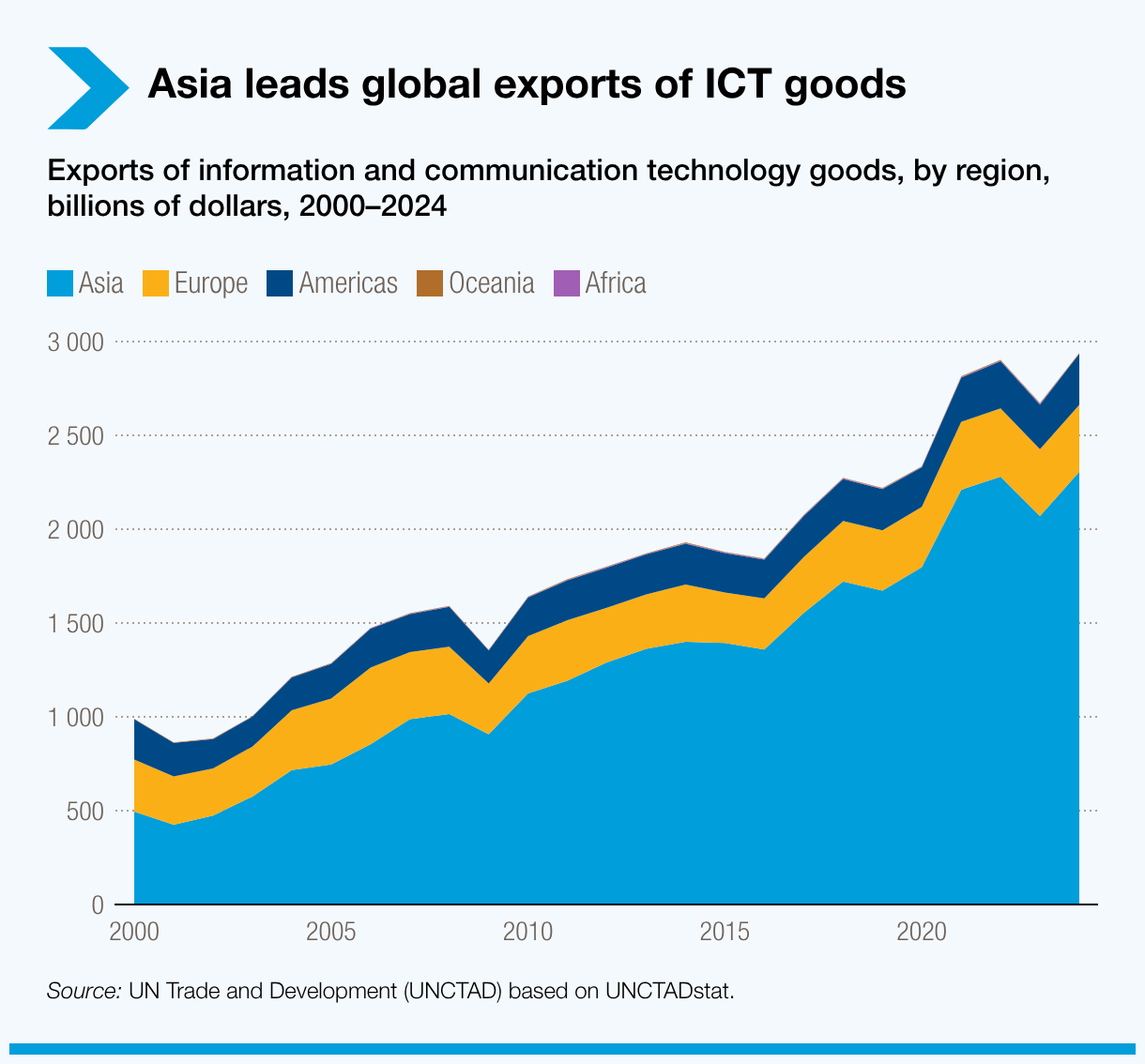
For many developing economies, participation remains limited to lower-value components or assembly. This constrains their ability to benefit fully from digital and energy transitions.
Without targeted investment and skills development, many developing economies risk being sidelined as digital trade deepens.
Europe leads ICT services exports
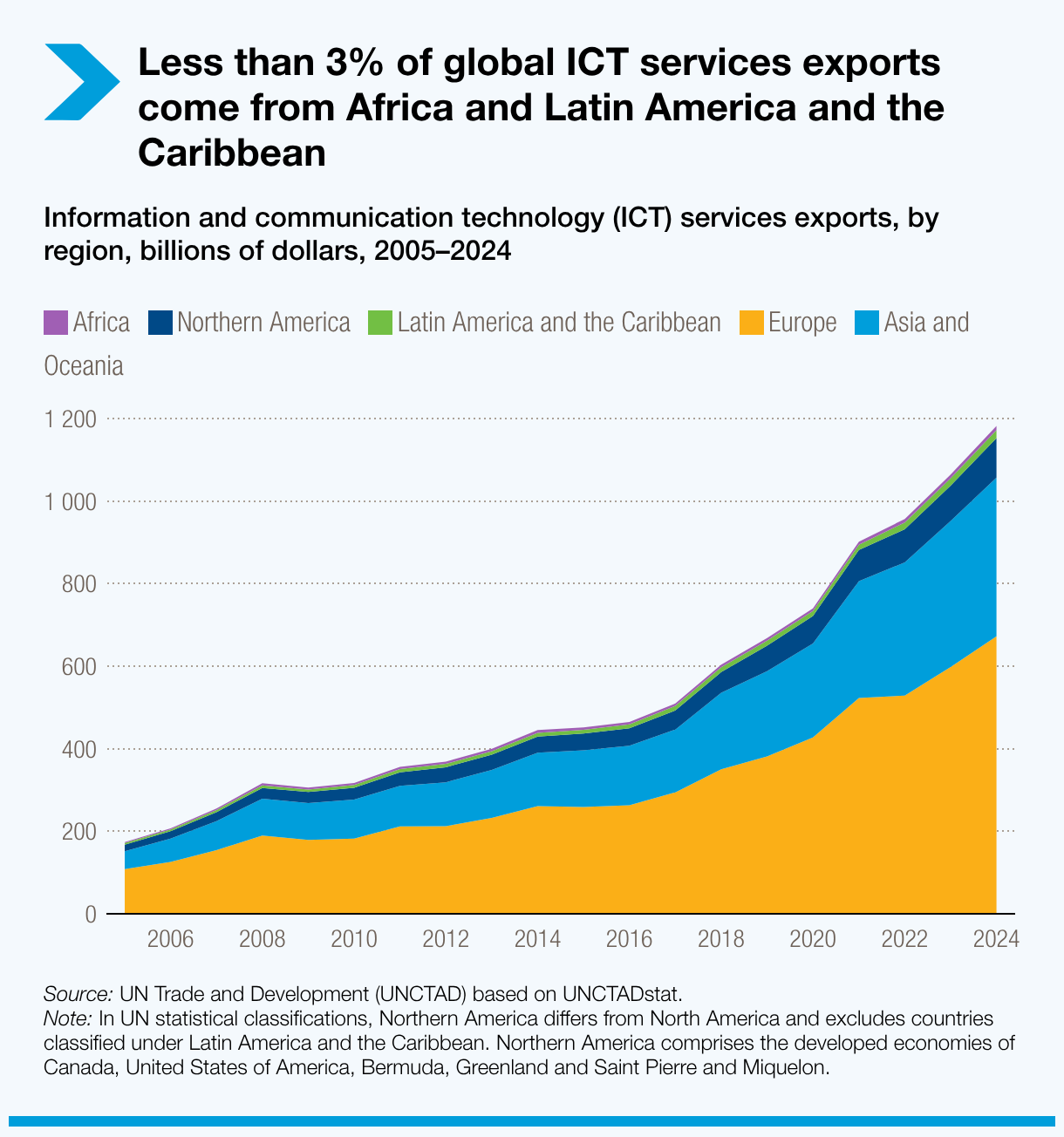
Global trade in ICT services – including telecommunication and computer services – reached $1.2 trillion in 2024. The sector has seen steady growth since 2017, with demand boosted during COVID-19 disruption.
The gains, however, remain very uneven. European economies accounted for 57% of ICT services exports in 2024, followed by Asia and Oceania with 33%. Northern America held an 8% share. Meanwhile, Africa and Latin America and the Caribbean together accounted for just 2.5%, or under $30 billion.
Digitally deliverable products keep growing
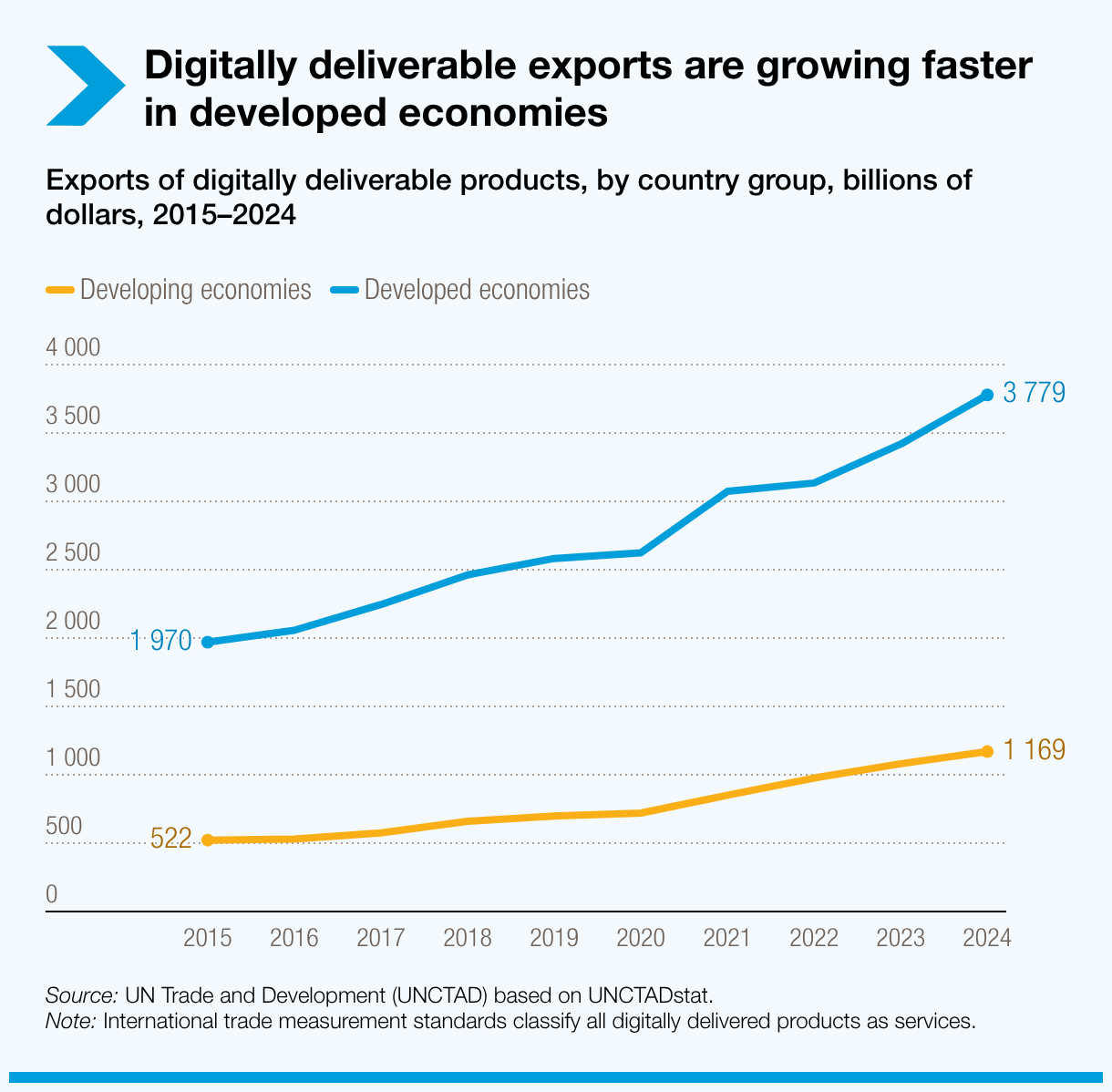
Trade in products that can be delivered remotely over computer networks – including telecommunications and computer services, consulting, health and education, and digital movies, music and books – rose 10% in 2024.
International trade measurement standards classify all digitally delivered products as services.
Their share of global services exports has climbed over the past decade, reaching 56% in 2024. The COVID-19 pandemic gave an additional boost to digitally deliverable trade, which had already been on a sustained rise since 2010.
Developed economies accounted for about three quarters of these exports, worth roughly $3.8 trillion, while developing economies exported an estimated $1.2 trillion.
Digitally deliverable products are opening access to new markets and reshaping global trade. By eliminating the need for physical proximity between service suppliers and consumers, digital delivery lowers traditional barriers to services trade. But their dependence on digital connectivity and skills raises new ones for countries with weaker digital ecosystems.
The imbalances between developed and developing countries in exports of ICT services and digitally deliverable products highlight persistent gaps in digital capacity. Without investment in broadband, digital skills, data governance and supportive trade policies, many developing countries risk remaining marginal players in one of the fastest-growing segments of global trade.
Turning data into insight for policymakers
In an era marked by rapid technological change, global trade and economic development are undergoing structural shifts. Behind the numbers are changing patterns that reveal deeper stories about opportunity, inequality and transformation.
UNCTAD’s Data Insights make this visible by turning raw statistics into context-rich narratives that help policymakers, researchers and the public grasp the forces shaping today’s world.
Related data