

Key points
- The 3rd generation Productive Capacities Index (PCI) measures 195 economies from 2000 to 2024 using 43 indicators across eight dimensions.
- Data coverage improved for 34 of the 42 indicators comparable with the previous edition, but significant gaps remain, particularly in least developed countries.
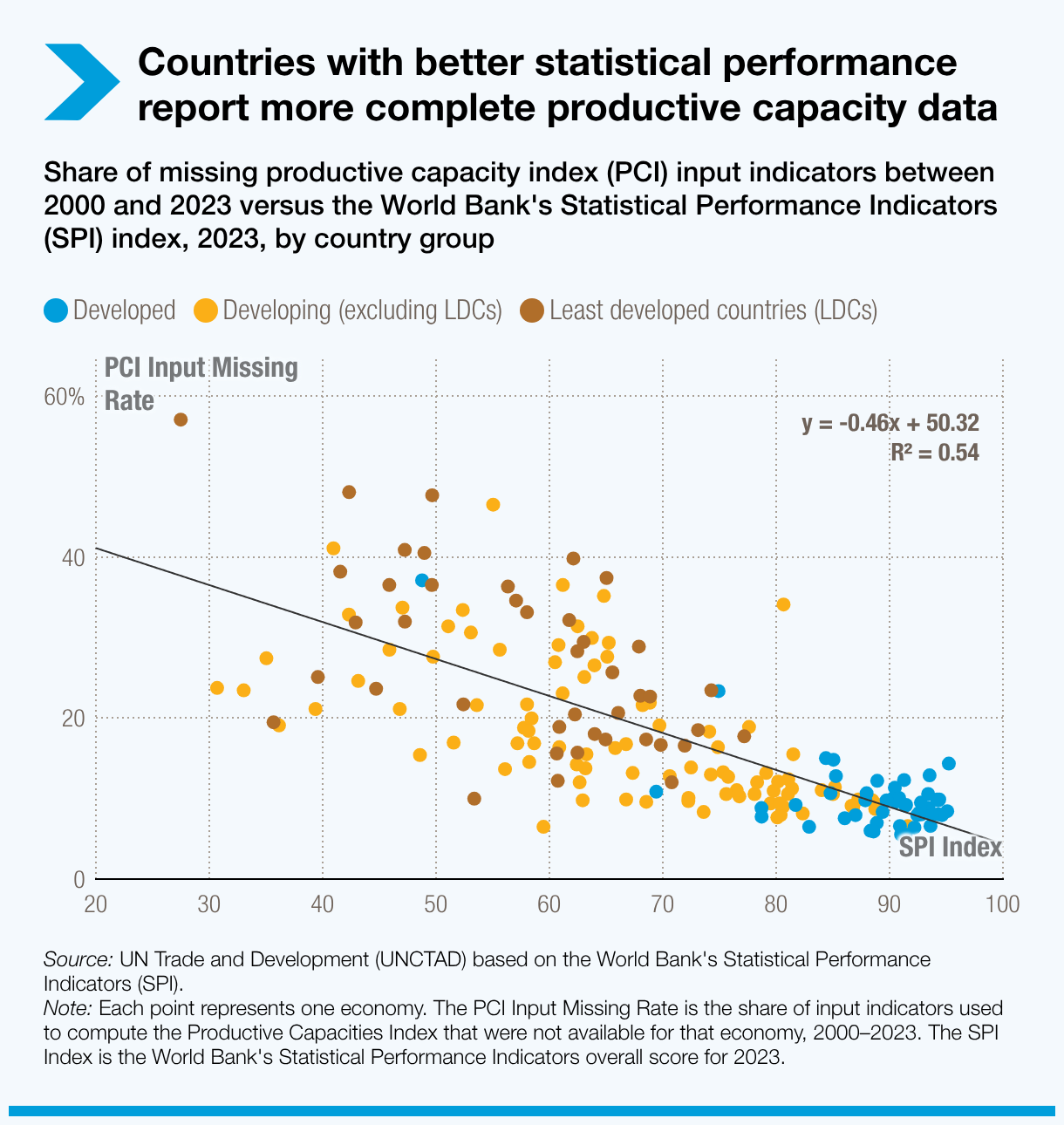
- A new maritime transport indicator, based on newly available country-level UNCTADstat data, strengthens the transport capacity measurement.
- The redesigned data pipeline handles missing data more effectively and produces more robust, stable results that remain highly comparable with those from the previous edition.
The report presents the 3rd generation of the Productive Capacities Index (PCI), covering 195 economies from 2000 to 2024. Productive capacities are the resources, capabilities and connections that enable an economy to produce goods and services.
The PCI's 43 indicators assess eight dimensions of productive capacity: human capital, natural capital, energy, transport, information and communications technology (ICT), institutions, private sector development and structural change.
The update adds a maritime transport indicator based on newly available country-level UNCTADstat data. It also redesigns the statistical pipeline and improves the treatment of missing data. Repeating the calculations with different random starting points reduces the influence of chance and makes the results more robust and stable.
Data coverage has improved: missing values declined in 34 of the 42 indicators comparable with the previous edition. Yet significant gaps remain, especially in least developed countries. The report calls for stronger national statistical systems, better international coordination and more standardized reporting.
A stronger and more comprehensive measurement tool
Previous editions lacked a direct measure of maritime transport because suitable country-level data were unavailable. The new indicator on seaborne goods discharged helps address this gap and complements existing measures of road, rail and air transport.
Together, the index's eight dimensions provide a multidimensional picture of productive capacity for country benchmarking, policy analysis and assessment of development gaps.
The methodological update also makes the process more transparent and easier to reproduce.
Data gaps remain largest in least developed countries
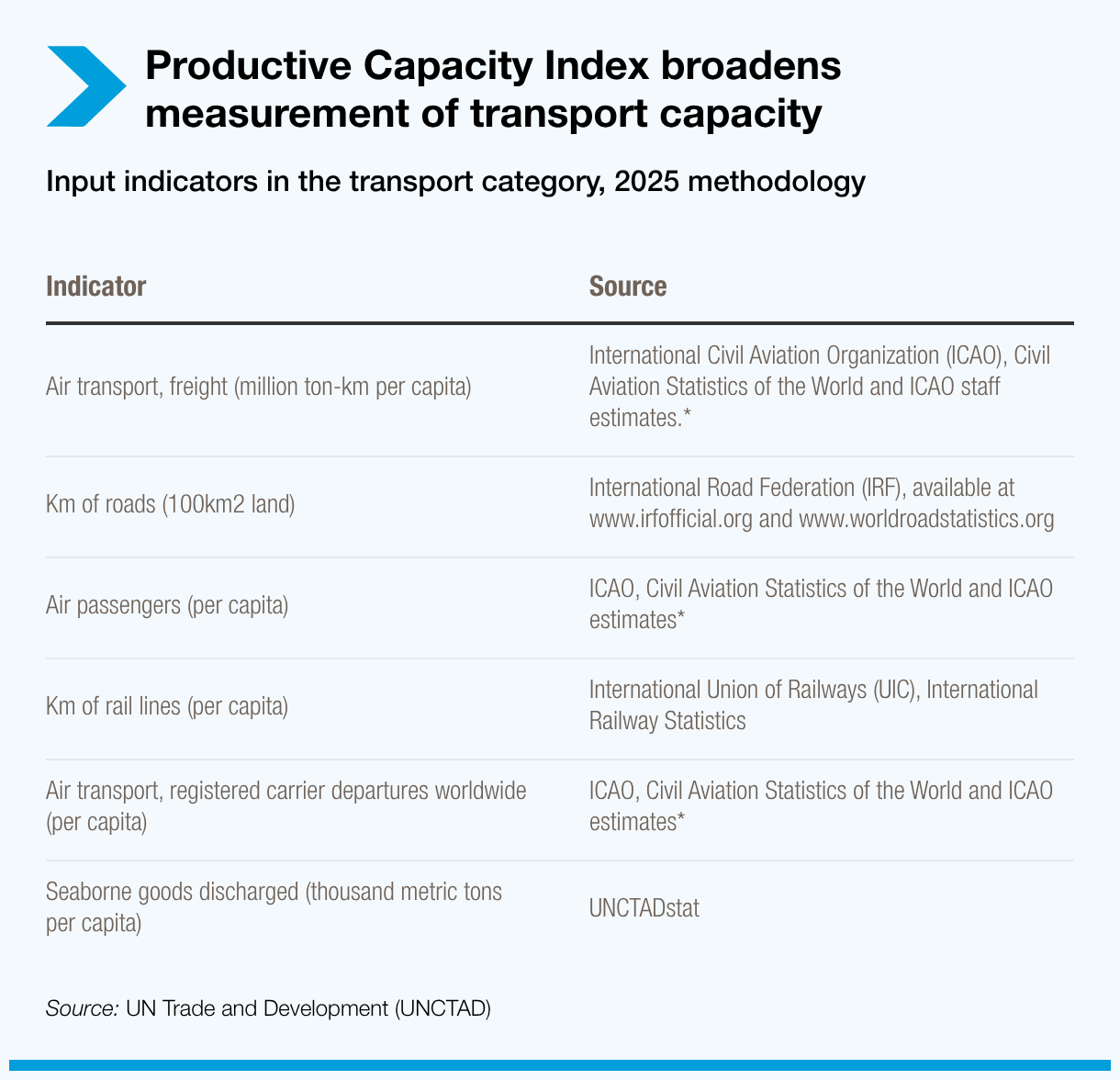
Missing data continue to constrain the measurement of productive capacities: 22.9% of observations in the PCI input data set are missing. The gaps are largest in least developed countries, where missing observations reach 61.4% for transport, 55.7% for the private sector and 37.5% for energy.
Data availability is closely linked to statistical capacity. On average, a one-point increase in the World Bank's overall Statistical Performance Indicators score is associated with a 0.46 percentage-point decrease in the missing rate.
The report calls for stronger national statistical systems, improved international coordination and standardized reporting, particularly where data collection remains difficult.
New methods improve reliability while preserving comparability
The update moves most data transformations earlier in the process and improves how missing values are estimated. The analysis is run 200 times, each with a different random starting point. The published category scores are the mean of these runs, limiting the influence of chance and making the estimates more robust and reproducible.
Despite these changes, results remain highly consistent with the previous edition. For the overall PCI, the Spearman rank correlation – which measures the similarity of country rankings – is 0.9862, while the Pearson correlation – which measures how closely the scores align – is 0.9911. Both values are close to 1, indicating very strong consistency between the two editions.
This continuity supports long-term analysis while allowing the methodology to evolve.
Better data will support further development
The third-generation PCI provides a more robust basis for policy analysis while preserving continuity with the previous edition. Further progress will depend on stronger statistical systems, better access to data and continued methodological development. UNCTAD will also develop specialized versions of the index tailored to specific policy priorities and country groups.