

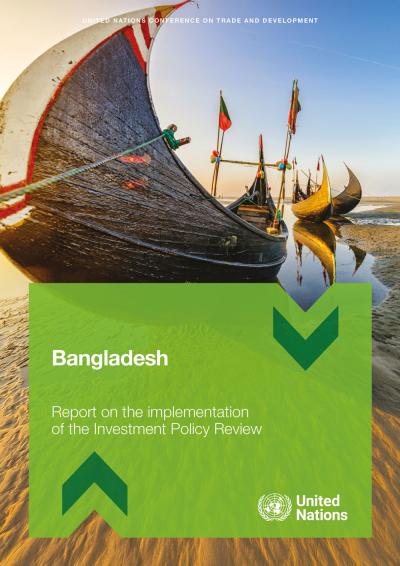
The Investment Policy Review (IPR) of Bangladesh, published in 2013, provided a comprehensive assessment of the country’s strategic, legal and institutional framework for investment, along with tailored recommendations to improve the investment climate and attract foreign direct investment (FDI). It also outlined measures to strengthen public–private partnerships (PPPs) as a vehicle for mobilizing FDI in infrastructure development, with a focus on policy, regulatory, financial and institutional constraints.
In 2025, the Bangladesh Investment Development Authority (BIDA) requested UNCTAD to assess the implementation of the IPR recommendations, including in the context of the country’s forthcoming graduation from least developed country (LDC) status.
The resulting report highlights the notable progress made since 2013, despite various crises, through institutional, regulatory and sectoral reforms. In this regard, the establishment of BIDA, the expansion of digital platforms and enhanced investment promotion efforts have eased investor entry and engagement. Reforms in labour, taxation and intellectual property reflect closer alignment with international standards, while targeted initiatives in pharmaceuticals, energy, higher education and emerging industries support economic diversification.
Despite these advances, important constraints persist and, looking ahead, priorities include adopting a national investment policy and a consolidated investment law, strengthening BIDA’s capacity as a unified investment authority and completing the full digitalization of investment procedures. Targeted support for priority sectors, skills development and stronger linkages between foreign and domestic firms will be essential to diversification. In parallel, proactive engagement with trade and investment partners, stronger competition policy and decisive action to improve land access, infrastructure planning and PPP execution will be essential to mitigate LDC graduation impacts and sustain long-term, inclusive growth.
This analysis and its recommendations are based on UNCTAD’s Investment Policy Framework for Sustainable Development. Through its IPR programme, UNCTAD has supported more than 60 economies, including 26 LDCs, in strengthening their investment frameworks in line with national development objectives and the Sustainable Development Goals.
Follow-up implementation reports, prepared at the request of beneficiary countries, assess progress and help guide further reforms.