

Key points
- Gaza’s recovery and reconstruction needs are estimated at $71.5 billion, while 92% of its economic establishments have been damaged or destroyed.
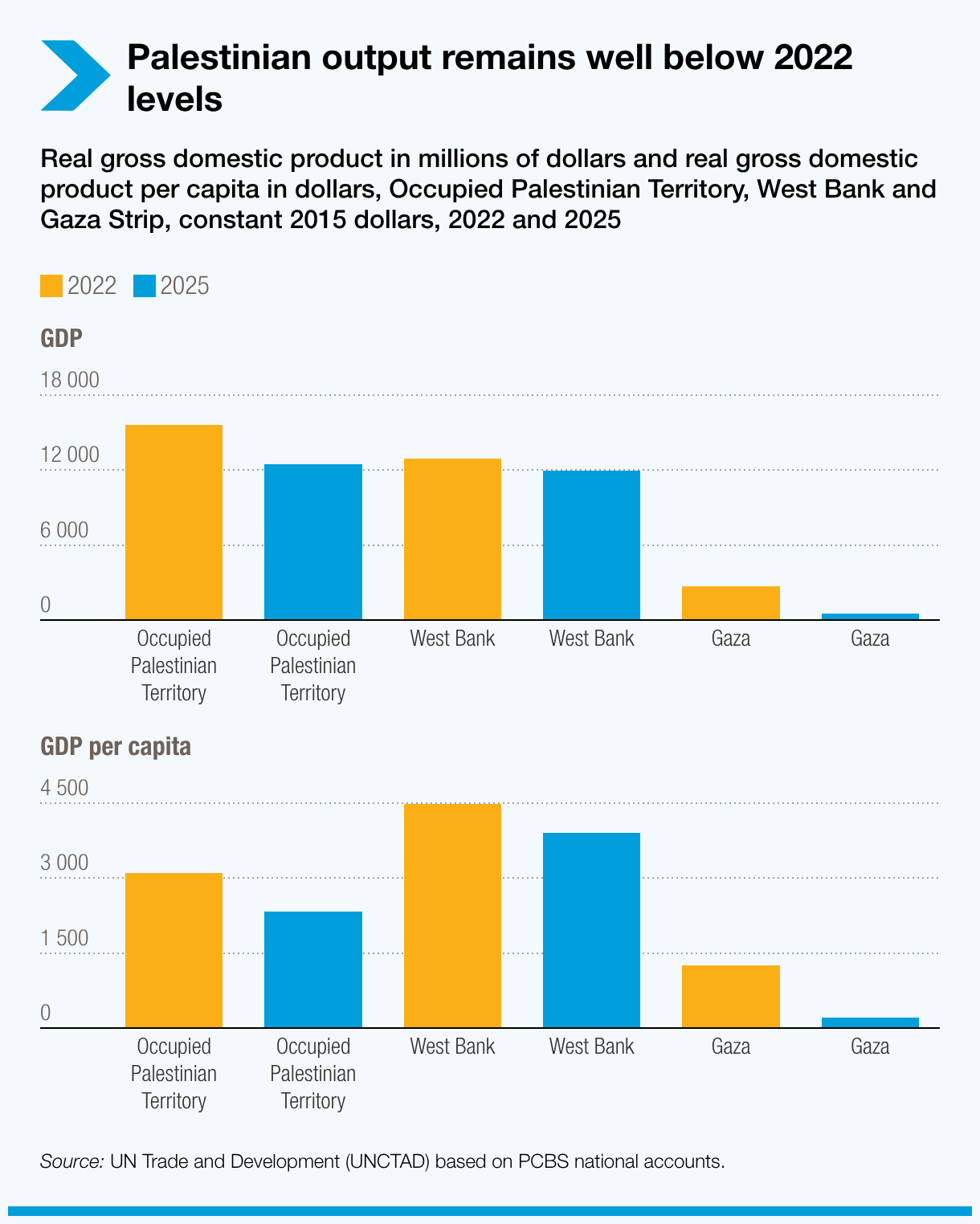
- Palestinian GDP grew 4.3% in 2025 but remained 20% below its 2022 level. In Gaza, GDP per capita stood at just $212.
- Fiscal pressures are constraining essential services and increasing risks to financial stability. Deductions and withheld revenues between January 2019 and March 2026 exceeded an estimated $3.67 billion.
- Economic constraints have intensified in the West Bank, where the report records reduced access to land and natural resources and rising displacement.
The report highlights a severe deterioration across the Occupied Palestinian Territory. Economic activity, public finances and the banking sector are all under growing strain.
Palestinian GDP grew by 4.3% in 2025 but remained 20% below its 2022 level. Following the sharp contraction in 2024, hundreds of thousands of jobs have been lost since October 2023, erasing an estimated $2.8 billion in cumulative labour income.
Thirty-eight communities have been emptied of Palestinian residents since 2023. In the West Bank, the report records reduced access to land and natural resources associated with Israeli settlement expansion. Displacement in the first quarter of 2026 exceeded the total recorded in 2025.
Gaza’s economy remains a fraction of its 2022 size
The report documents widespread economic destruction in Gaza. An estimated 92% of economic establishments have been damaged or destroyed since October 2023.
Gaza’s real GDP grew 34.2% in 2025 after contracting 83% in 2024. This was a statistical rebound from a sharply reduced base. GDP per capita stood at $212 – equivalent to about $0.58 per person per day in GDP terms and just 17% of its 2022 level. Unemployment reached 78%.
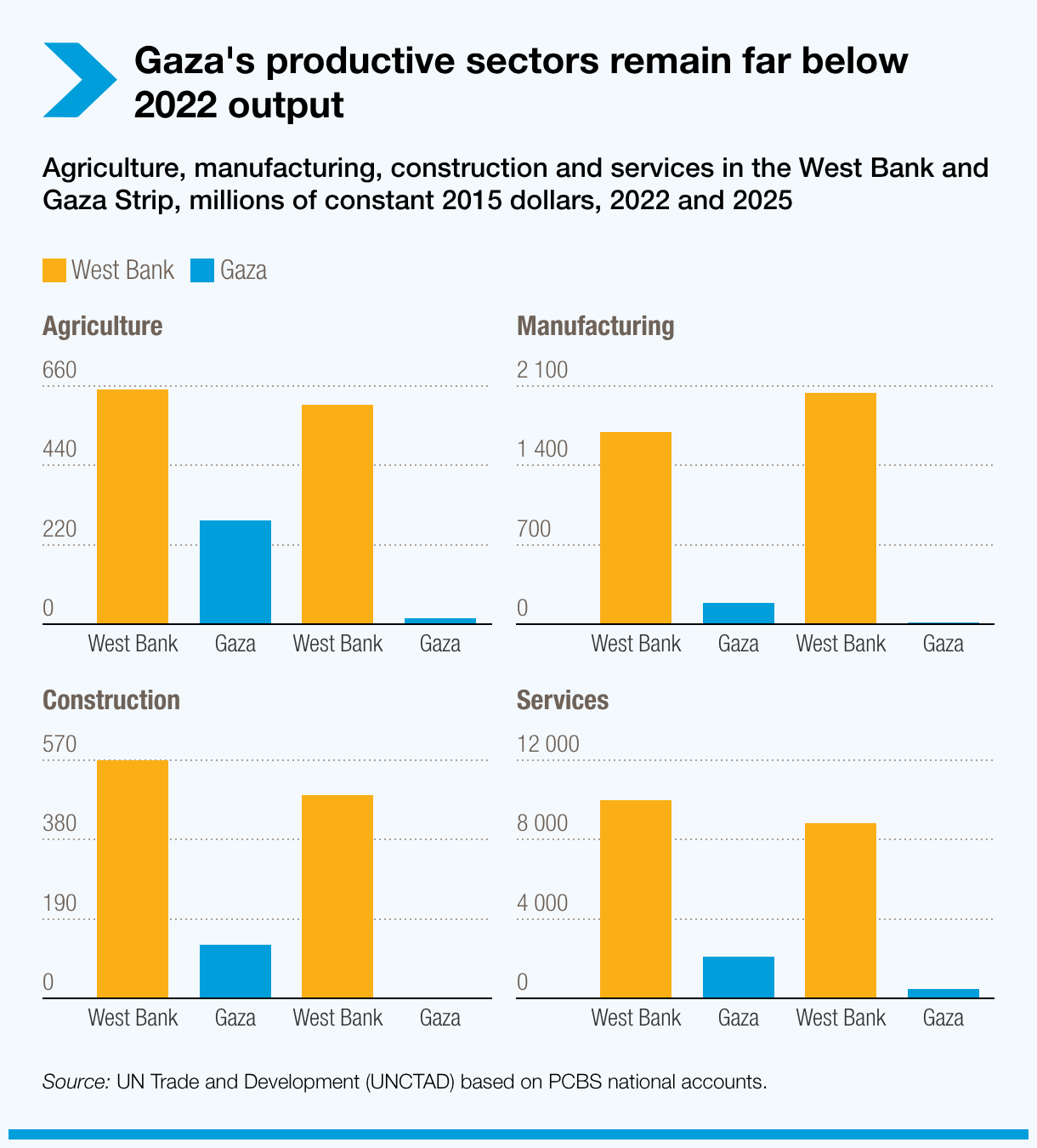
Gaza’s share of Palestinian GDP fell from 17.4% before October 2023 to less than 4% in 2025. Productive sectors remained far below their 2022 output levels. Agriculture and industry were each down 94%, while construction was down 99%.
Fiscal pressures are putting services and banks at risk
The Palestinian Government’s fiscal position has deteriorated sharply. Cumulative deductions and withheld revenues between January 2019 and March 2026 exceeded an estimated $3.67 billion at the exchange rates prevailing when the payments were due, equivalent to 83% of total Palestinian net revenue in 2025.
These pressures are affecting essential services. Health-related arrears reached $1.1 billion by late 2025. In the West Bank, resource shortages led schools to limit in-person instruction to three days a week in 2025.
Combined with lending secured against government salaries, the banking system’s exposure to the public sector has reached $5.3 billion, or 42% of all bank lending. Government borrowing and arrears have increased. The report warns that constraints affecting Palestinian banks could disrupt financing for imports of fuel, medicines and food.
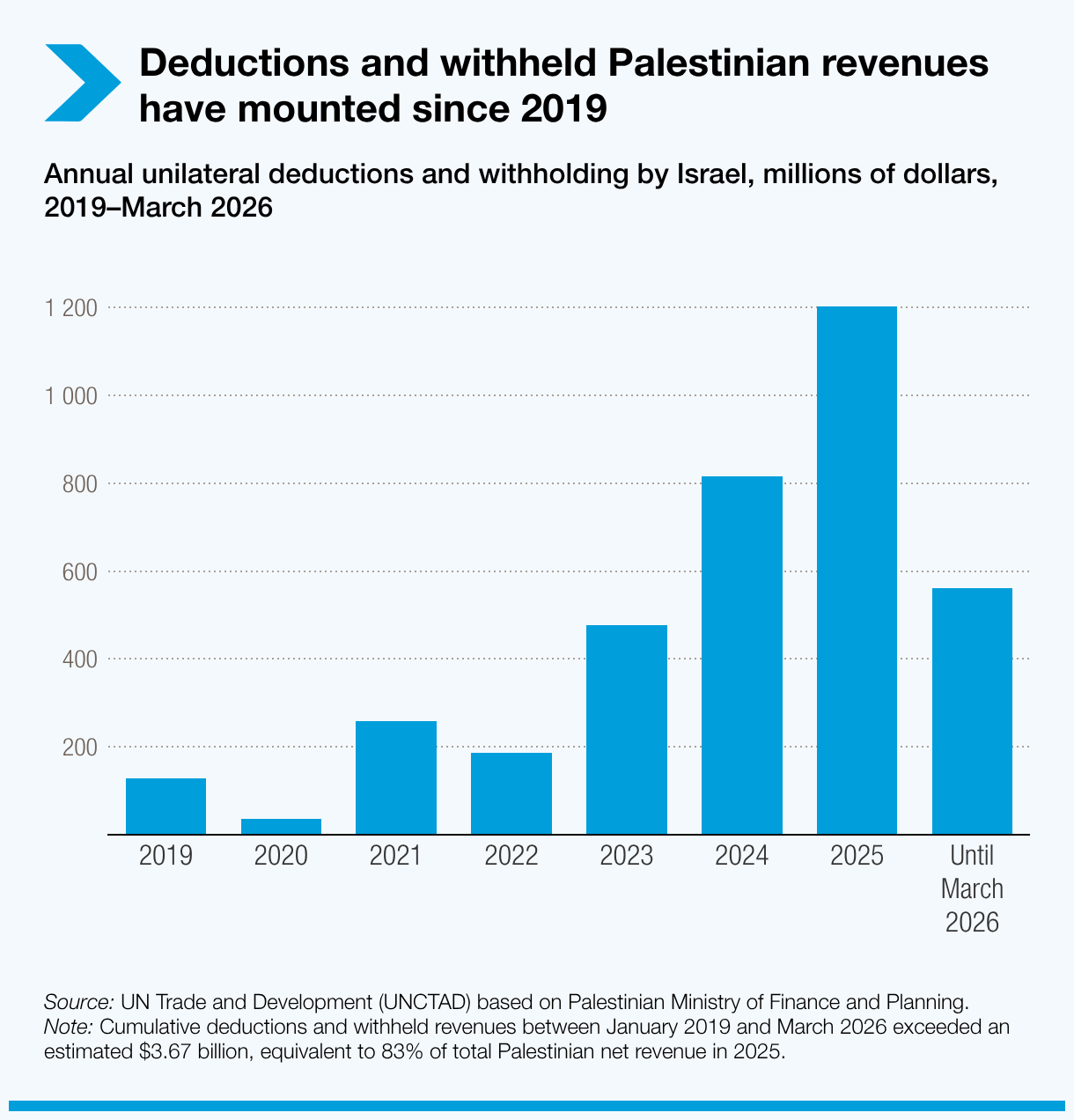
Cumulative deductions and withheld revenues between January 2019 and March 2026 exceeded an estimated $3.67 billion – equivalent to 83% of total Palestinian net revenue in 2025.
Reconstruction needs have reached $71.5 billion
Total recovery and reconstruction needs are estimated at $71.5 billion. Physical infrastructure damage in Gaza is estimated at $35.2 billion, with economic and social losses of $22.7 billion. The figure may rise if further damage is recorded.
Housing accounts for the largest category of damage and the largest reconstruction need. More than half of hospitals and primary health clinics are non-functional. Less than 1.5% of Gaza’s cropland remained accessible and undamaged.
The report identifies three immediate priorities: transferring withheld Palestinian revenues, safeguarding the banking system and aligning reconstruction support with the documented scale of damage and economic losses.
Recovery across the Occupied Palestinian Territory will require large-scale international financial and technical assistance. The report identifies rebuilding productive capacity in agriculture, industry, construction, energy and technology as central to recovery beyond pre-October 2023 conditions.