

Global trade is being reshaped by shifting trade partnerships and policies, evolving supply chains and the search for resilient growth. This report examines two decades of trade expansion among the 10 BRICS members, revealing how economic ties are evolving and creating new opportunities for the global South.
BRICS is named for its founding members, Brazil, the Russian Federation, India, China and South Africa. But it has grown to include Egypt, Ethiopia, Indonesia, Iran and the United Arab Emirates.
The report shows that trade between BRICS members has grown rapidly since 2003, driven by strong complementarities in natural resources, manufacturing and technology, as well as a changing global context. Yet constraints in policy-level cooperation still limit intra-BRICS trade’s full potential – highlighting the need for targeted strategies to strengthen cooperation and build deeper trade networks.
Rising intra-BRICS trade reshapes members’ economic ties
Intra-BRICS merchandise trade has expanded more than 13-fold since 2003. Exports reached $1.17 trillion in 2024. China remains the central driver and, alongside Brazil, India, Indonesia, Russia and the United Arab Emirates, significantly accounts for the most dynamic trade flows among the BRICS members.
Despite the rapid expansion, compared to the BRICS members’ economic scale and trade capacity, the enormous potential of the intra-bloc trade is yet to be fully tapped. For example, BRICS members collectively account for over two thirds of the global South’s total GDP, while intra-BRICS trade accounts for only about 20% of South-South trade.
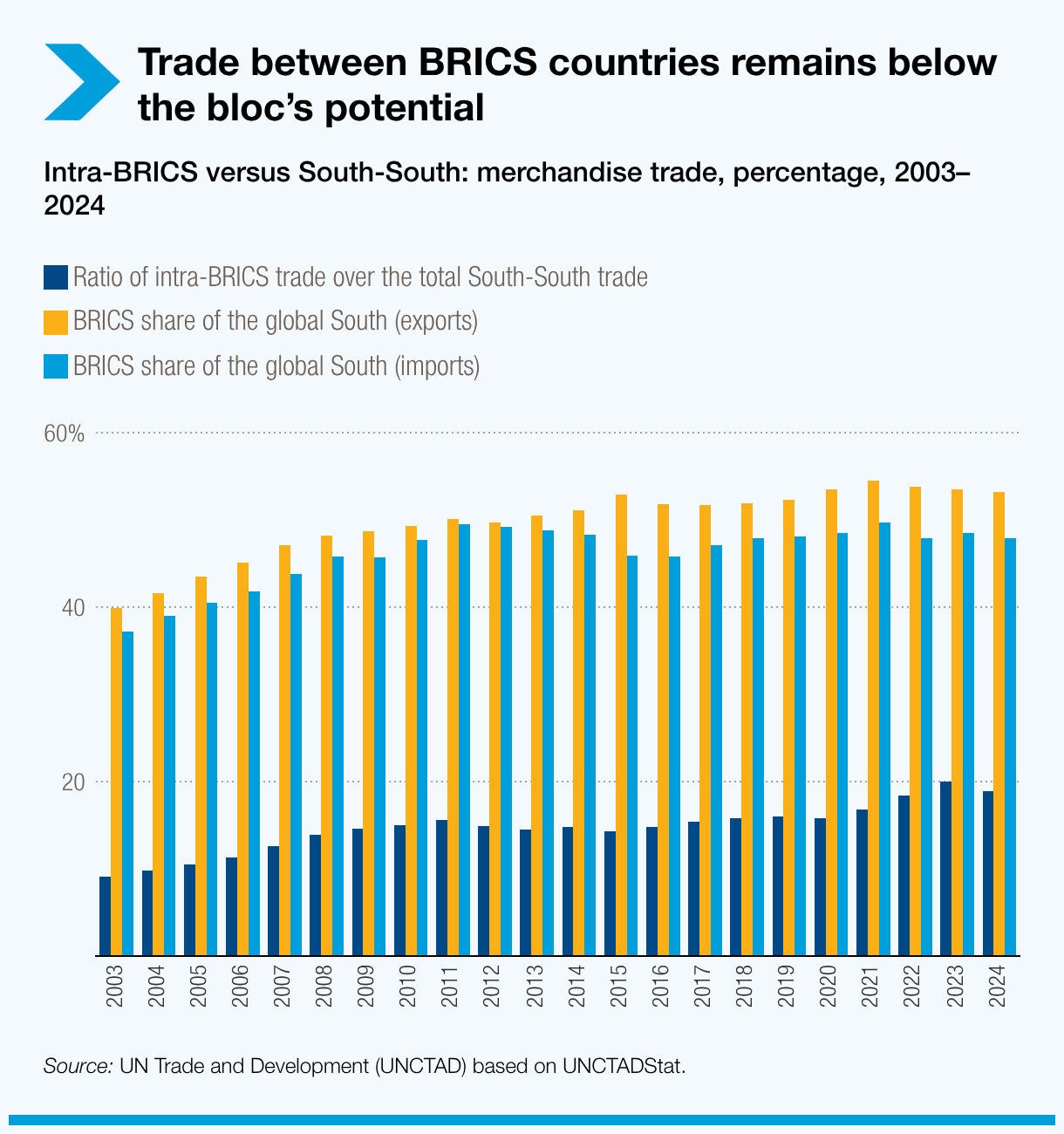
Across the 10 members, the dependence on intra-BRICS trade varies. Brazil, Russia and Indonesia are the three countries most reliant on BRICS markets. Their intra-BRICS exports accounted for over 30% of their total exports in 2024. Meanwhile, four of the members (Iran, Ethiopia, Russia and India) source over 40% of their total imports from BRICS members. China is the largest exporter and importer within intra-BRICS trade. But its dependence is the lowest among the 10 members.
Trade patterns show complementarities but also reveal challenges for structural transformation
The rapid trade expansion reflects strong economic complementarities among members. Many BRICS members show persistent dependence on primary product exports while importing manufactured goods with higher technological and skill intensity. Among the 10 members, seven (Brazil, Egypt, Ethiopia, Indonesia, Russia, South Africa and the United Arab Emirates) rely heavily on primary products for over 60% of their exports to other countries in the bloc.
The report warns that this dependence has remained largely unchanged over the past two decades, highlighting the persistent challenges of structural transformation and export diversification for some BRICS members. It also highlights that some of the countries, such as Egypt and Indonesia, have made incremental progress in diversifying towards higher value-added activities.
Among the members, China and India lead intra-bloc manufacturing exports, illustrating examples within BRICS of successful industrial development.
Policy cooperation does not fully align with intra-BRICS trade dynamics
An analysis of trade-weighted average bilateral tariffs among BRICS members shows a widespread decline in tariff levels. In 2003, many country pairs faced tariffs in the 10% to 20% range, with some exceeding 60%. By 2021, many bilateral tariffs had fallen to single digits, despite substantial differences driven by trade policies (such as free trade agreements) or trade structure.
The report also finds that, under the BRICS trade workstream, members have engaged in broad dialogue and cooperation on trade topics including WTO reform, e-commerce, trade and investment facilitation, and global supply chains. However, they still rely mainly on soft initiatives to lay the groundwork for deeper cooperation.
The report identifies several structural barriers that may constrain deeper intra-BRICS trade cooperation at the policy level. These include economic, institutional and regulatory differences, divergent expectations, institution and capacity gaps, and geopolitical factors.
Trade+ strategy offers a path forward
The report proposes a “Trade+ strategy” that builds political willingness, links trade with a variety of other economic policy issues, including macro-finance, industrial development, digital and data policies, and regulatory framework. The proposed strategy also calls for considering a bold BRICS trade agreement or arrangement, reforming the BRICS trade workstream and enhancing members’ institutional capacity.
These policy considerations aim to strengthen BRICS trade cooperation and unlock new opportunities. Such an approach could also leverage trade more effectively for broader development goals, including promoting structural transformation and more resilient growth for BRICS members and beyond.
The report also stresses that UN Trade and Development (UNCTAD) and other relevant international organizations, drawing on their expertise, networks and experience, can support BRICS members in addressing institutional gaps and enhancing capacities. This could help foster broader, deeper and more concrete intra-BRICS trade cooperation.