
Comoros faces key hurdles on the path to graduation from least developed country status
Key points
- Comoros met the income and human assets criteria for graduation in both 2021 and 2024 but remains above the economic and environmental vulnerability threshold.
- The Economic and Environmental Vulnerability Index stood at 37.0 in 2024, above the graduation threshold of 32.0.
- Nearly 45% of the population lived in poverty in 2020, up from 42% in 2014.
- Remittances reached $282 million in 2024, equivalent to 18% of GDP. These funds are a key source of foreign exchange and a financial lifeline for many Comorians.
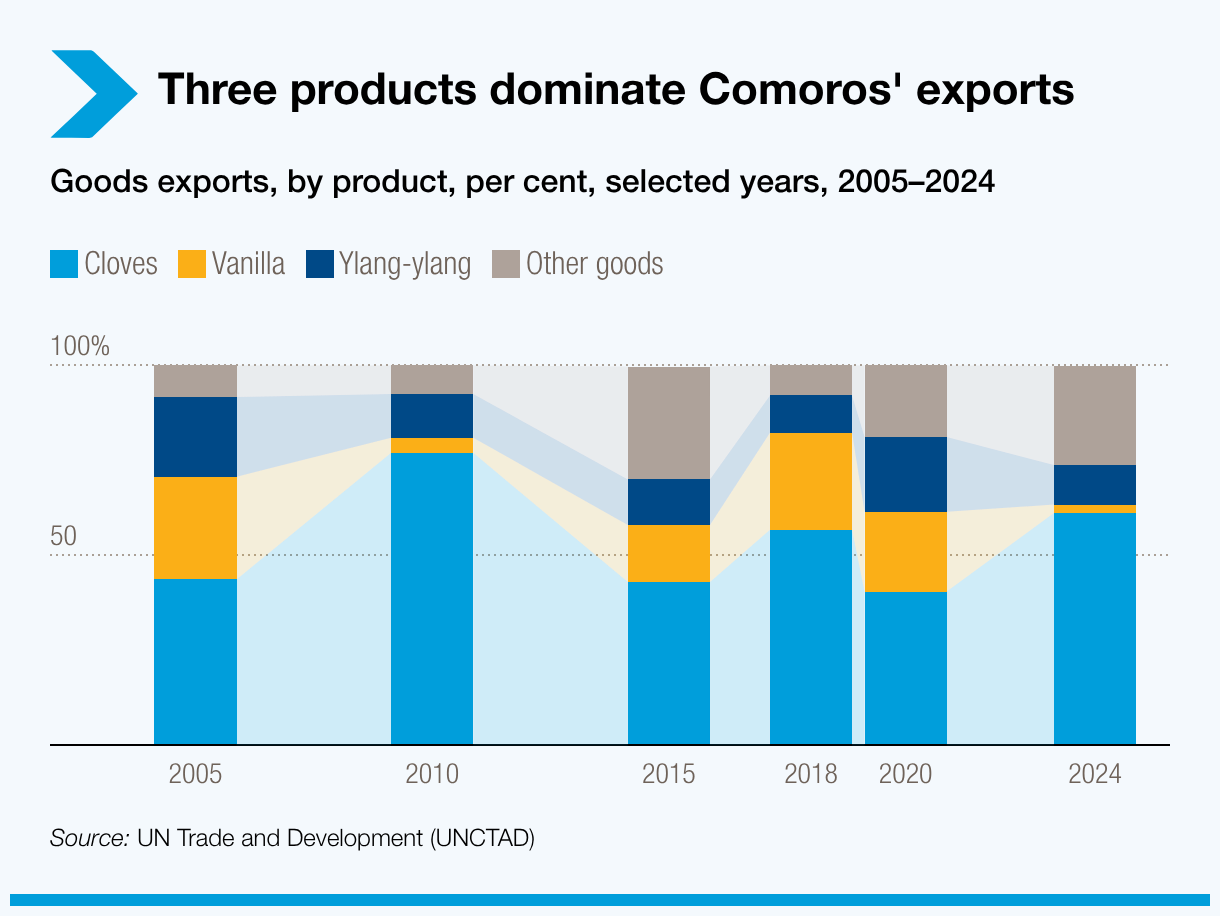
- Cloves, vanilla and ylang ylang accounted for 74% of goods exports in 2024.
This report was prepared by UN Trade and Development (UNCTAD) in anticipation of the 2024 review by the Committee for Development Policy of the United Nations list of least developed countries.
The report assesses the progress of Comoros towards graduation from least developed country status and highlights the structural challenges that continue to affect the country's resilience. While income levels and human development indicators have improved, the economy still needs to diversify and vulnerability remains above the graduation threshold.
The assessment highlights the need to strengthen productive capacity – the resources, skills and infrastructure needed to produce goods and services –, diversify economic activity and improve resilience to external shocks. Addressing these challenges will be important as the country prepares for a possible graduation recommendation in 2027.
Graduation prospects constrained by high vulnerability
Comoros met the income and human assets criteria in both the 2021 and 2024 reviews. However, its Economic and Environmental Vulnerability Index remained above the graduation threshold, reaching 37.0 in 2024 compared with the threshold of 32.0.
The report identifies vulnerability as one of the principal challenges facing the country, due to its dependence on a narrow range of exports and on external financial flows, as well as its exposure to environmental shocks, particularly the growing impacts of climate change and sea-level rise. Accordingly, the report recommends measures to strengthen productive capacity and strengthen the country’s own ability to withstand shocks.
Poverty and employment challenges remain significant
The report notes that economic transformation has been limited. The secondary sector, which includes manufacturing, processing and construction, represented an average of 10% of GDP between 2008 and 2020.
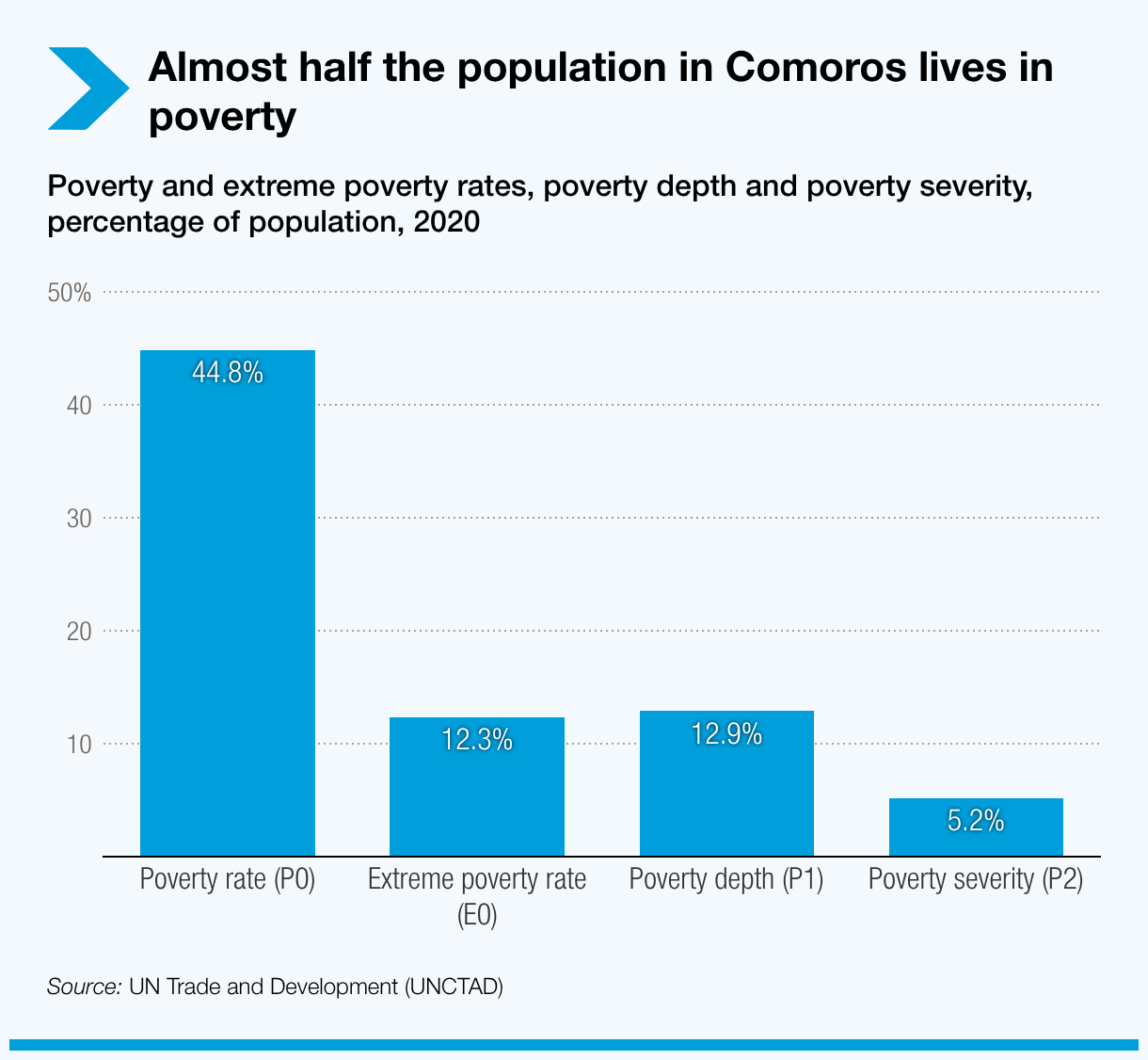
Poverty affected 44.8% of the population in 2020, up from 42.0% in 2014. Unemployment increased from 14.3% in 2003 to 22.1% in 2017. Nearly half of the population was under the age of 20 in 2024. Strengthening productive capacity and generating productive employment are therefore key to expanding economic opportunities.
Almost half the population in Comoros lives in poverty
Poverty and extreme poverty rates, poverty depth and poverty severity, per cent, 2020.
Remittances play a major role in the economy
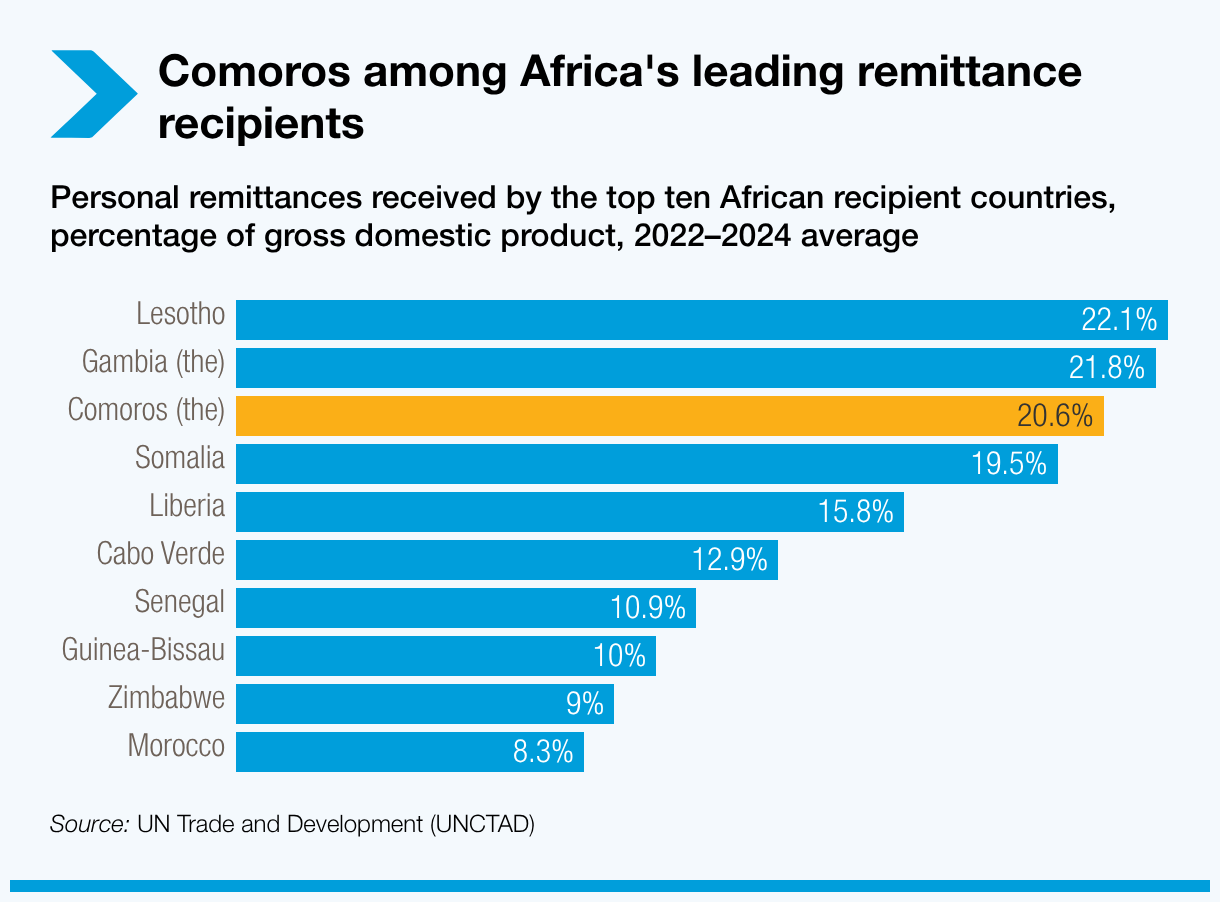
Remittances – money sent home by people living abroad – reached $282 million in 2024, equivalent to 18% of GDP. Around 40% of households receive remittances. The report notes that these funds are used mainly for consumption and customary wedding expenses, rather than productive purposes.
The report recommends improving domestic resource mobilization and increasing investment in productive sectors to strengthen long-term resilience.
Comoros among Africa's leading remittance recipients
Personal remittances received by the top ten African recipient countries, percentage of gross domestic product, 2022–2024 average.
A narrow export base increases economic exposure
Cloves, vanilla and ylang ylang represented 74% of goods exports in 2024. Goods exports totalled 14.3 billion Comorian francs, while imports reached 138.8 billion Comorian francs.
The report identifies economic diversification and stronger productive capacity as important priorities for reducing vulnerability and improving resilience.
Three products dominate Comoros’ exports
Goods exports, by product, per cent, selected years, 2005–2024.
From progress to resilience
Comoros has made progress in income levels and human development, meeting two of the three graduation criteria from least developed country status. Yet high vulnerability, persistent poverty, dependence on a narrow range of exports and exposure to external shocks continue to pose significant challenges.
Tropical Cyclone Kenneth – a category 3 storm – affected more than 40% of the population in 2019. It damaged more than 60% of food crops and more than 30% of cash crops. COVID-19 and rising global food, energy and fertilizer prices following the war in Ukraine provide other examples of how deeply external shocks have affected the country’s social and economic development.
The report recommends action in areas including productive capacity, economic diversification, domestic resource mobilization, climate adaptation, human capital development and statistical capacity. These measures would help strengthen resilience and support future development progress.