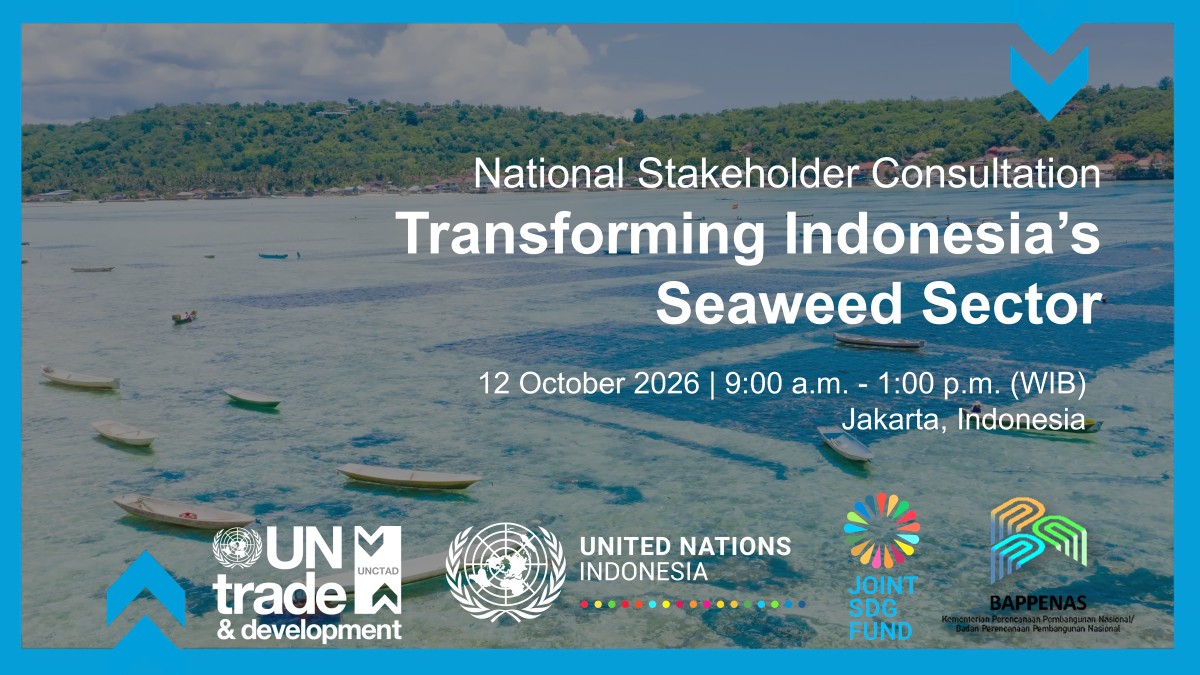
The national stakeholder consultation brought together 60 participants from government, industry, development partners, and academia to discuss the challenges and opportunities facing Indonesia’s seaweed sector.
Participants discussed market opportunities, raw material availability, processing capacity, commercial feasibility, and regulatory requirements. They highlighted the importance of considering seaweed quality, quantity, and species, as well as technology, standards, certification, traceability, and the connections between cultivation areas and processing facilities.
The discussions will inform further consultations, facility visits, and analysis of relevant value chains, markets, and regulations. The assessment will build on existing national plans and explore practical pathways for developing commercially viable and environmentally sustainable seaweed applications that create greater domestic value and benefit coastal communities.
Bringing stakeholders together to unlock the potential of Indonesia’s seaweed downstream value chain
Between 2002 and 2022, global seaweed production tripled from 12 to 36 million tonnes, while exports rose fourfold to $3.9 billion. Today, seaweed and algae account for about one third of global aquaculture production by volume, providing income and economic opportunities for coastal communities worldwide.
Indonesia plays a central role in the global seaweed economy, but nearly two-thirds of its seaweed exports are raw seaweed. This limits the value captured domestically. Addressing bottlenecks and barriers towards higher-value production, processing and trade is critical for Indonesia to increase domestic value creation, strengthen competitiveness and generate wider social and environmental benefits.
Objectives
The national consultation aims to bring together public institutions, seaweed-derived products producers, processors, technology providers, researchers, investors, buyers, and development partners to identify barriers and opportunities and policy recommendations for upgrading Indonesia’s trade and production potential within the seaweed downstream sector.
More precisly, the consultation will explore economically viable and environmentally sustainable pathways for producing higher-value seaweed-derived biopolymers, bioplastics, bio-based packaging, and biostimulants and fertilizers while improving income, resilience, and market participation among coastal communities, including women.
This national consultation is being conducted within the framework of the project “Transforming Indonesia's seaweed sector,” which seeks to support Indonesia in strengthening its seaweed by-products industry and advancing value addition. The project is currently being implemented by UNCTAD and the United Nations Resident Coordinator Office in Indonesia, with support from the UN SDG Fund.
Methodology
The consultation will adopt an evidence-based and participatory approach, structured around three sessions. These sessions will aim to develop a shared understanding of the seaweed sector and the scope of the assessment; gather expert perspectives and evidence on market trends, industry opportunities, and value addition potential; and identify key constraints, enabling factors, and policy recommendations to strengthen Indonesia’s seaweed-derived products value chain and foster a conducive policy, regulatory, and institutional environment for sustainable sector development.
