

A coordinated global response is key to putting development at the centre, from the rules governing frontier technologies to the flow of investment and the transition to green industry.
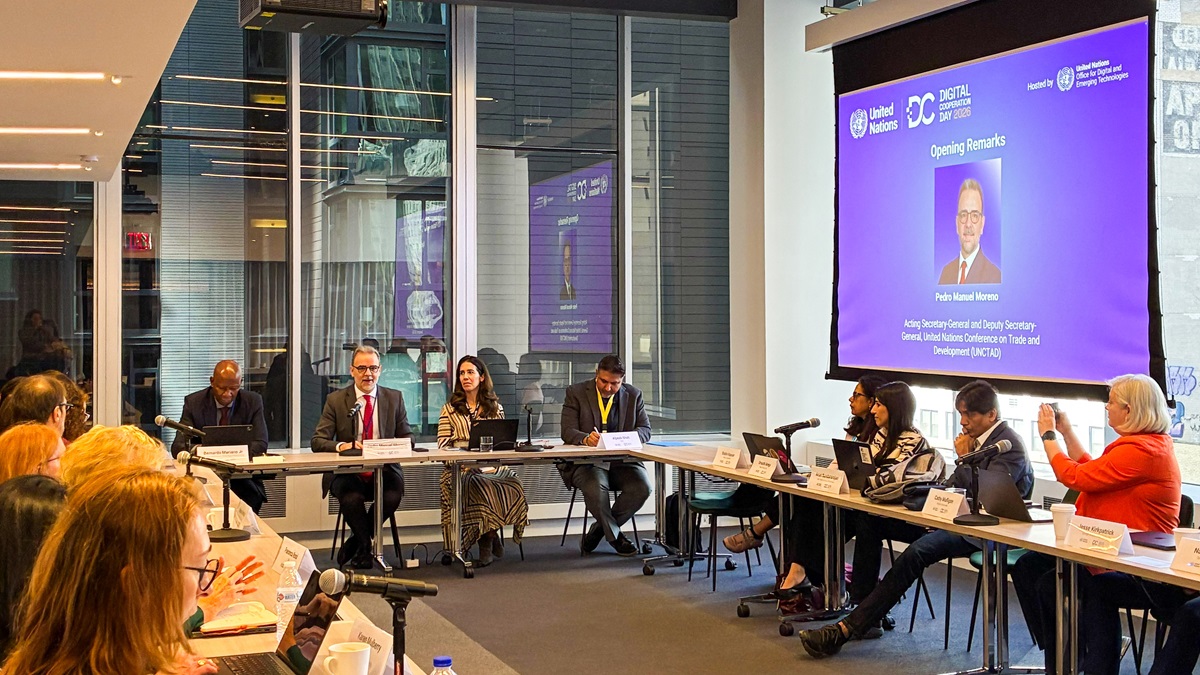
© UNCTAD Photo | Acting Secretary-General Pedro Manuel Moreno (centre left and on screen) addresses UN Digital Cooperation Day 2026 in New York.
Global cooperation must translate into practical support so that the fast-evolving technological and economic landscape expands development opportunities rather than deepening existing divides.
That was the overarching message UN Trade and Development (UNCTAD) brought to New York, where world leaders gathered for the high-level week of the 81st session of the UN General Assembly from 18 to 28 September.
During a series of high-level engagements, UNCTAD called for more inclusive global rules and standards, greater mobilization of public and private finance, as well as stronger partnerships to help least developed countries build productive capacity and move into higher-value green industries.
AI: Governing through science, policy and capacity
Artificial intelligence (AI) took centre stage during UN Digital Cooperation Day on 21 September.
As AI governance develops across jurisdictions, interoperability - enabling different digital systems to work together - is becoming increasingly important.
Greater interoperability can help reduce fragmentation in global data and AI governance, UNCTAD Acting Secretary-General Pedro Manuel Moreno said to a session during the day.
But internationally agreed principles need to be backed by practical support, including investment in digital infrastructure, institutional capacity and skills, as well as technology transfer and partnerships.
This is key to helping developing countries and smaller firms not only connect to interoperable systems but also shape them and benefit from the value they create.
“Interoperability by design must also mean development by design,” Mr Moreno said.
“The success of interoperability should not be judged simply by how seamlessly systems connect, but by what those connections enable, for whom, and under what conditions.”
Investing in development
Foreign direct investment reached $1.6 trillion in 2025 but flows to developing economies fell. UNCTAD analysis shows that in three quarters of least developed countries, investment inflows were stagnant or declining.
Speaking at a session on “Financing the future”, Mr Moreno highlighted three conditions for mobilizing more investment where it can have greater development impact:
- Scale up blended finance and guarantee instruments to reduce investment risks.
- Build stronger pipelines of bankable projects that connect investors with development priorities.
- Strengthen regional cooperation to transform fragmented markets into investable ones.
“The capital exists. The instruments exist. The political commitment, reaffirmed in Sevilla, exists,” Mr Moreno said.
“The task ahead is execution.”
Unlocking opportunities from green value chains
The high-level week also saw the introduction of a UN-backed initiative to help turn green industrial opportunities into concrete projects across the 44 least developed countries (LDCs), home to about 15% of the global population.
Manufacturing accounts for about 14% of LDC output, providing a base to build on as new green value chains emerge in areas such as solar power, batteries and green hydrogen.
The initiative, known as the LDC-GIF mechanism, seeks to bridge the gap between viable projects and the finance, technology, infrastructure and expertise needed to deliver them, starting with 10 pilot countries.
The mechanism will be officially launched in Antalya, Türkiye, during the UN climate conference COP31 in November.
“COP31 in Antalya offers a real opportunity - to match climate commitments with industrial strategy for those who need it most. UNCTAD stands ready to support,” Mr Moreno concluded.