Key takeaways
- Africa attracted about $70 billion in foreign direct investment in 2025, the third-highest level since 1990.
- Despite a decline from the exceptional level reached in 2024, inflows remained roughly one-third above the continent's long-term average.
- Greenfield project values fell by almost one third, but the number of announced projects increased, pointing to broader engagement through smaller projects.
- Investors from the Gulf and other Asian economies are becoming important sources of greenfield investment, especially in energy, logistics, real estate and infrastructure.
- African LDCs received about $33 billion in FDI, with inflows concentrated in a few economies linked to natural resources, energy, infrastructure and selected manufacturing projects.
- Energy, infrastructure and critical minerals are drawing investment, but benefits remain concentrated in a limited number of countries and sectors.
Africa attracted less foreign direct investment (FDI) in 2025 than in the previous year. Yet the bigger story is that investors continue to position themselves in sectors that are becoming increasingly important to the global economy.
According to the World Investment Report 2026 by UN Trade and Development (UNCTAD), FDI inflows to Africa reached about $70 billion in 2025. That was below the exceptional $94 billion recorded in 2024, when a small number of large transactions boosted regional totals. Even so, 2025 was the third-highest level since 1990 for investment into Africa and remained roughly one-third above the continent's long-term average.
Egypt remained Africa’s largest FDI recipient, with inflows of about $15 billion, helping North Africa remain the continent’s largest recipient subregion despite a sharp decline from the exceptional 2024 level.
At a time when competition for investment is increasingly centred on energy, infrastructure, technology and critical resources, Africa continues to attract investor attention including from the Gulf and other Asian economies. The question is whether that interest can translate into broader economic gains.
Investors are looking beyond the headlines
Headline inflows tell only part of the story.
While FDI declined from the unusually high level recorded in 2024, greenfield project values fell by almost one third. However, project numbers increased, pointing to broader engagement through smaller projects. That suggests companies continue to commit capital to future projects despite geopolitical tensions, trade policy uncertainty and a more selective global investment environment.
The contrast matters because large transactions can cause sharp swings in annual FDI figures. Greenfield projects often provide a clearer indication of where investors see long-term opportunities.
Energy, minerals and infrastructure remain major draws
African Least Developed Countries were an important part of the continent’s investment picture. They received about $33 billion in FDI, but inflows remained concentrated in a small number of economies linked to natural resources, energy, infrastructure and selected manufacturing projects.
Much of that interest is focused on sectors that are becoming more important in the global economy.
This reflects three overlapping drivers: demand for energy infrastructure, interest in critical minerals needed for batteries and advanced manufacturing, and the search for new industrial and logistics locations as supply chains are reconfigured.
Parts of Africa are well positioned to benefit from these trends. The continent holds major reserves of minerals essential for renewable energy technologies, battery manufacturing and advanced industrial production. Copper, cobalt, lithium, manganese, graphite and rare earth minerals are becoming increasingly important to global investors seeking to secure future supply chains.
Countries such as Egypt, Morocco and South Africa continued to attract investment linked to industrial development, hydrogen production, logistics and renewable energy. Namibia and other resource-rich economies are drawing attention as demand rises for minerals needed in batteries, renewable energy systems and advanced manufacturing.
These trends position parts of Africa within some of the fastest-growing segments of global investment.
However, the benefits remain uneven. Investment continues to be concentrated in a relatively small number of countries and sectors, leaving many economies with limited participation in the activities attracting the most capital.
The opportunity is growing. So is the competition.
For many African economies, attracting investment into energy or resource projects is only the starting point.
The bigger prize lies in capturing more of the value created around those investments through processing, manufacturing, services and stronger regional supply chains. Achieving that will require infrastructure, skills, industrial capabilities and policies that help connect investment projects to the wider economy.
Policy priorities include better project preparation, risk-sharing mechanisms, reliable power and transport infrastructure, supplier development, local processing where commercially viable, and regional corridors that connect smaller markets to larger production systems. Without those links, investment in minerals or energy can raise headline inflows without creating enough domestic value.
This means the success of Africa's next development chapter will depend not only on how much investment arrives, but also on how effectively countries can transform that investment into jobs, technology transfer, industrial upgrading and economic diversification.
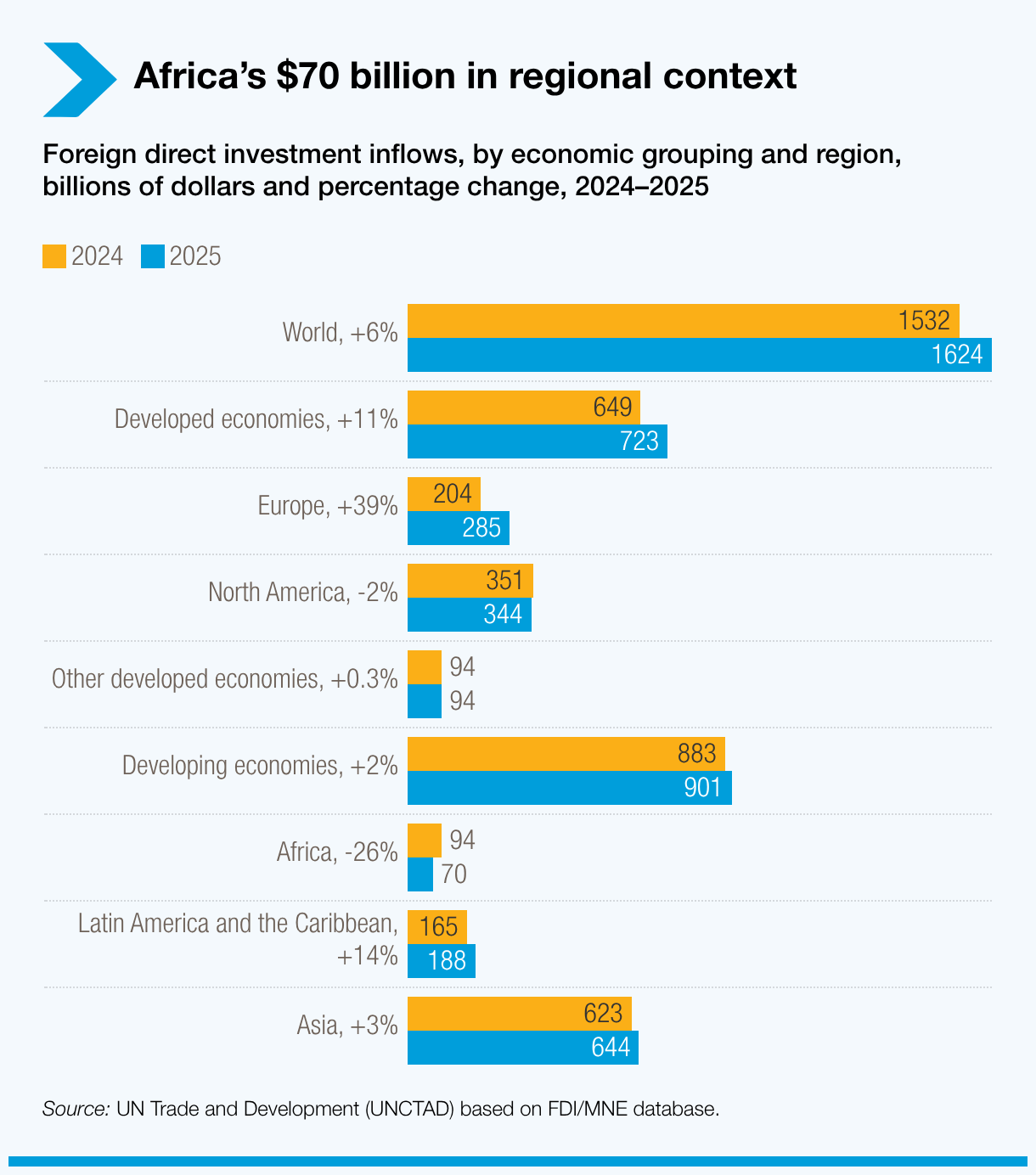
Africa-specific chart contrasting lower greenfield project values with higher project numbers.
More from the World Investment Report 2026
- Global investment rises 6% to $1.6 trillion, but development gains remain uneven.
- Developing Asia leads investment among developing regions as patterns shift within the region.
- More capital, fewer projects: Latin America’s investment paradox.
About UN Trade and Development (UNCTAD)
UNCTAD is the UN’s leading body on trade and development. Founded in 1964, it supports 195 member states with expert analysis, technical assistance, and serves as a platform for intergovernmental dialogue.
UNCTAD helps developing countries make trade, finance, investment, and the digital economy work for inclusive and sustainable development.