
Key takeaways
- Foreign direct investment rose 14% to $188 billion in 2025.
- Brazil accounted for much of the increase, with inflows rising from $63 billion to $77 billion.
- The region's top 10 recipients captured 95% of regional inflows.
- The value of announced greenfield projects fell by about one-third, signaling a weaker pipeline of future productive projects.
Latin America and the Caribbean attracted more foreign investment in 2025 than in the previous year, despite an uncertain global economy.
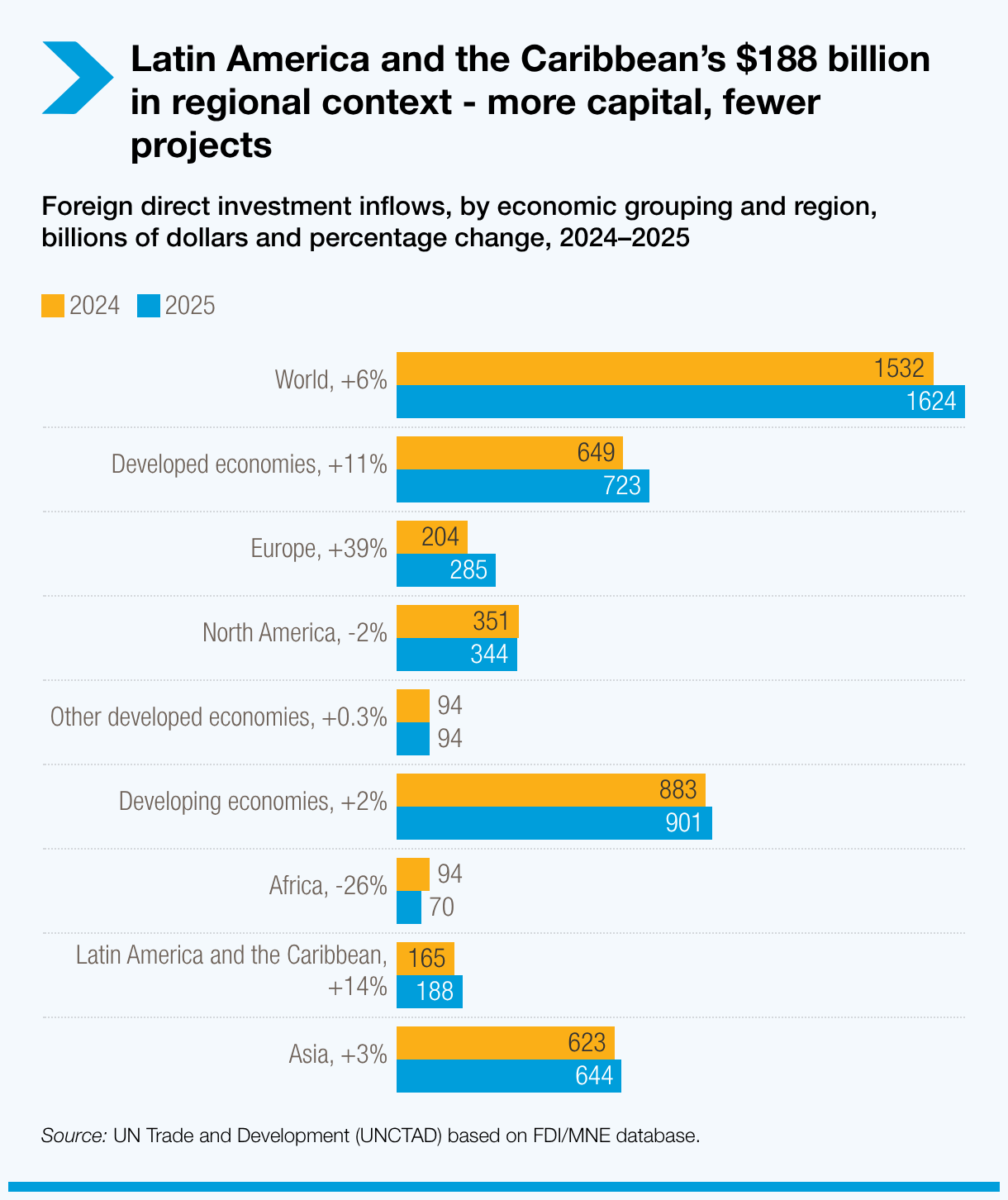
According to the World Investment Report 2026 by UN Trade and Development (UNCTAD), foreign direct investment (FDI) inflows to the region, excluding Caribbean offshore financial centres, rose 14% to $188 billion. That represented roughly one fifth of all FDI flows to developing economies. The increase was driven largely by South America, particularly Brazil, while investment linked to commodities and sectors supporting the energy transition continued to attract investor interest.
For development, the concern is not whether capital is entering the region, but whether it is building new productive capacity, diversifying economies, and supporting higher-value activities.
Yet beneath the stronger headline numbers lies a more complex story. Much of the increase was concentrated in a handful of countries and transactions, while indicators of future productive investment weakened.
A strong year, but not for everyone
The numbers show how concentrated the rebound was.
The top 10 recipient economies accounted for 95% of all FDI inflows in Latin America and the Caribbean in 2025. Brazil and Mexico together accounted for roughly two thirds of total regional inflows, showing how strongly regional trends were shaped by a few large economies and a limited number of large projects. Brazil was the largest contributor to regional growth, with inflows increasing from $63 billion to $77 billion, placing it among the world's five largest recipients of foreign investment.
Mexico also remained one of the region’s leading destinations, with inflows rising from about $38 billion to $41 billion, supported by its role in regional production networks and continued investment in services and manufacturing.
The strongest inflows were linked to large markets, commodities, sectors connected to the energy transition and economies integrated into major trade and production networks. But these drivers did not translate into a stronger pipeline of new productive projects across the region.
These figures point to continued investor confidence in the region's largest markets. They also highlight a persistent challenge: rising regional inflows do not automatically translate into broad-based gains across countries or sectors.
The investment pipeline is sending a different signal
The clearest sign comes from greenfield investment, often regarded as one of the best indicators of future productive activity.
While overall inflows increased, the value of announced greenfield projects fell by about one-third, dropping to less than $120 billion. Manufacturing and logistics were among the sectors registering declines.
The decline was particularly pronounced in Mexico, where announced greenfield values fell from $44 billion to $24 billion, as firms postponed or scaled back projects amid trade and industrial policy uncertainty. Argentina also saw a sharp fall, from about $37 billion to $1.4 billion.
The contrast matters because greenfield projects typically involve new facilities, infrastructure and production capacity. Fewer new projects can mean fewer future factories, logistics platforms, supplier opportunities and technology spillovers. They often provide a clearer picture of future economic activity than annual FDI totals, which can be heavily influenced by mergers, acquisitions or large financial transactions.
In other words, more capital entered the region in 2025, but less was committed to building new productive assets.
Latin America and the Caribbean continue to offer many advantages to investors, including abundant natural resources, growing renewable-energy potential, large consumer markets and strategic proximity to major trading partners.
Building a stronger project pipeline
The report points to the need for policies that convert investor interest into bankable productive projects. For Latin America and the Caribbean, this means strengthening investment facilitation and aftercare, improving logistics and energy infrastructure, supporting supplier development, and using regional integration to connect smaller economies to larger markets and value chains. Countries rich in minerals or renewable-energy potential also need strategies that encourage local value addition rather than relying only on commodity-linked inflows.
More from the World Investment Report 2026
- Global investment rises 6% to $1.6 trillion, but development gains remain uneven.
- Developing Asia leads investment among developing regions as patterns shift within the region.
- Africa is attracting investment in strategic industries. The challenge is turning it into broader industrial development.
About UN Trade and Development (UNCTAD)
UNCTAD is the UN’s leading body on trade and development. Founded in 1964, it supports 195 member states with expert analysis, technical assistance, and serves as a platform for intergovernmental dialogue.
UNCTAD helps developing countries make trade, finance, investment, and the digital economy work for inclusive and sustainable development.