

Countries have agreed to mobilize $300 billion a year by 2035 as part of a broader $1.3 trillion climate finance ambition. But rising headline figures mask deeper concerns about whether the system is delivering real, additional support to developing countries facing the climate crisis.
This report examines how climate finance interacts with official development assistance (ODA) and broader development flows. It finds that much of the reported growth in climate finance reflects changes in accounting practices rather than a genuine increase in fiscal effort.
Climate finance draws from the same shrinking aid pool
Headline ODA rose from $133 billion in 2009 to $235 billion in 2023. Yet once in-donor refugee costs and support for Ukraine are excluded, ODA as a share of gross national income (GNI) fell from 0.33% to 0.30%.
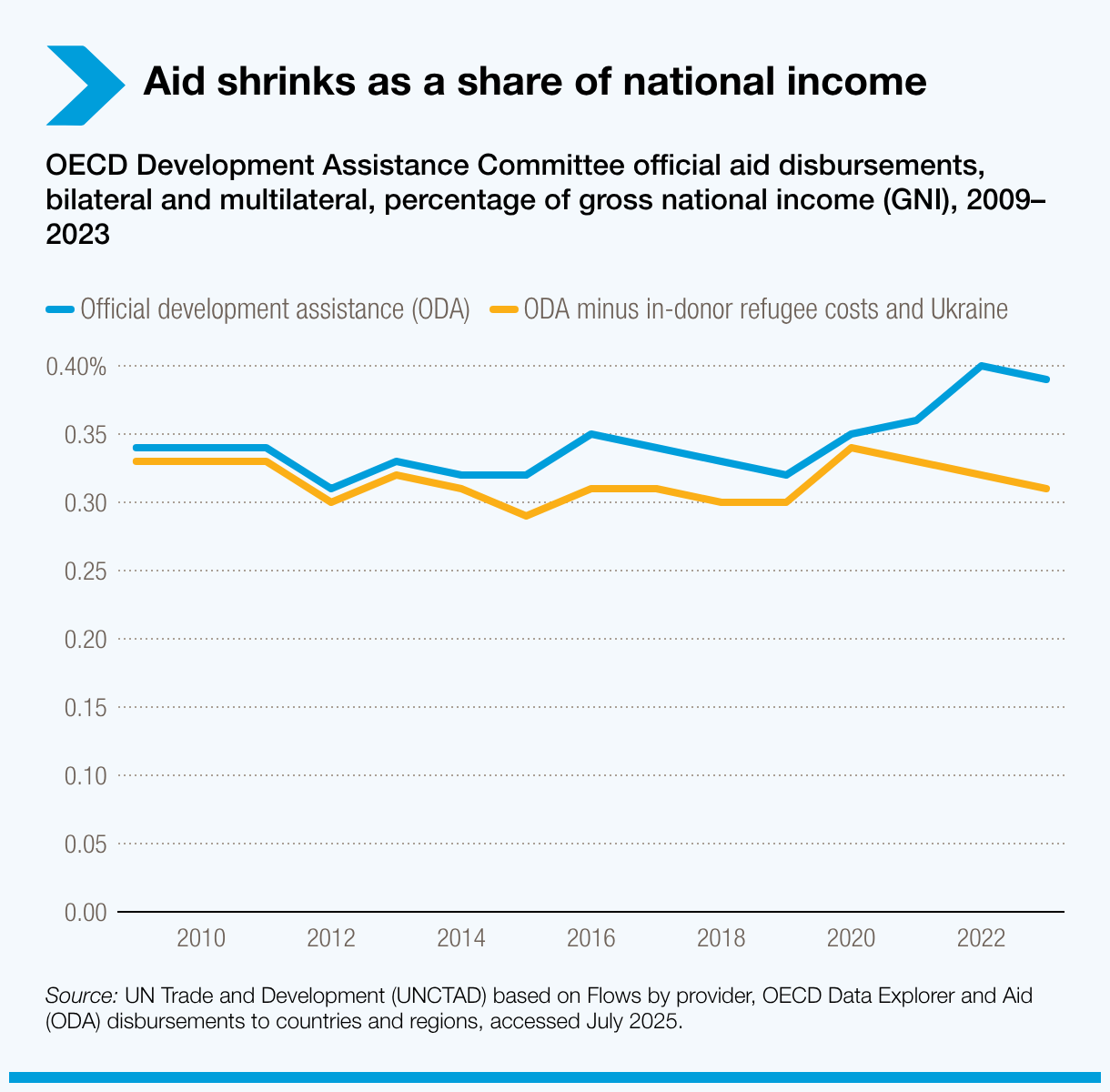
The decline is sharper for non-climate ODA. Adjusted for climate-marked spending, non-climate ODA fell from 0.31% of GNI in 2009 to 0.25% in 2023.
This suggests that climate finance is not being layered on top of development aid but is increasingly being provided at the expenses of the non-climate ODA.
Double-counting: Climate finance is often not additional
The report shows that only a limited share of climate finance is clearly additional to existing ODA commitments. Under the strictest benchmark – finance provided above the long-standing 0.7% of gross national income ODA target – very few providers meet the test.
In practice, most climate-related projects also qualify as development assistance and are routinely counted towards both climate and ODA targets. This double-counting inflates totals without increasing actual resources available to developing countries. The result is a growing gap between reported commitments and real support on the ground.
Classification changes are driving much of the increase in climate aid
The report shows that expanded use of classification systems has significantly boosted climate finance totals.
The use of “Rio markers” – tags identifying projects with climate objectives – has expanded sharply. Bilateral ODA carrying a Rio marker rose from $5.7 billion in 2009 to $27.7 billion in 2023, even as other aid was squeezed by rising spending on Ukraine and in-donor refugee costs. Over the same period, the share of bilateral ODA marked as climate-related increased from 6% to nearly 16%.
The rise reflects not only shifts in priorities but also changes in how projects are classified. Since 2009, projects marked with a “significant” climate objective – where climate is not the primary purpose – have increased tenfold.
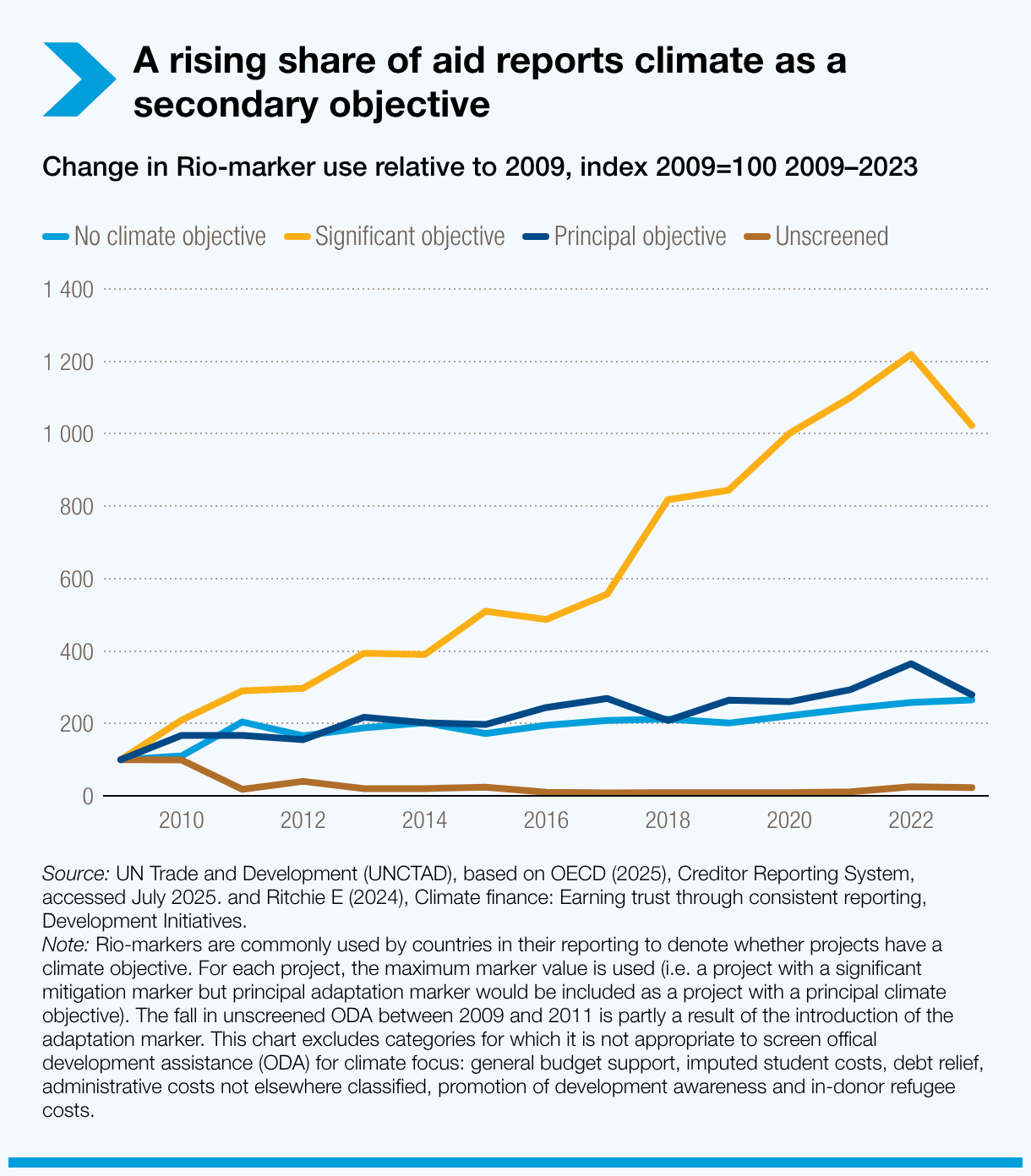
The distinction matters. The threshold for assigning a significant marker is lower than for a principal marker. Significant projects include activities where climate is one objective among several, rather than the core purpose. In many cases, projects previously reported as general development assistance are now classified as climate finance.
The result is that reporting changes have contributed substantially to higher climate finance totals, even when underlying spending priorities have not fundamentally shifted.
Developing countries face impossible trade-offs
Developing countries must simultaneously adapt to climate impacts, invest in clean energy, strengthen resilience and meet basic development needs. When climate finance growth reflects accounting adjustments rather than new money, governments are forced into difficult choices between climate action and poverty reduction.
At a time when several major donors are cutting aid budgets, pressure to meet climate commitments through reclassification rather than scaling up resources is intensifying. Without stronger safeguards, the system risks undermining trust and weakening both climate and development outcomes.
Restoring integrity and trust
The report calls for robust, common accounting standards that prevent double-counting and ensure consistency across providers. Clearer definitions and harmonized methodologies are essential to distinguish genuinely new climate finance from re-labelled aid.
It also recommends publishing impact metrics to strengthen accountability and urges developed countries to scale up overall financial commitments to meet both climate and development targets.
Delivering on the $1.3 trillion ambition will require more than creative accounting – it will require real, measurable and transparent support that developing countries can rely on.