
Key points
- 85 institutions in 63 countries used DMFAS in 2025.
- Nearly two thirds are low-income or lower-middle-income countries, while more than half of all least developed countries rely on DMFAS to manage public debt.
- 95% of countries using DMFAS maintained comprehensive central government external debt records in the system, while 91% reported to the World Bank’s Debtor Reporting System.
- DMFAS 7 launched in March 2025 and was installed in Rwanda, South Sudan and Zambia by year-end.
In a global environment marked by rising debt vulnerabilities, debt sustainability and transparency remain pressing concerns. Countries are managing increasingly complex debt portfolios while facing growing demands for reliable debt information.
Over 44 years, the UN Trade and Development (UNCTAD) Debt Management and Financial Analysis System (DMFAS) Programme has supported 118 institutions in 77 developing countries to strengthen their debt management systems and institutional capacity.
The report presents the programme’s achievements during the first year of its Strategic Plan 2025–2028 and highlights the launch of DMFAS 7, the next generation of its debt management system.
Stronger debt management in 63 countries
In 2025, 85 institutions in 63 countries used DMFAS to manage public debt data. More than half of all least developed countries use the system, including 79% of least developed countries in sub-Saharan Africa. South Sudan joined as a new user in 2025, while the Central African Republic reactivated the system.
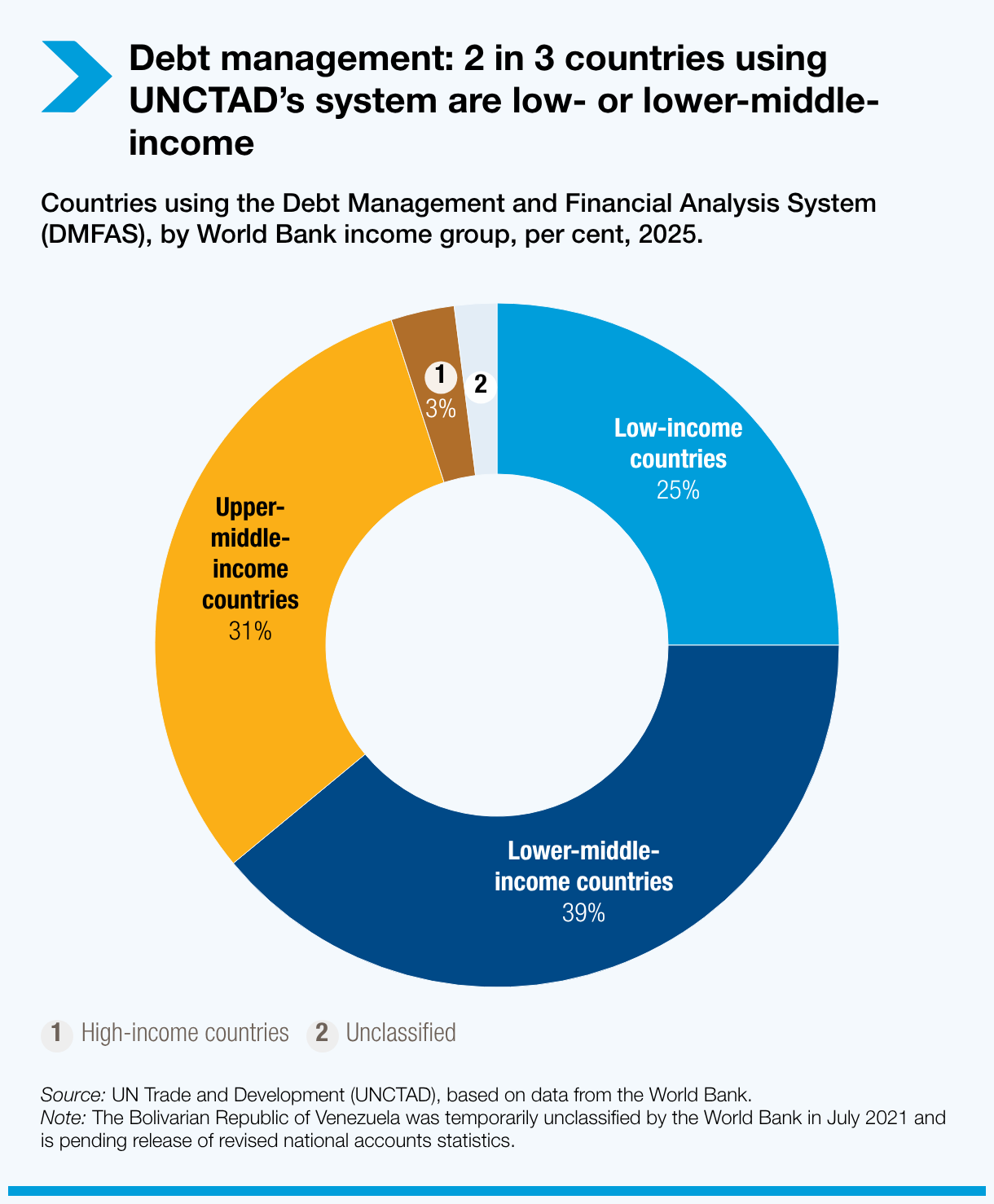
Nearly two-thirds of countries using DMFAS are low-income or lower-middle-income.
DMFAS has evolved beyond a technical debt-recording system. The report describes it as core public infrastructure for sovereign debt governance. It helps governments maintain authoritative debt records, strengthen coordination across institutions and produce reliable information for policy decisions and risk analysis.
A new phase in debt management
DMFAS 7 was released in March 2025 and installed in Rwanda, South Sudan and Zambia by year-end. Zambia also recorded state-owned enterprise debt in DMFAS 7.
The new system supports more integrated and forward-looking debt governance. It expands debt coverage and strengthens recording, reporting, monitoring and analysis. It also facilitates links with other public finance systems. The programme aims to install DMFAS 7 in 34 countries by the end of 2028.
The rollout of DMFAS 7 is part of a broader four-year strategy to strengthen debt management capacity and transparency. The Strategic Plan 2025–2028 focuses on four priorities:
- Building effective debt management frameworks
- Enhancing the capacity of debt managers
- Strengthening debt transparency and accountability
- Expanding the coverage and quality of public debt data
Training remains central to stronger debt governance
The programme trained 643 officers from 22 countries in 2025, with women accounting for 33% of participants. It organized or co-organized 71 training events and participated in 13 partner events.
Staff turnover creates a continuing need for training. Increasingly complex debt portfolios also test the resilience of public debt management systems. Training for trainers and a certification programme are planned to help sustain knowledge and strengthen debt management skills.
Stronger reporting and transparency remain priorities
Debt reporting remained a major focus in 2025. Some 91% of countries using DMFAS reported to the World Bank’s Debtor Reporting System. In addition, 46 countries published a debt statistics bulletin in the previous 18 months and 36 used DMFAS to extract data for debt sustainability analyses.
The programme plans to continue rolling out DMFAS 7, expand training and strengthen cooperation with other technical assistance providers.
Stronger institutional capacity and greater transparency remain central to improving sovereign debt governance, supporting sustainable financing and advancing long-term development.