



Manufacturing and exports helped several Asian economies gain ground. That route to prosperity is becoming harder to follow.
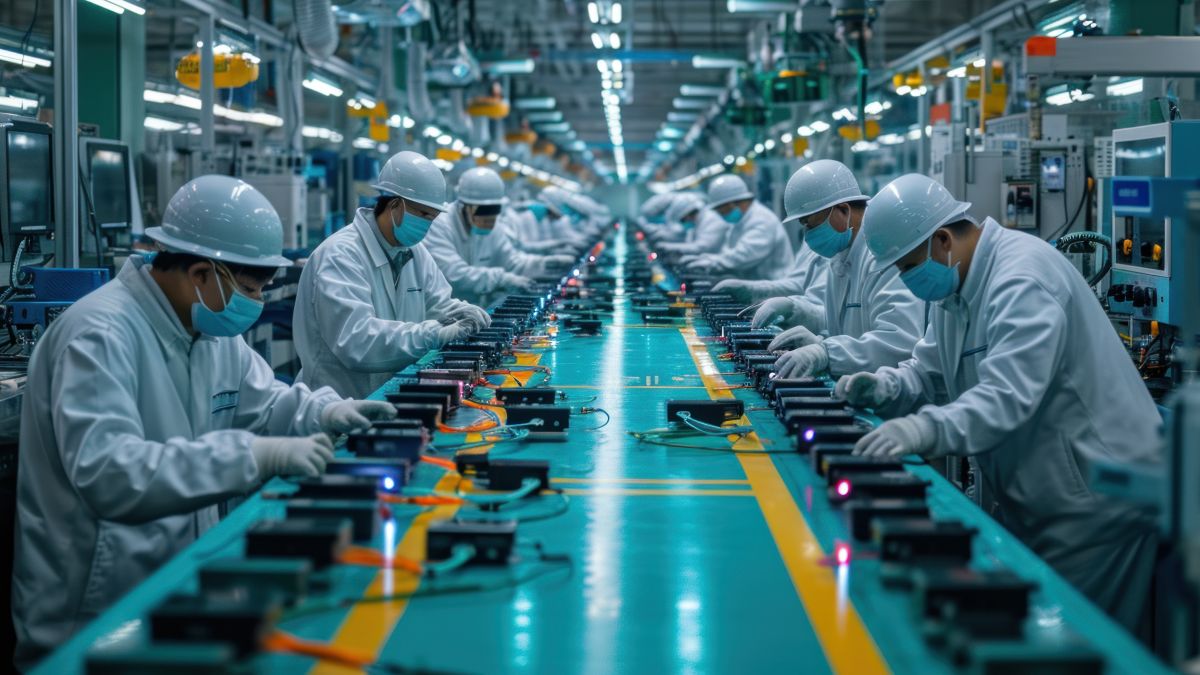
© Shutterstock/sirisakboakaew (AI-generated)
In the early 1990s, a group of eight Asian economies had an average output per person less than half that of the remaining developing countries. By 2026, their average is projected to be roughly twice as high.
Asia is expected to account for 59% of global growth in 2026. India’s economy is projected to expand by 7.3%, Indonesia’s by 5.2% and China’s by 4.5%. By comparison, global growth is forecast to slow to 2.6%, down from 2.9% in 2025. Growth in developing economies is set to fall from 4.7% to 4%.
Apart from a handful of Asian frontrunners, developing economies as a group have fallen further behind developed ones since the mid-2010s. And the route that helped parts of Asia advance is becoming more challenging. Competition between major economies over strategic sectors like semiconductors, artificial intelligence (AI) infrastructure and clean energy technologies is raising barriers for those hoping to follow.
Two speeds
UN Trade and Development (UNCTAD) highlights the divide in its Trade and Development Report 2026, comparing the rest of the global South to a selection of Asian economies – China, India, Indonesia, Malaysia, Singapore, Viet Nam, Hong Kong SAR (China) and Taiwan Province of China.
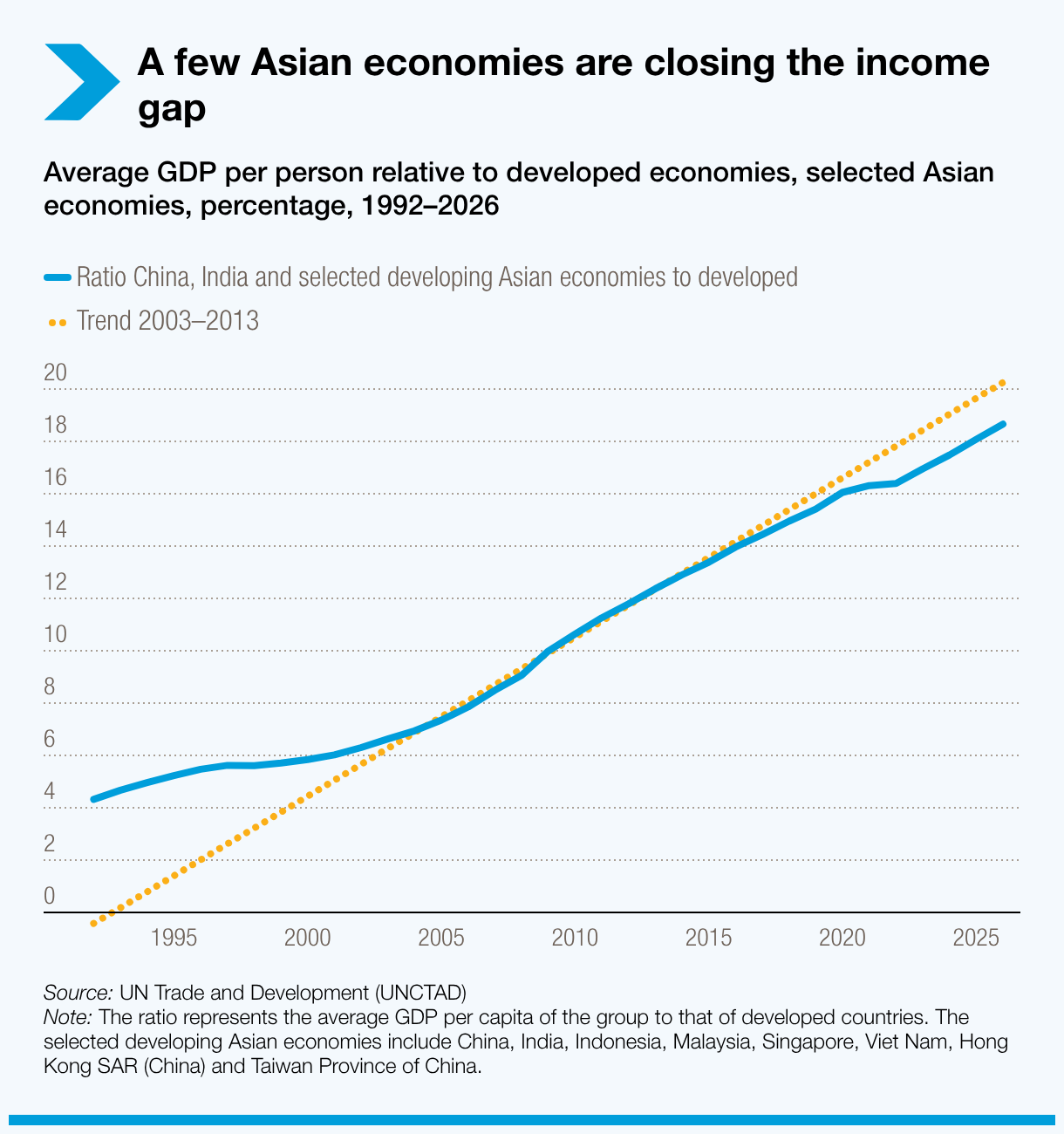
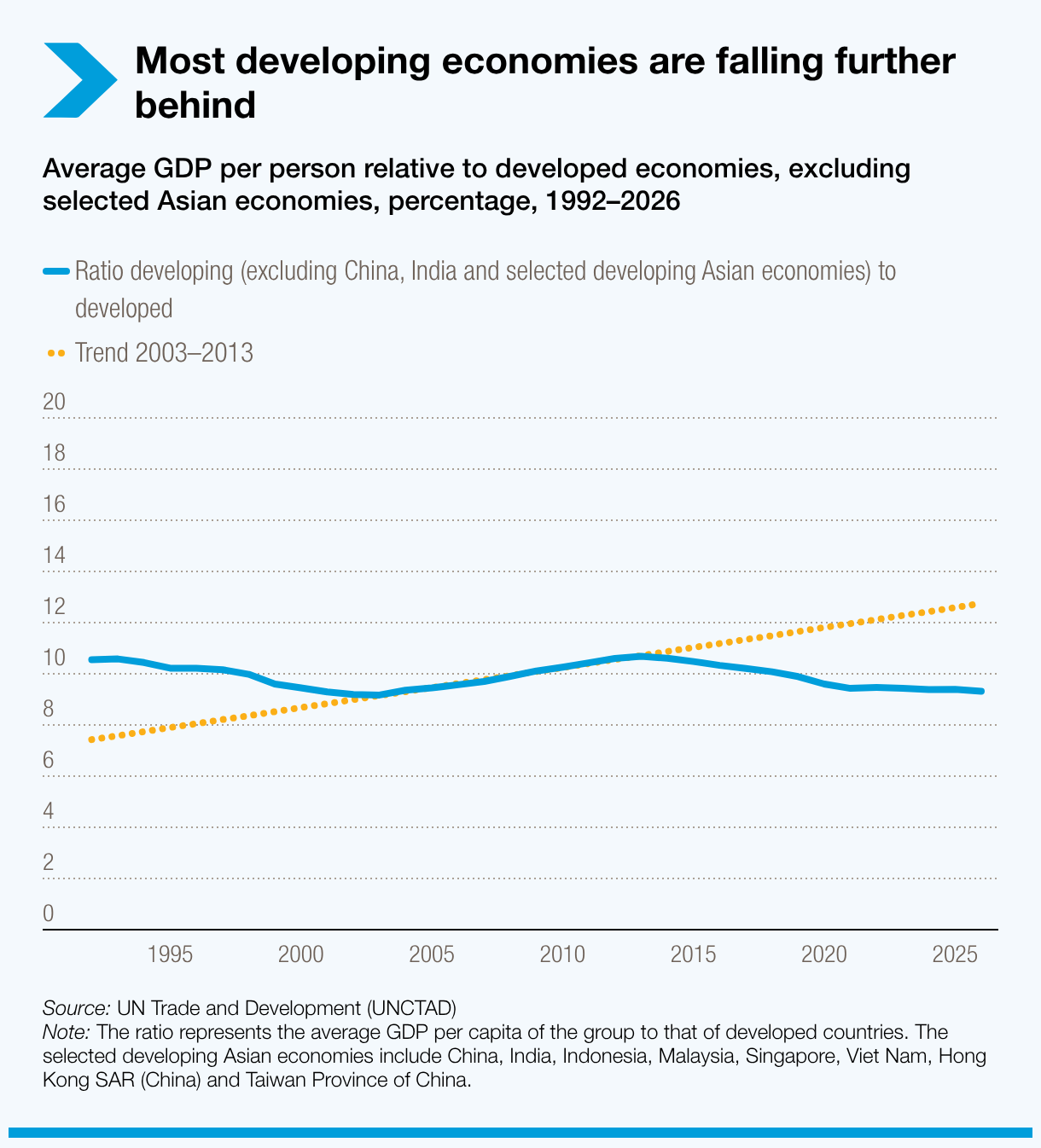
The Asian group’s average output per person has risen from about 4% of the average for developed economies in the early 1990s to a projected 18% in 2026. The remaining developing economies started higher, at about 10%, but have edged down to about 9%.
Even between 2003 and 2013, when both groups were narrowing the gap, the Asian group did so almost four times as fast. Since the mid-2010s, their paths have diverged further: the Asian group has continued gaining ground, while the rest has slipped back.
A harder route to prosperity
The report says that industrialization and exports have been important routes to development and helped Asian economies catch up. But traditional manufacturing, from textiles to consumer goods, no longer offers the same potential for progress.
Investment is increasingly directed towards industries requiring advanced technology, substantial finance and specialized skills. In 2025, strategic sectors including semiconductors, AI infrastructure and clean energy technologies accounted for 44% of the value of announced greenfield foreign investment – firms’ plans to establish new operations abroad – up from 16% in 2020.
Governments increasingly treat these industries as matters of national security. Export controls, investment screening and restrictions on technology can make it harder to enter and climb the value chains.
Europe and North America together attracted more than half of announced inward investment in strategic sectors in 2020–2025. Developing economies received the larger share only in critical minerals and strategic materials.
Where are firms planning to expand operations in the global South?
In the global South, Asia captured most greenfield foreign investment in strategic sectors: $561 billion between 2020 and 2025, compared with $126 billion for Latin America and $71 billion for Africa. Roughly three quarters of the developing-economy total went to Asia.
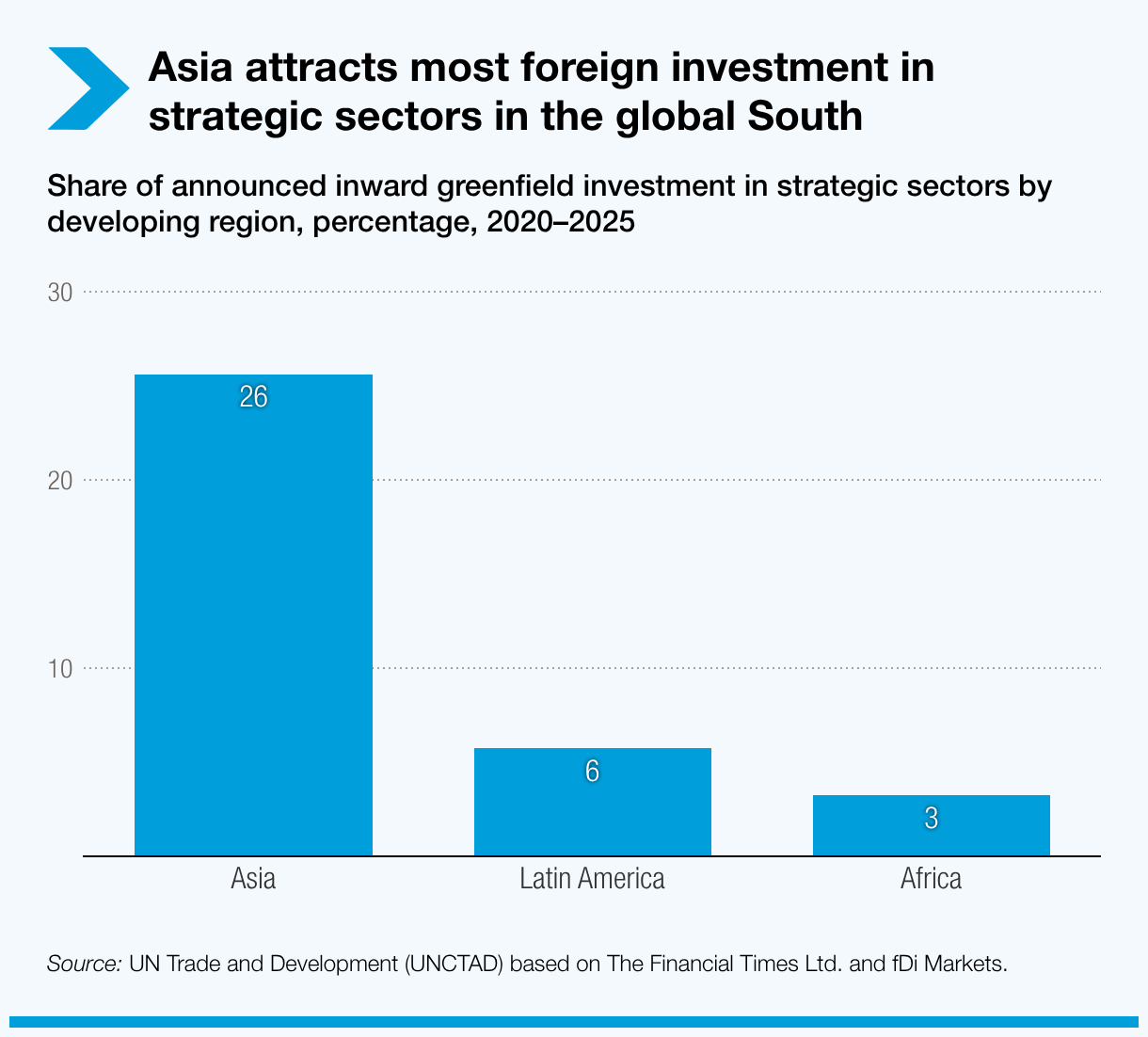
The mix differed too. Critical minerals and energy-transition sectors accounted for 54% of greenfield foreign investment in strategic sectors in both Africa and Latin America, compared with 38% in developing economies in Asia, where semiconductors alone accounted for 20%.
The report describes Asia’s portfolio as more diversified. It warns that concentration in minerals and energy in other regions risks reinforcing their commodity dependence.
Asia’s frontrunners are pulling ahead of most developing economies. For those hoping to follow, the route is becoming steeper. The report calls for stronger local suppliers and skills, supported by regional cooperation in markets, technology and finance.