



Asia continues to drive global growth, but the changing rules of trade, technology and industrialization are making its development model harder to replicate.

© Shutterstock/Azami Adiputera | A factory worker in Muadzam Shah, Malaysia.
Asia is expected to account for nearly 60% of global economic growth in 2026, underlining the region’s resilience as the world economy slows.
India’s economy is projected to grow by 7.3%, Indonesia’s by 5.2% and China’s by 4.5%, while global growth is forecast to ease to 2.6%, according to UNCTAD’s Trade and Development Report 2026.
While the region’s success offers broader development lessons, the conditions that enabled several Asian economies to industrialize, expand exports and raise living standards are changing.
What powered Asia’s rise “was less a transferable strategy than a rare alignment of scale, timing and accumulated capacity, sustained by long investment in the most contested sectors”, said UNCTAD Director Anastasia Nesvetailova, presenting the report at a lecture hosted by the London School of Economics and Political Science on 13 November.
“Such conditions are not widely shared, and the target is moving,” Ms Nesvetailova added, “as value creation shifts towards ever more technology- and infrastructure-intensive activities, the capabilities needed to catch up become more demanding.”
An increasingly challenging path to development
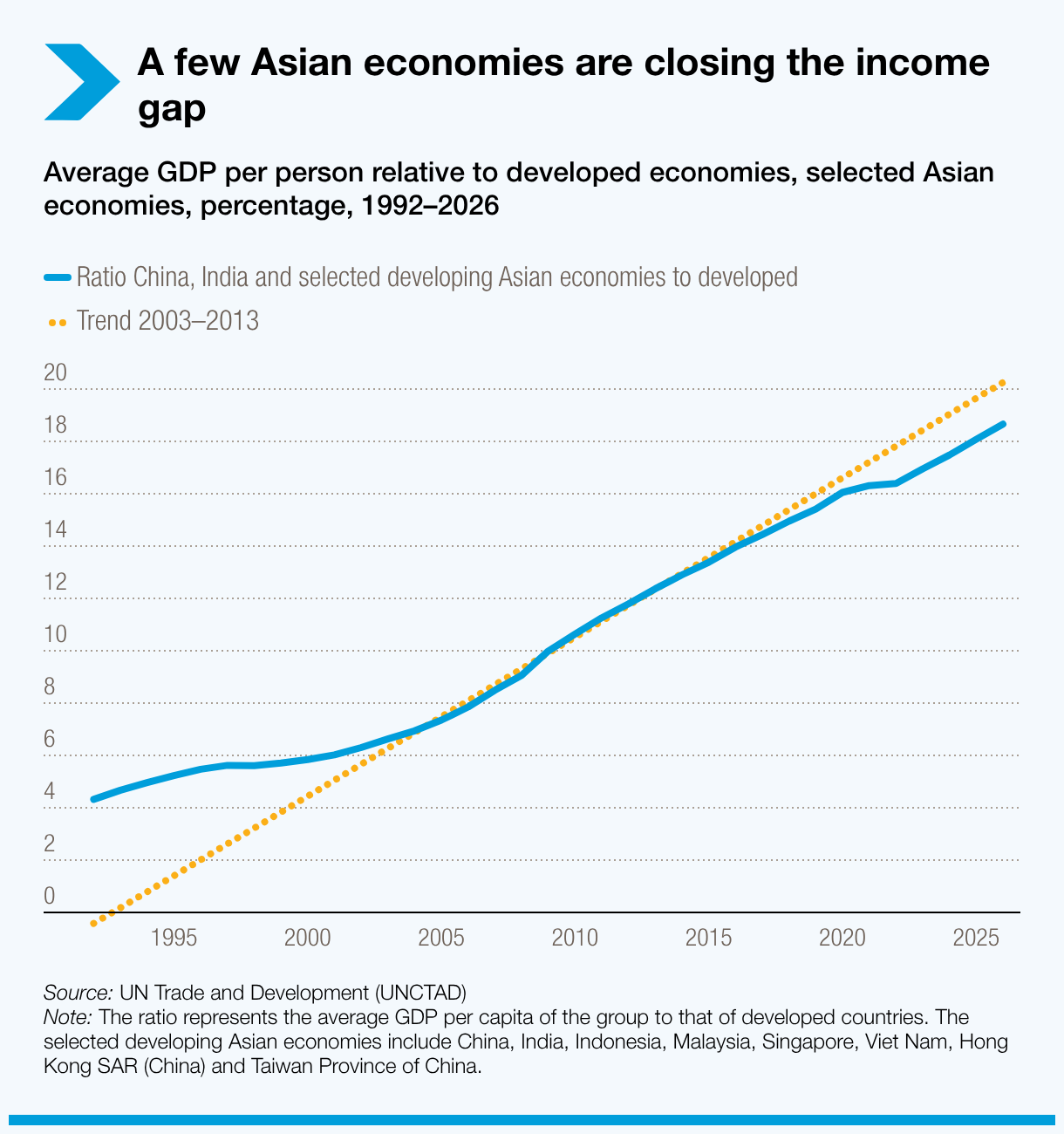
In the early 1990s, eight Asian economies had average output per capita below half that of other developing countries. By 2026, their average is projected to be roughly twice as high.
However, this progress has not been widely shared. Apart from a handful of Asian frontrunners, most developing economies have fallen further behind developed countries since the mid-2010s.
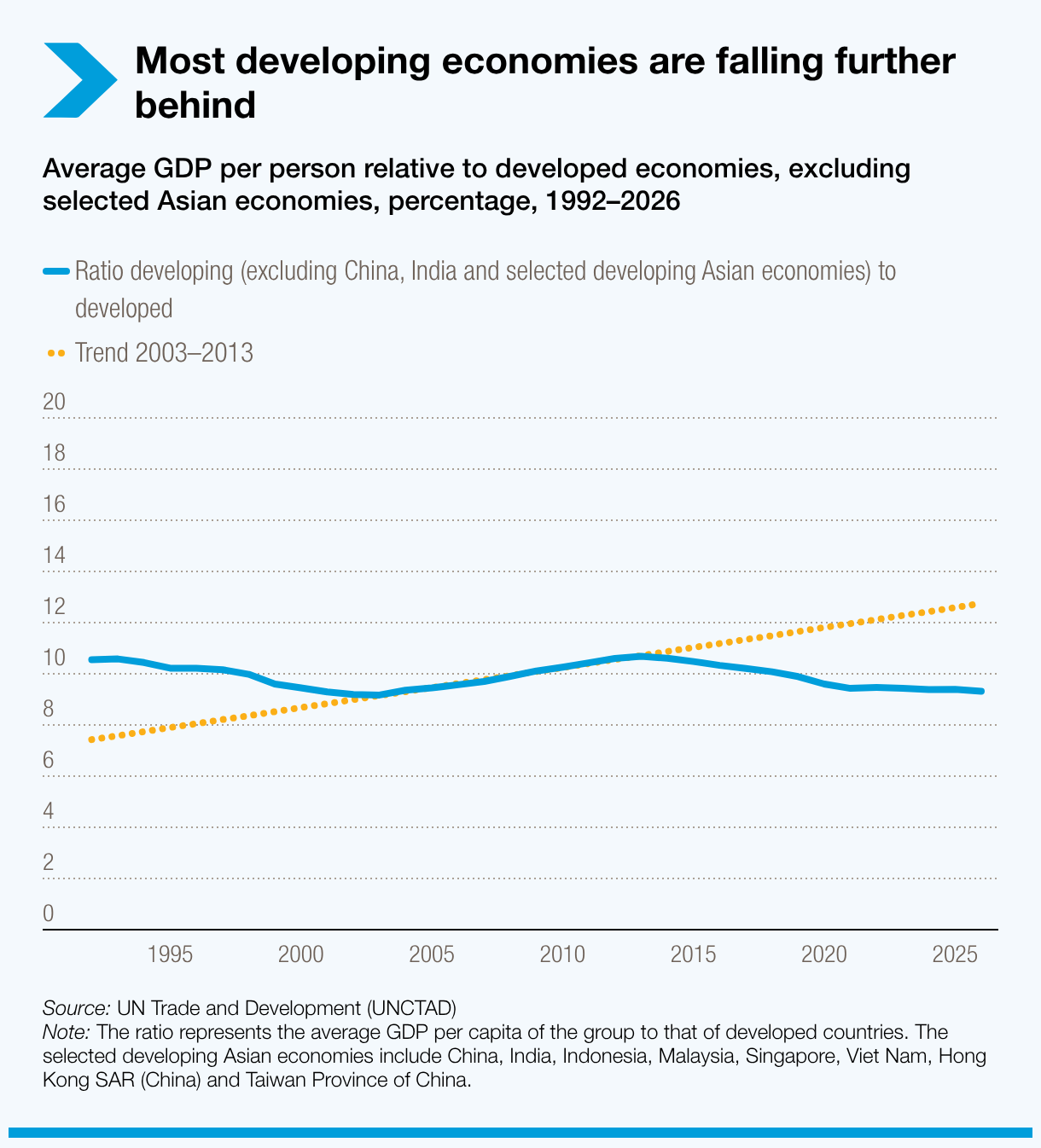
The traditional route to industrialization is also becoming harder to follow. Manufacturing industries such as textiles and consumer goods no longer offer the same opportunities for sustained growth and productivity gains.
Instead, investment is increasingly flowing into industries that require advanced technology, substantial finance and highly specialized skills.
Strategic industries, concentrated gains
Semiconductors, artificial intelligence infrastructure and clean energy technologies are becoming central to global trade and investment.
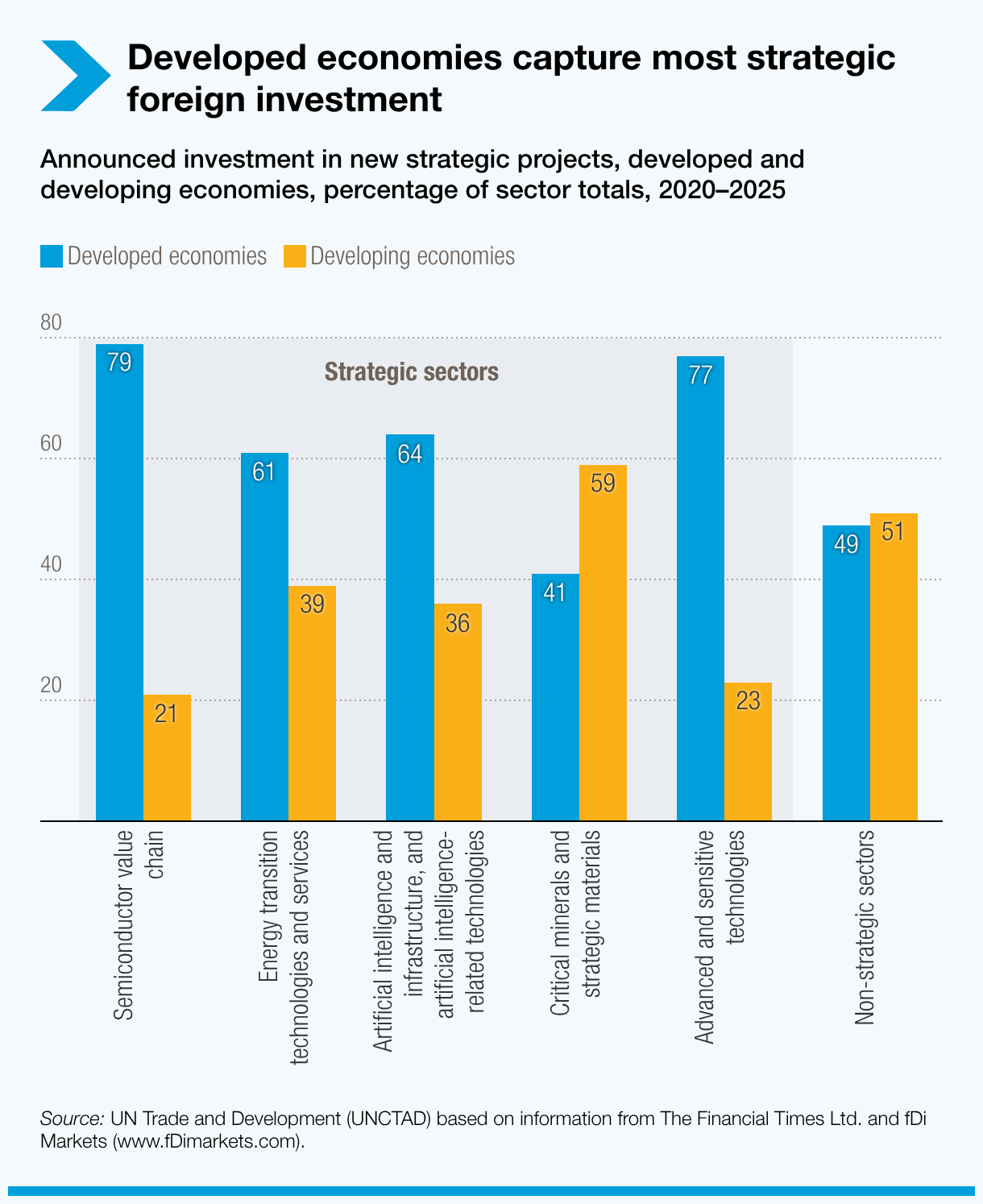
In 2025, these strategic sectors accounted for 44% of the value of announced greenfield foreign investment, up from 16% in 2020.
But the benefits are concentrated. Europe and North America attracted more than half of announced investment in strategic industries between 2020 and 2025. Developing economies secured the larger share only in critical and strategic materials.
Governments are also increasingly treating these industries as matters of national security. Export controls, investment screening and restrictions on technology transfer are changing who can access markets, attract investment and move up global value chains.
For developing countries, these barriers can make it harder not only to enter strategic industries but also to move into their higher-value activities.
Exports alone don't guarantee development gains
Malaysia illustrates how export-led catch-up strategies are being tested by technological and geoeconomic shifts.
Decades of investment and industrial planning have helped the country establish a major semiconductor industry, with electrical and electronic shipments accounting for 44.3% of its merchandise exports.
But the most valuable parts of the industry remain concentrated in established semiconductor powerhouses, limiting Malaysia’s ability to move up the value chain.
What needs to happen next
In a world economy increasingly shaped by technology and geopolitical competition, developing countries need more room to build, trade and grow.
To participate in and benefit from the industries of tomorrow, countries need to strengthen domestic productive capabilities while adapting industrial policies to a more competitive global environment.
This means investing in skills, infrastructure, technology and research, while building stronger links between domestic firms and international production networks.
The Trade and Development Report also underscores the importance of regional cooperation. Asia’s experience shows that sustained cooperation can support trade and investment even when global consensus is harder to achieve.
In this context, Asia’s experience remains relevant, but its success cannot simply be copied.