


Secretary-General Grynspan’s visit highlights the continent’s industrial potential, critical minerals opportunity and the need for sustained policy action.
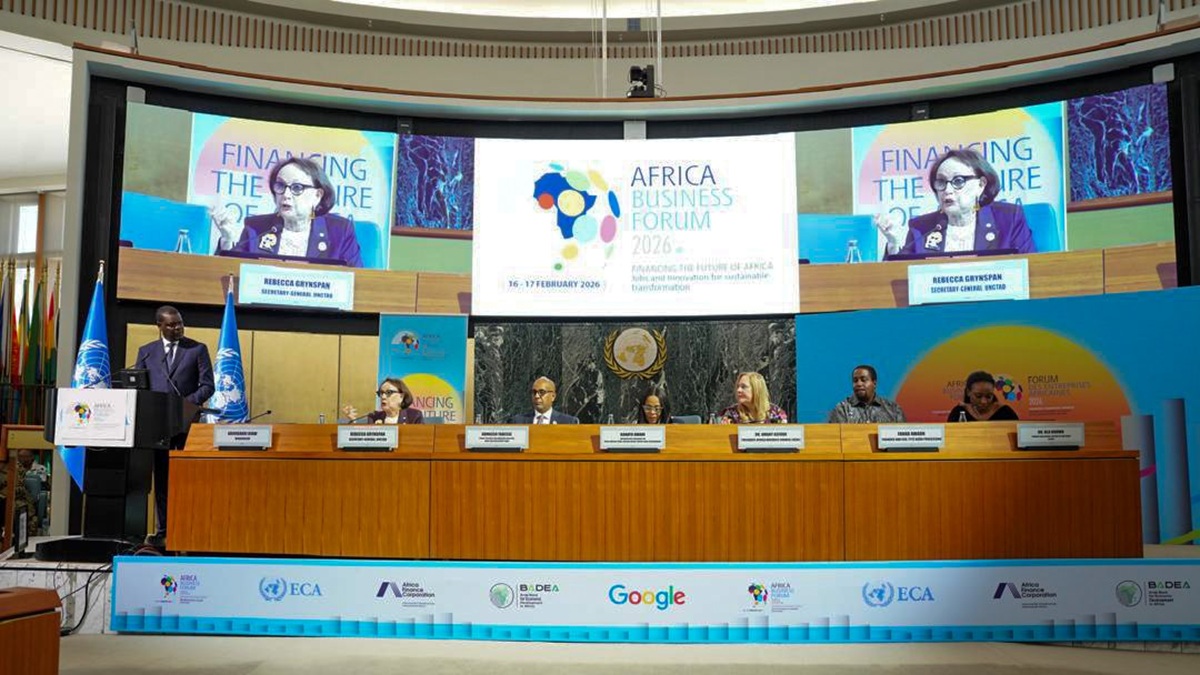
© Africa Business Forum 2026 | Secretary-General Grynspan (second from left and on-screen) speaks to the forum held on the sidelines of the 39th African Union Summit.
UN Trade and Development (UNCTAD) Secretary-General Rebeca Grynspan concluded a week-long mission to Africa, highlighting the continent’s strong economic prospects at a decisive moment for global trade and the energy transition – while underscoring the policy choices needed to translate potential into prosperity.
Bringing together participation in the African Union Summit with the launch of two country-level diversification assessments, the visit focused on one central question: how countries can change what they produce so that what they produce can change their economies.
Addis Ababa: Advancing economic sovereignty
In Addis Ababa, Ms. Grynspan took part in the African Union Summit and held bilateral meetings with Heads of State and senior officials. At a time of global economic uncertainty and geopolitical fragmentation, discussions underscored the importance of regional cooperation and collective action in advancing Africa’s development agenda.
At the Africa Business Forum, UNCTAD launched its Least Developed Countries Report 2025, examining how services can become a driver of structural transformation when supported by strategic investment in infrastructure and skills.
“It is not lost on me where I am standing,” Ms. Grynspan said, recalling the historic links between Africa’s liberation movements and UNCTAD’s founding mandate.
“Political independence without economic independence is incomplete.”
With 13 million young people entering labour markets across least developed countries each year through 2050, she stressed the urgency of expanding productive sectors that generate jobs at scale.
“Structural transformation,” she noted, “is the difference between exporting a raw diamond and cutting it.”
Lusaka: From minerals to manufacturing
In Lusaka, the Secretary-General launched UNCTAD’s Rapid Assessment of Value Addition and Diversification Capacity for Zambia, developed in partnership with, and funded by, the Government of Japan.
Zambia, one of the world’s largest copper producers, sits at the heart of the global energy transition. The assessment identifies over 400 products across 25 sectors into which the country can realistically diversify, including 73 linked to energy transition mineral value chains – representing at least $1.4 billion in potential export opportunities.
“The mineral is identical,” Ms. Grynspan said.
“What changes is the work that surrounds it.”
Moving from copper ore to higher-value products multiplies jobs, skills and local enterprise development across the economy.
She also met with Zambia’s President and Cabinet members, as well as development partners, to discuss trade diversification and debt management support, including through UNCTAD technical assistance.
Windhoek: Seizing the green transition
In Windhoek, Ms. Grynspan presented a similar Rapid Assessment tailored to Namibia’s diversification ambitions.
The study identifies 353 products across 23 sectors, including 60 linked directly to energy transition mineral value chains. A priority subset represents more than $800 million in market opportunities and the potential to generate around 26,000 jobs.
“Two-thirds of developing countries remain commodity-dependent,” she noted.
“The question is whether the energy transition repeats old patterns – or becomes the catalyst for structural change.”
A pivotal moment
Across the mission, Ms. Grynspan emphasized that Africa’s mineral wealth, demographic dynamism and institutional progress position it strongly for the future.
But realizing that promise requires deliberate industrial policies, investment in productive capacity and sustained cooperation at regional and international levels.
The visit reaffirmed UNCTAD’s commitment to supporting African countries with practical tools and evidence-based analysis to help turn opportunity into inclusive and sustainable development.