



New analysis shows how linking information governments already collect can reveal who benefits from services trade and help guide better policy.

© Shutterstock
Services are no longer a standalone sector. They are embedded across the economy, with finance, transport, logistics, telecommunications and professional services providing essential inputs for production and trade in almost every sector. This growing use of services across the economy is known as “servicification”.
Services account for around 30% to 35% of value added in industry and about 20% in agriculture, according to a new report, “Measuring servicification and impacts of services trade and policy”, by UN Trade and Development (UNCTAD).

The report, prepared with funding support from China, was launched in Beijing on 11 September at the 2026 China International Fair for Trade in Services, to which UNCTAD is a longstanding partner.
How services trade and policy affect development outcomes
World services exports reached $9.7 trillion in 2025, up 8.3% from the previous year and nearly double their level a decade earlier. Digitalization is accelerating this shift, with digitally deliverable services exports growing by 7% annually between 2015 and 2024.
The contribution of services varies widely. Services account for roughly one third of the intermediate inputs embodied in industrial exports from developed economies, compared with 27% in developing economies and just 13% in least developed countries for which data are available.
Understanding whether the growing role of services creates better jobs, raises productivity and supports economic diversification requires evidence that aggregate trade figures cannot provide.
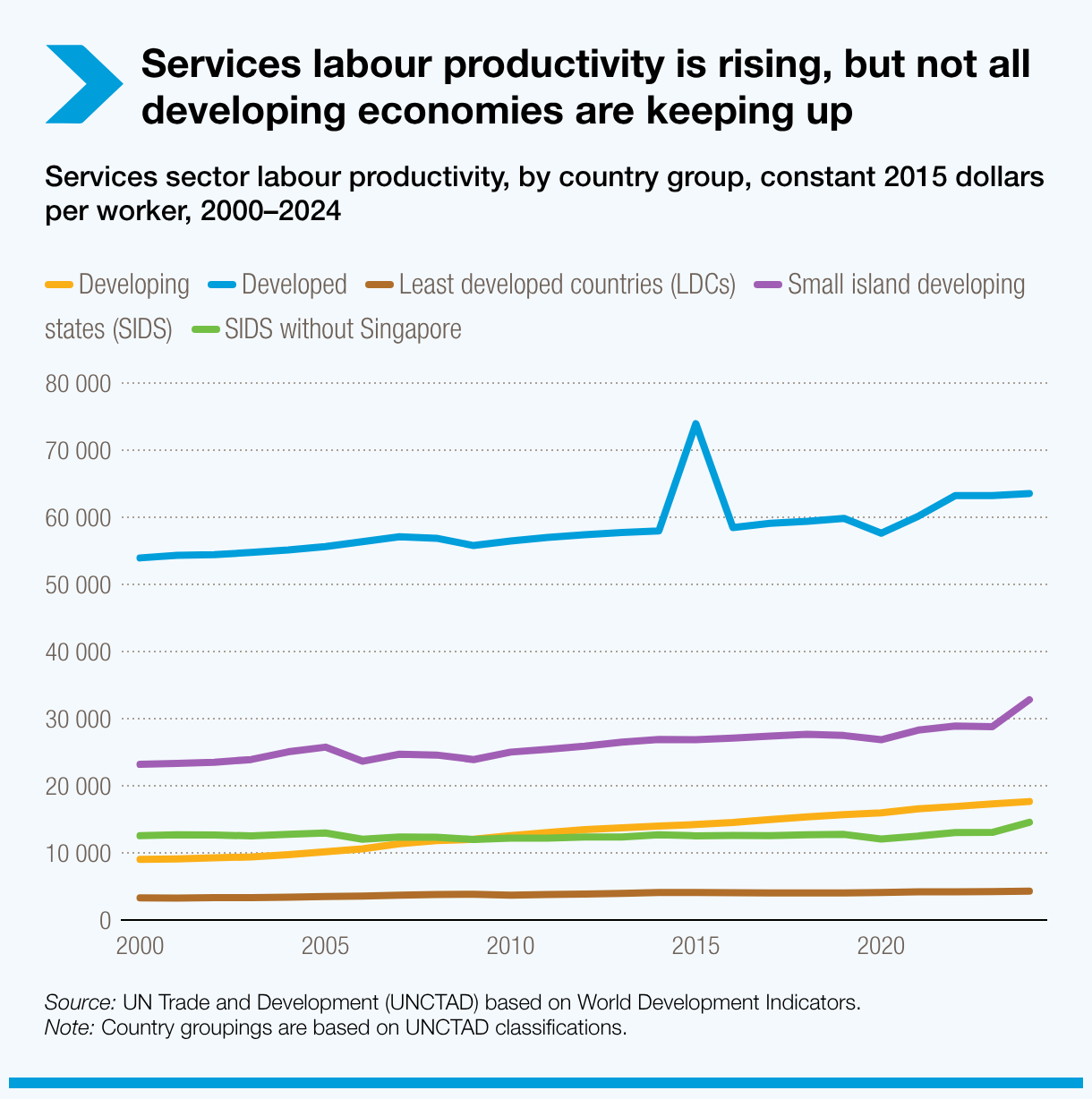
Despite progress, productivity gains in the services sector remain highly uneven across country groups, underscoring the need for more detailed evidence on what drives these differences.
Existing data already hold some answers
Countries often already collect much of the information needed to measure servicification and assess the impact of services trade and related policies.
Linked data from Ecuador showed that firms entering digital services export markets increased employment by around 21%. In Uruguay, linked data showed that domestic firms supplying inputs to beef producers that export to China experienced significant sales growth.
“Without better data, it is difficult to assess how servicification contributes to productivity, diversification and inclusive participation in trade, or to identify which policies are most effective or which sectors are most valuable,” said Ambassador Richard Brown, Jamaica’s Permanent Representative to the UN Office and other International Organizations in Geneva.
“Multilateral discussions should therefore give greater priority to improving statistical capacity and data collection as a foundation for informed policy making and negotiations. In this regard, UNCTAD’s new report is a useful start to strengthening the capabilities of countries to develop policies based on available data and evidence,” the ambassador added.
Connect data, strengthen policy
The UNCTAD report recommends that countries work towards disaggregated services trade data by trading partner, category and mode of supply, while reviewing the national data already held across government.
Linking tax, customs, business and employment data through common identifiers, with appropriate anonymization and confidentiality safeguards, can provide secure access to detailed evidence for policy analysis.
Development partners can provide financing, digital tools and expertise to help national statistical offices collect and link services data.
Sharing best practices, strengthening data access and confidentiality guidelines, and promoting South-South exchanges can also help countries overcome data and systems compatibility challenges.
“UNCTAD’s new report provides practical tools to make better use of data. This is key to identify opportunities for trade partnerships,” said Ambassador Luigi Maria Vignali, Permanent Representative of Italy to the United Nations Office and other International Organizations in Geneva.
“Trade in services can provide the inputs that can transform economies. This will be precisely at the heart of the discussions at the upcoming WTO Public Forum session ‘Services trade for development partnerships: Italy and Africa’, organized by Italy and UNCTAD on 16 September 2026,” the ambassador concluded.