Key points
- Inflows rebounded but remained concentrated: Foreign direct investment to the region rose from $4.5 billion in 2024 to $27.2 billion in 2025. Approximately 93% went to the Russian Federation.
- Fewer projects attracted more announced investment: Announced investment in new projects rose 12% to $25.9 billion in 2025, while project numbers fell from 122 to 80.
- Investment policies diverged: From 2016 to 2025, 63% of measures were restrictive in Belarus and the Russian Federation. In Armenia, Kazakhstan and Kyrgyzstan, 69% were favourable.
- Older treaties dominate: Pre-2010 treaties represent 79% of the network. Approximately 97% of investor–State arbitration cases against member states relied on pre-2010 treaties.
- Industrial cooperation expanded: Deliveries under industrial cooperation among member states more than doubled from $13.7 billion in 2016 to $31.1 billion in 2023.
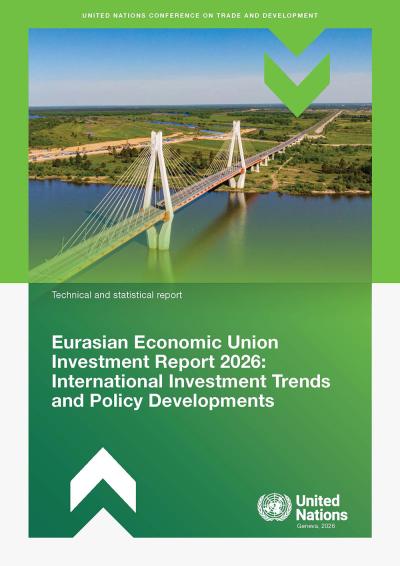
Investment in the Eurasian Economic Union rebounded in 2025, but the recovery remained concentrated in a few countries, investors, sectors and large projects. The report examines how member States can turn this renewed momentum into broader investment that strengthens productive capacity across the Union.
The union’s combination of higher investment values and fewer announced projects mirrors a global trend. Worldwide, foreign direct investment increased 6% in 2025, while new project announcements fell 10% by number and international project finance deals declined 11%.
The rebound remains uneven
Inflows to the Russian Federation rose, but the value of new project announcements fell 83% to $250 million. The report suggests the increase likely reflected reinvested earnings, corporate restructuring and other financial movements, rather than new projects.
Kazakhstan recorded negative net inflows of $860 million but led new-project announcements. Negative flows can reflect repayments or divestments alongside new projects. A durable recovery requires investment across more member states and sources.
Larger projects require follow-through
Greenfield investment – announced projects for new facilities or operations – increased in value despite fewer projects. Kazakhstan accounted for approximately $24 billion, and China was the largest source, with $16 billion.
Metals attracted approximately $12.5 billion, up from $2.3 billion in 2024. Domestic processing, suppliers and skills can broaden project benefits. Larger projects require implementation follow-up.
Project finance recovered only partially, rising 81% to $8.6 billion through 11 deals, below $63.7 billion in 2021.
Clearer policies and modern treaties can support investment
The union recorded 43 measures from 2016 to 2025. Most were restrictive in Belarus and the Russian Federation, favourable elsewhere in the union. The comparison excludes sanctions and counter-sanctions. Kazakhstan’s one-stop shop and digital platform illustrate efforts to simplify procedures. Coordinated investor services could improve conditions.
Member states have 242 investment agreements in force, many of them signed before 2010. Negotiating new agreements alone isn’t enough. Existing treaties also need reform. The report calls for clearer rules, stronger safeguards and improved ways to resolve disputes.
Regional cooperation can spread the benefits
Manufacturing output rose 35.6% from 2016 to 2023, according to Eurasian Economic Commission data cited in the report. Regional production networks can help broaden investment’s benefits.
The union’s share of global foreign direct investment remains small, but 2025 brought renewed momentum. The report advocates building on it through focused investment strategies and regional cooperation.