


At the end of the 1960s, countries gathered at UNCTAD to discuss how developing countries could increase their export revenues and industrialize more quickly.
The outcome was a commitment by developed economies to grant reductions – and in some cases total elimination – of tariffs on products made in the developing world under what is to be known as the “Generalized Systems of Preferences (GSP)”. Since then, the GSP has represented the basis for various forms of non-reciprocal trade preferences (NRTPs).
Today, preference-granting markets continue to represent the principal destinations for exports originating from least developed countries (LDCs). In 2024, approximately 70% of total LDC exports were directed to the 25 economies that currently provide some form of preferential access.
While NRTPs have been particularly beneficial for LDCs, the effectiveness of these schemes depends critically on their design, renewal and sequencing.
UNCTAD’s Trade Preferences Outlook 2025 warns that the loss of such preferential conditions due to suspension, expiration or graduation represents a substantial threat to achieving development goals in LDCs, especially for those exporting manufactured goods, while presenting avenues for modernization.
Suspensions: the cost of unpredictability
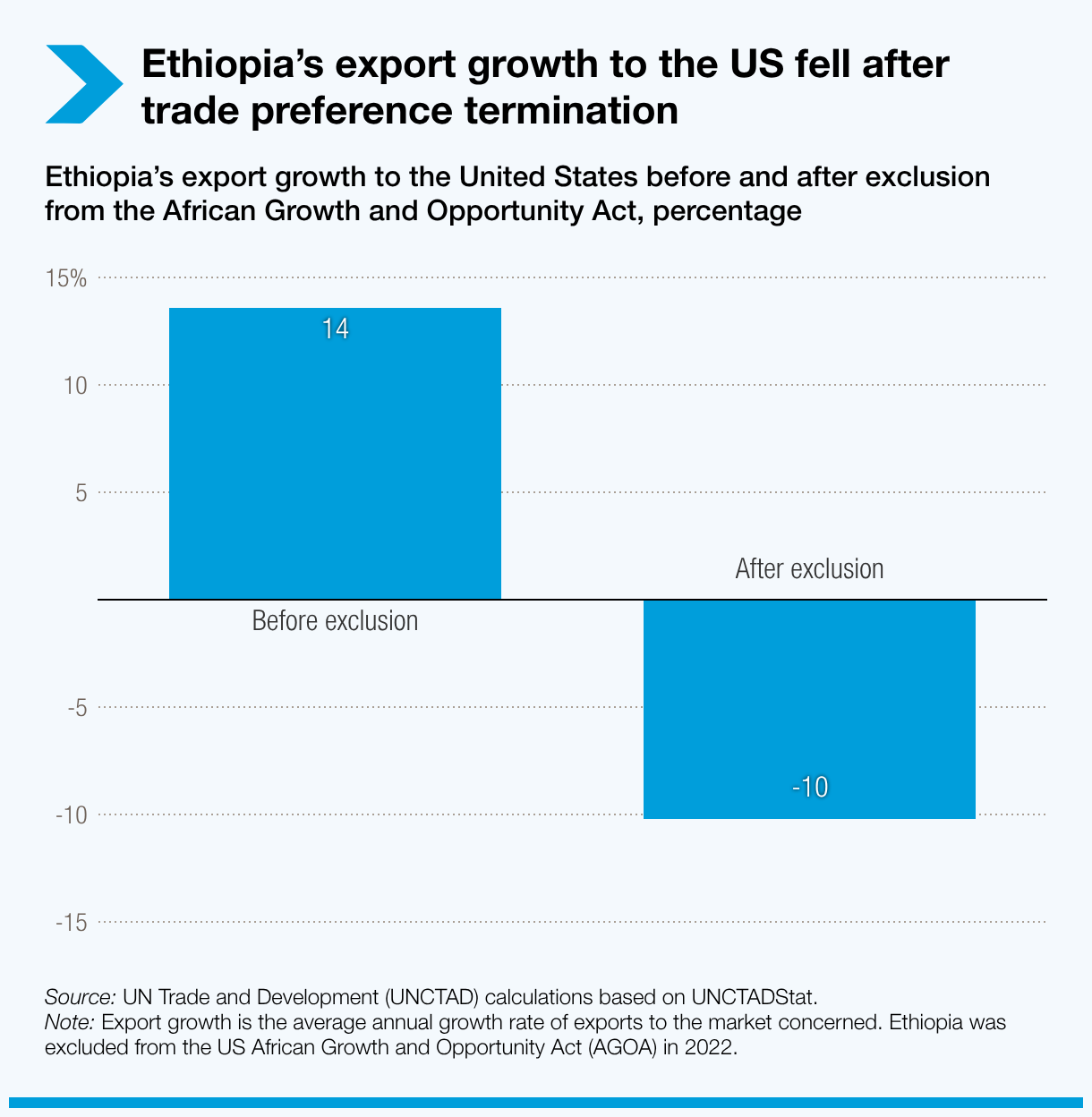
The removal of Ethiopia from the African Growth and Opportunity Act (AGOA) in 2022 illustrates the consequences of abrupt suspension. Following its exclusion, Ethiopia’s export growth to the United States shifted from +13.6% annually to -10.2%. The shock led to over 1,000 layoffs in garment factories within one year, the departure of 18 foreign companies between 2022 and 2025 and a $1 billion reduction in foreign direct investment inflows.
Expiration: why renewal matters
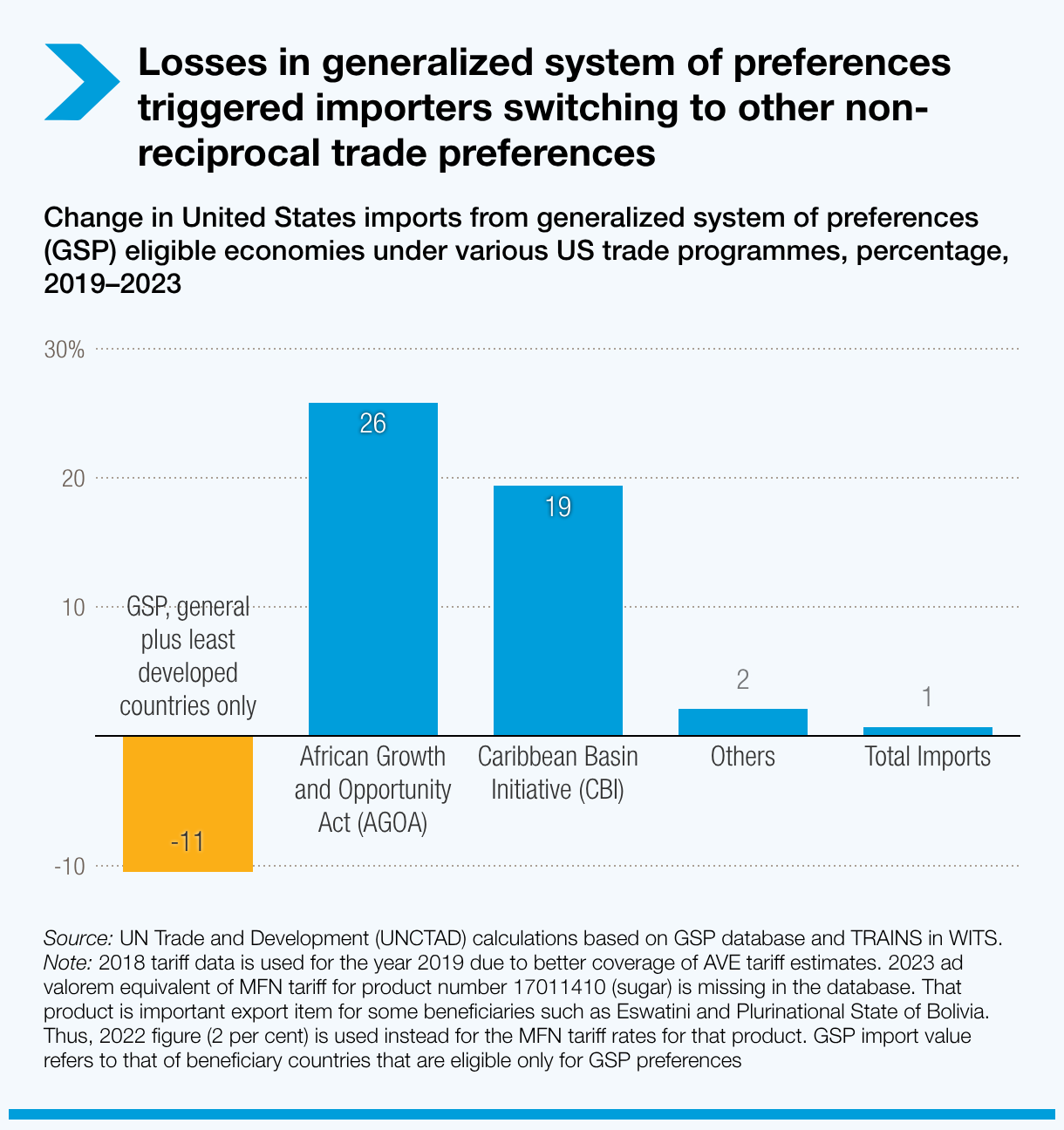
The expiration of the United States’ Generalized System of Preferences (GSP) in 2020 demonstrates how lapses can disrupt trade flows. US imports from eligible countries without access to alternative preferential schemes declined by 10.5%.
By contrast, countries that could switch to other arrangements such as AGOA or the Caribbean Basin Initiative were able to mitigate the shock. This contrast underscores that overlapping, well-sequenced frameworks can preserve continuity and cushion adjustment. Gaps in coverage, by contrast, erode the development gains that preferences are meant to generate.
Graduation: managing success to preserve development gains
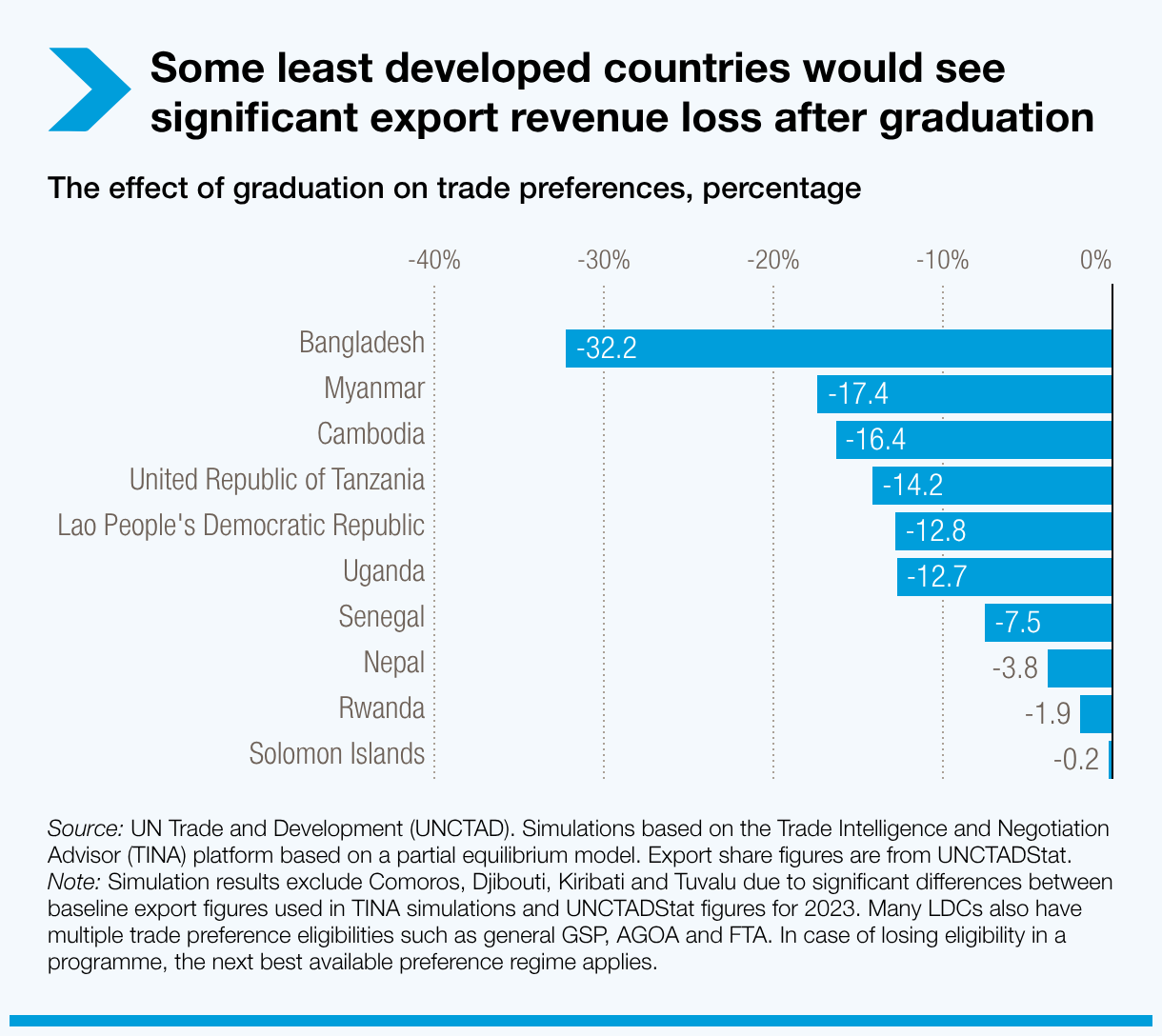
Losing trade preferences due to graduation could reduce total exports by 32% for Bangladesh, 17% for Myanmar and 16% for Cambodia. These projected declines highlight the need for smoother transition mechanisms, extended phase-out periods and pathways into alternative schemes.
Modernizing trade preferences for greater development impact
The evidence points to a clear conclusion: non-reciprocal trade preferences can reinforce industrialization, employment and poverty reduction when they are predictable, transparently administered and supported by clear renewal and transition mechanisms. Conversely, when they are abruptly suspended, allowed to lapse or withdrawn without supportive transition mechanisms, the economic costs are significant – in lost exports, investment and jobs.
Modernizing NRTPs therefore means strengthening their reliability, ensuring timely renewal, building in better transition frameworks for graduating countries and aligning them with long-term development strategies of the programme beneficiaries.
As policies are discussed, while UNCTAD’s Special Committee on Preferences is not operational anymore, UNCTAD continues to provide a forum for dialogue today. Building on this legacy, such platforms could support the co-design of modernized NRTP schemes, fostering experience-sharing and monitoring progress.