Key points
- Cambodia has met the criteria for graduation from least developed country status, but structural vulnerabilities will continue beyond graduation.
- Strong growth has relied heavily on exports, trade preferences and foreign investment, making deeper structural transformation essential.
- The country’s export basket remains concentrated, with garments, footwear, travel goods, handbags and related products still accounting for 53% of merchandise exports in 2019–2022.
- Long-term resilience will depend on stronger skills, productive capacity and finance, including better links between education, industry, local firms and foreign investment.
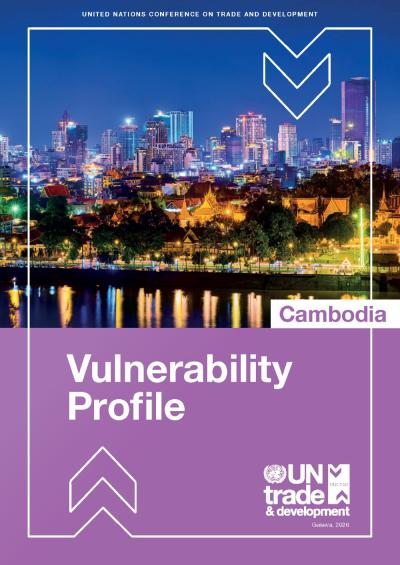
The report examines Cambodia’s main vulnerabilities as the country prepares to graduate from least developed country status.
At the 2024 Triennial Review of the Committee for Development Policy, Cambodia was recommended for graduation.
- Its gross national income per capita stood at $1,590, above the $1,306 graduation threshold.
- Its Human Assets Index score was 77.8, above the threshold of 66.
- Its Economic and Environmental Vulnerability Index score was 24.1, below the threshold of 32.
But graduation does not remove the structural weaknesses that affect long-term development. Cambodia’s challenge is to build momentum beyond graduation.
Strong growth still rests on a narrow base
Cambodia has recorded strong economic progress since the mid-1990s. Annual average real gross domestic product growth reached 7.19% from 1995 to 2023. Real gross domestic product per capita growth averaged 5.54% over the same period.
Exports, trade preferences and foreign direct investment have supported this growth. The report says Cambodia’s development model has largely targeted export growth, with high use of trade preferences and efforts to attract foreign investment through incentives.
The lesson is clear: Cambodia needs deeper structural transformation. This means stronger productive capacities, better human resources and closer links between foreign investment, local firms and industrial policy.
Productive capacities are the skills, infrastructure, institutions, technology and finance that help a country produce goods and services, create jobs and move into higher-value economic activities.
Trade openness has not ended export concentration
Cambodia is deeply tied to international trade. In 2022, its trade-to-GDP ratio stood at 194.25%. Exports of goods and services reached $27.8 billion, while imports stood at $34.4 billion.
The export basket has become more diverse over time. But garments, footwear, travel goods, handbags and related products still accounted for 53% of merchandise exports in 2019–2022.
The report says textiles and apparel still drive Cambodia’s current export growth. These products have lower economic complexity and limited benefits for structural transformation. It identifies potential to diversify into more sophisticated nearby products, especially in machinery, electronics and chemicals, including plastics.
Skills gaps could slow the next phase
Cambodia has made major social gains:
- The poverty rate fell from 33.8% in 2009 to 17.8% in 2019/2020.
- Household access to electricity rose from 26% to 86% between 2009 and 2019.
- Access to improved sanitation increased from 35% to 83%.
But human capital remains a major constraint. Cambodia faces shortages of skilled workers, even in low- and medium-skill industries. In a survey of 400 registered small and medium-sized enterprises, only 12% reported having enough skilled workers to meet their needs.
The response must link skills policy more closely to industrial goals. The report points to the need for clearer skills priorities, updated curricula, stronger technical and vocational education and training, and better links between education, enterprises and industrial policy.
Finance must support a more resilient economy
Cambodia has strengthened domestic resource mobilization. Total tax revenue rose from about 7% of gross domestic product in 2000 to 20% in 2019. It then dipped to 17.9% in 2020 because of the COVID-19 pandemic.
But the report says Cambodia anticipates an imminent fall in concessional development finance. This is because it has reached lower-middle-income status and is graduating from least developed country status.
To mobilize more resources, the report calls for a review of activities exempted from taxation, a rationalization of investment incentives, a review of bilateral tax treaties where appropriate and stronger use of the domestic financial sector to finance development, green growth and the low-carbon transition.
Cambodia must build economic resilience to sustain development gains beyond graduation
Cambodia has met the criteria for graduation and built a strong record of growth, poverty reduction and social progress.
The report’s central message is clear. Development progress will be more sustainable if Cambodia uses this transition to diversify its economy, strengthen skills, improve local productive capacity and mobilize finance for long-term resilience.