
Key points
- Senegal met two of the three criteria for graduation from the least developed country category in 2024. It did so for income and the Human Assets Index but not for economic and environmental vulnerability.
- The economy has grown significantly but structural transformation has not kept pace. Services account for more than 57% of GDP, while manufacturing remains at 16%, roughly the same share as in the 1970s.
- Trade is expanding but remains imbalanced. Exports of goods and services reached $7.5 billion in 2022, compared with $14.6 billion in imports, contributing to a trade deficit of over 10% of GDP.
- Poverty and other social challenges remain significant. Around 50.8% of the population lived in multidimensional poverty in 2019, with large gaps between urban and rural areas.
- Climate and environmental risks remain major vulnerabilities. About 91% of the population lives in arid zones, while floods and droughts continue to affect development prospects.
The report assesses Senegal's progress towards graduation from the category of least developed countries. It also examines the structural vulnerabilities that could affect the country’s long-term development.
Senegal has made notable gains in income, human capital and economic growth. Meanwhile, low productivity, weak trade competitiveness, geographic inequalities and exposure to climate risks continue to constrain sustainable development prospects.
Growth has accelerated, but the economy needs deeper transformation
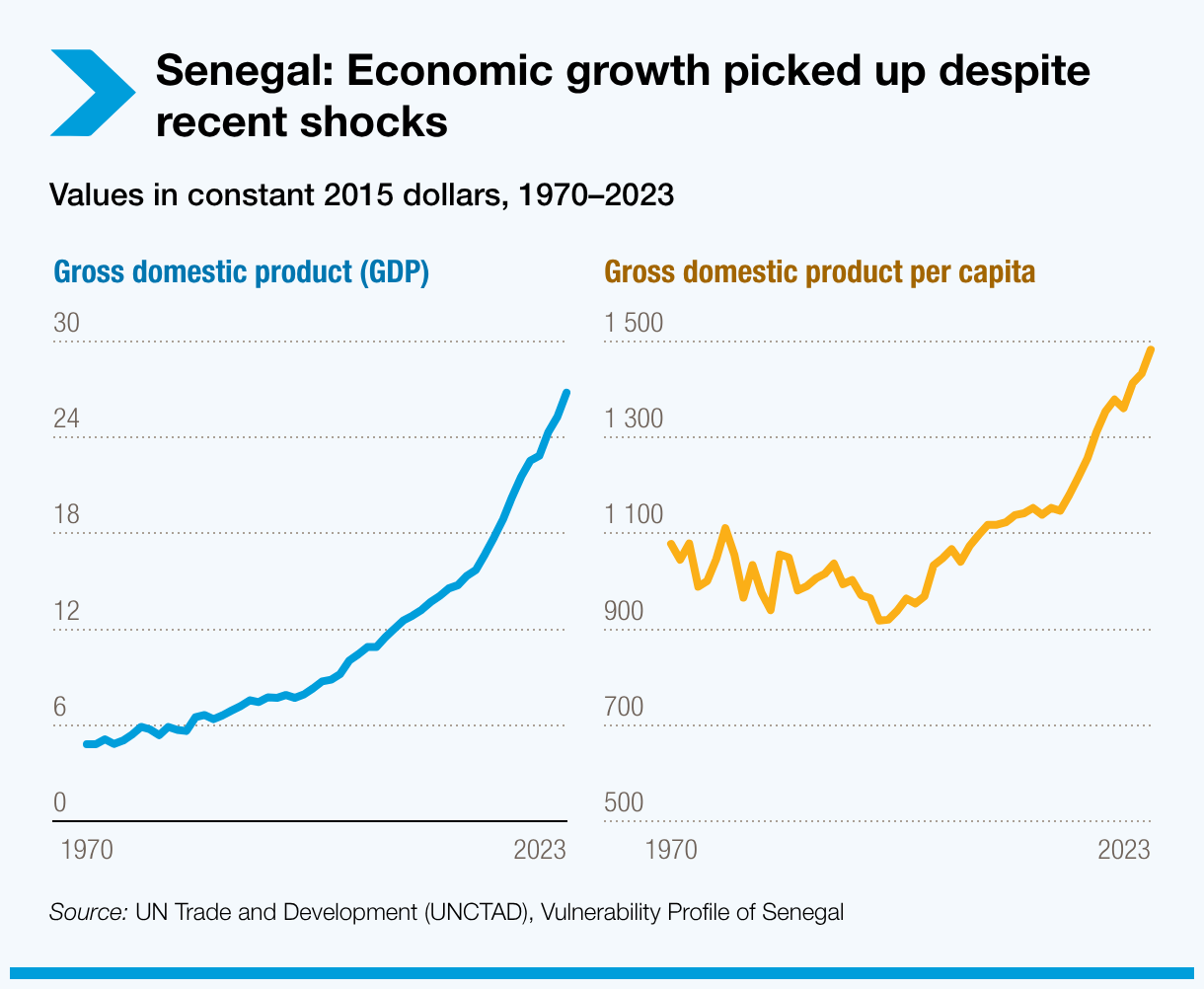
Senegal has recorded sustained economic progress over recent decades. In 2022, GDP reached $27.8 billion and GDP per capita stood at $1,604. Real GDP grew by an average of 4.3% a year between 2017 and 2022.
However, the structure of the economy has changed only gradually. Services generate more than half of economic output, while agriculture and industry continue to face productivity constraints. Employment also remains concentrated in low-productivity activities. The informal economy accounts for 45.8% of GDP and around 90% of employment. In this context, expected growth in fossil fuel production could boost growth and exports but may also reinforce Senegal’s commodity dependence, unless revenues are effectively channelled into economic diversification.
The report recommends accelerating structural transformation – the shift towards more productive and higher-value activities. This will require strengthening productive capacities, enhancing competitiveness and supporting higher-value, non- traditional sectors.
Trade offers growing opportunities, but more diversification and value addition are needed
Senegal is a small, open economy with a trade-to-GDP ratio of 79.9%. Yet imports of goods and services ($14.6 billion) were almost double exports ($7.5 billion) in 2022.
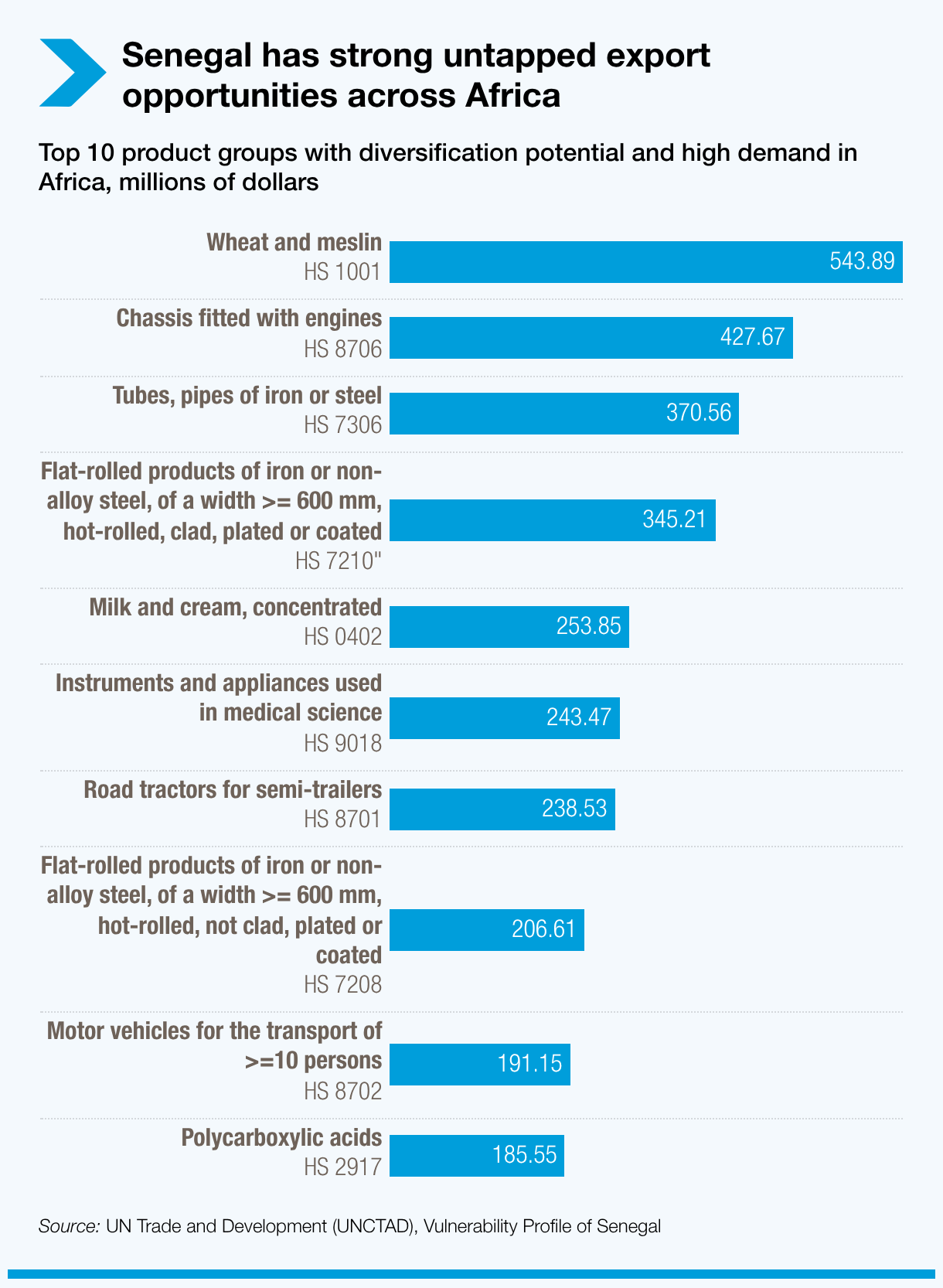
Export diversification has improved, with 2,531 active export product lines recorded in 2019. Nevertheless, around 75% of merchandise exports still consist of primary commodities, often exported with limited value added in Senegal.
The report identifies opportunities to expand manufacturing and agro-processing exports. Regional markets could also play a pivotal role in supporting economic diversification and transformation.
These markets include the African Continental Free Trade Area, the West African Economic and Monetary Union and the Economic Community of West African States.
Human development has improved, but poverty and geographic inequalities persist
In 2024, Senegal recorded a Human Assets Index score of 66.7, slightly above the graduation threshold of 66. Over the past two decades, health indicators have also improved steadily, including significant reductions in child and maternal mortality.
Yet development challenges remain substantial. In 2019, 50.8% of the population lived in multidimensional poverty, meaning they faced several overlapping forms of deprivation. Sharp disparities exist between rural areas and peripheral regions and Dakar.
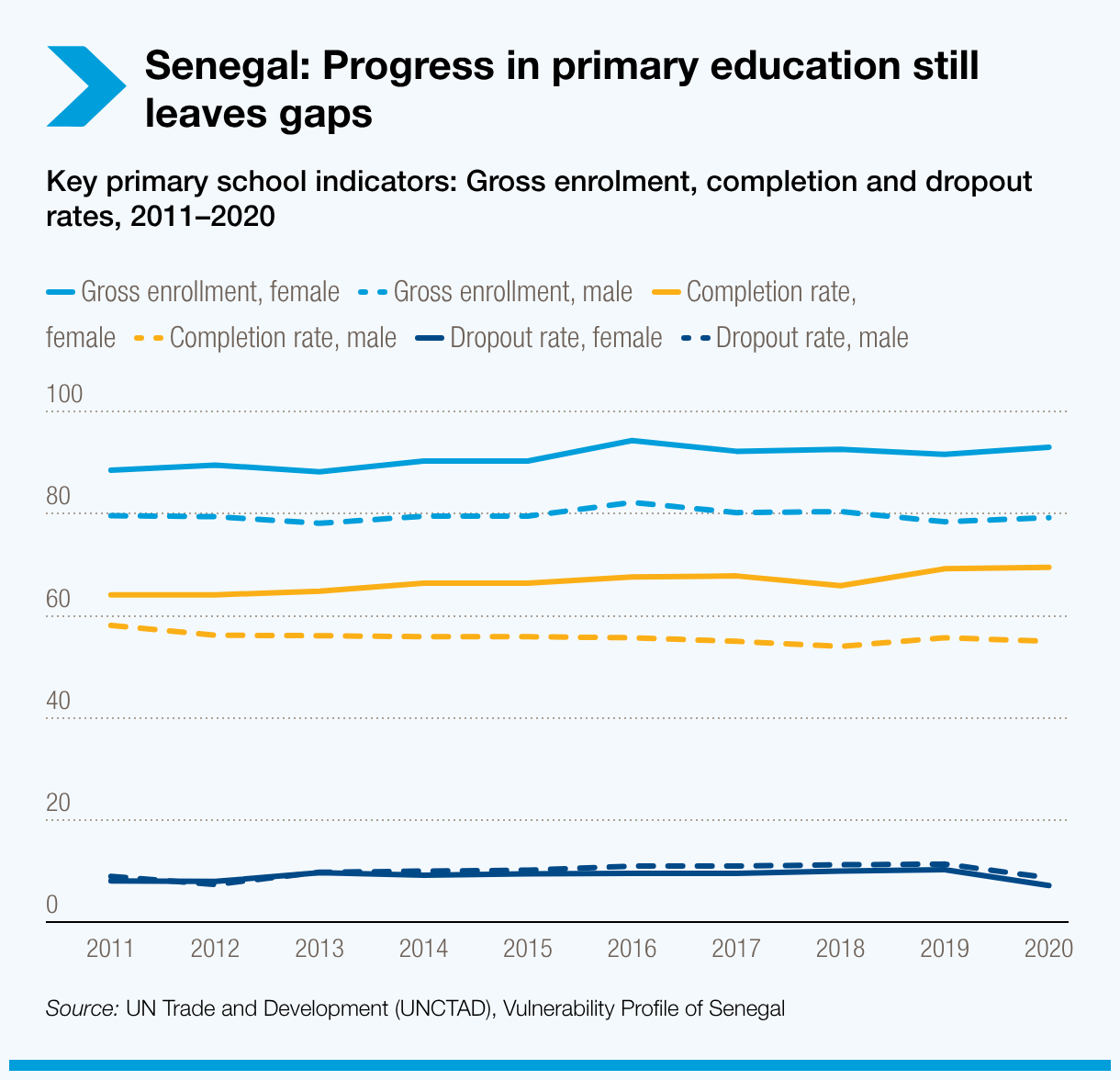
Adult literacy stood at 51.8%. Although educational outcomes have improved, progress remains uneven.
The report calls for greater investment in human capital, education, skills development and productive employment, especially for young people and women.
Climate risks increasingly threaten development gains
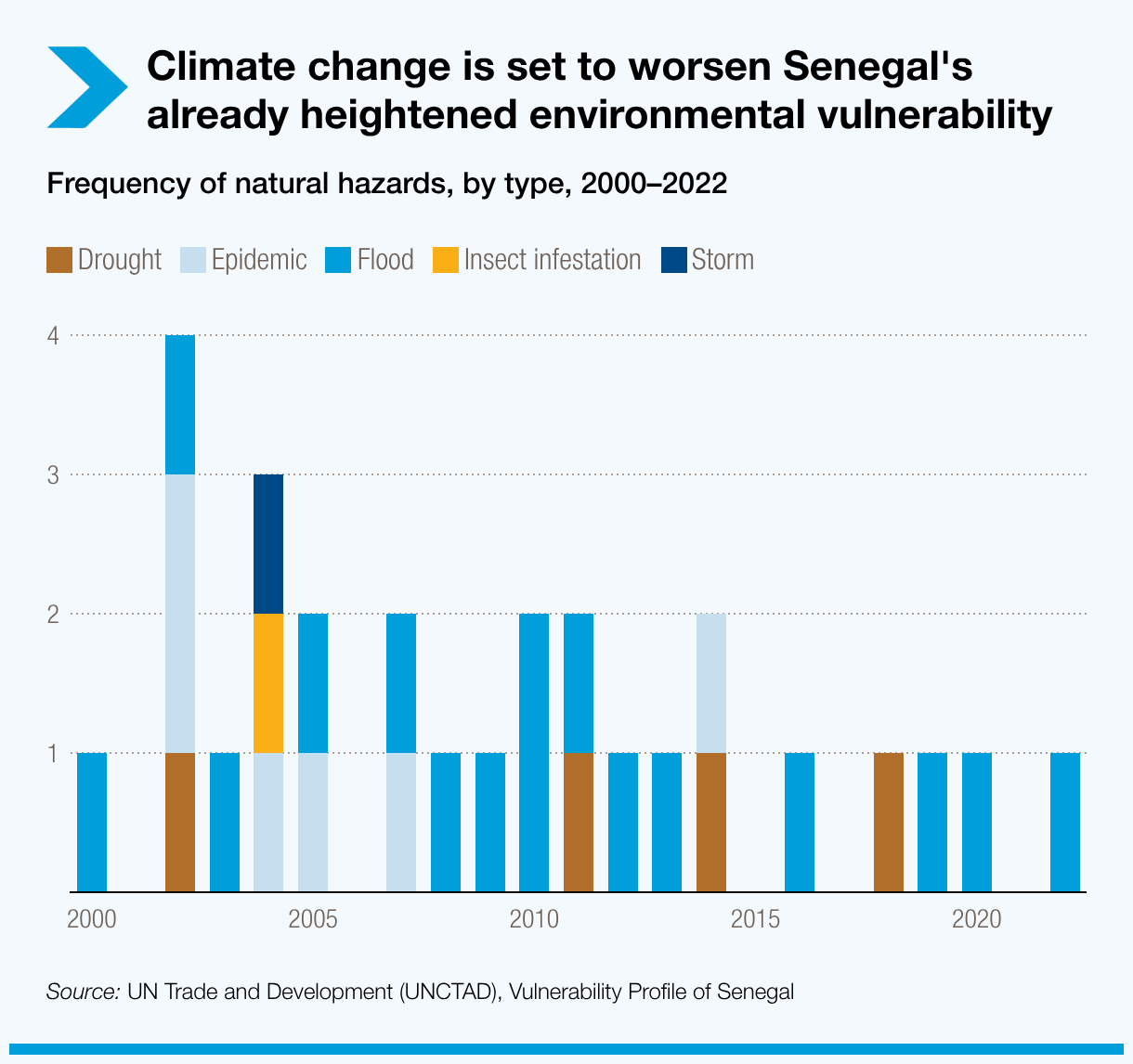
Environmental vulnerability remains a major concern. About 91% of the population lives in arid areas, while 7% lives in low-lying coastal zones exposed to climate-related risks.
The report records 28 natural disasters between 2000 and 2022, including 16 floods and four droughts. Rising temperatures and increasing climate pressures could place additional strain on livelihoods, infrastructure and food systems. These pressures could also drive internal migration towards already congested urban areas.
The report recommends an inclusive transition to a low-carbon economy, greater investment in resilience and stronger preparation for climate-related shocks.
Preparing for a successful graduation
Senegal has made significant progress, as reflected in its fulfilment of the income and human assets criteria for graduation from the LDC category. Yet important structural vulnerabilities persist.
Sustaining momentum towards graduation and beyond will require greater economic diversification, more higher-quality jobs and stronger climate resilience. Senegal will also need to mobilize development finance more effectively to support investment in productive capacities while preserving stable economic fundamentals.