

Acting Secretary-General Moreno calls for the global energy transition to become a driver of sustainable development for mineral-rich developing countries, avoiding a repetition of past extractive models.
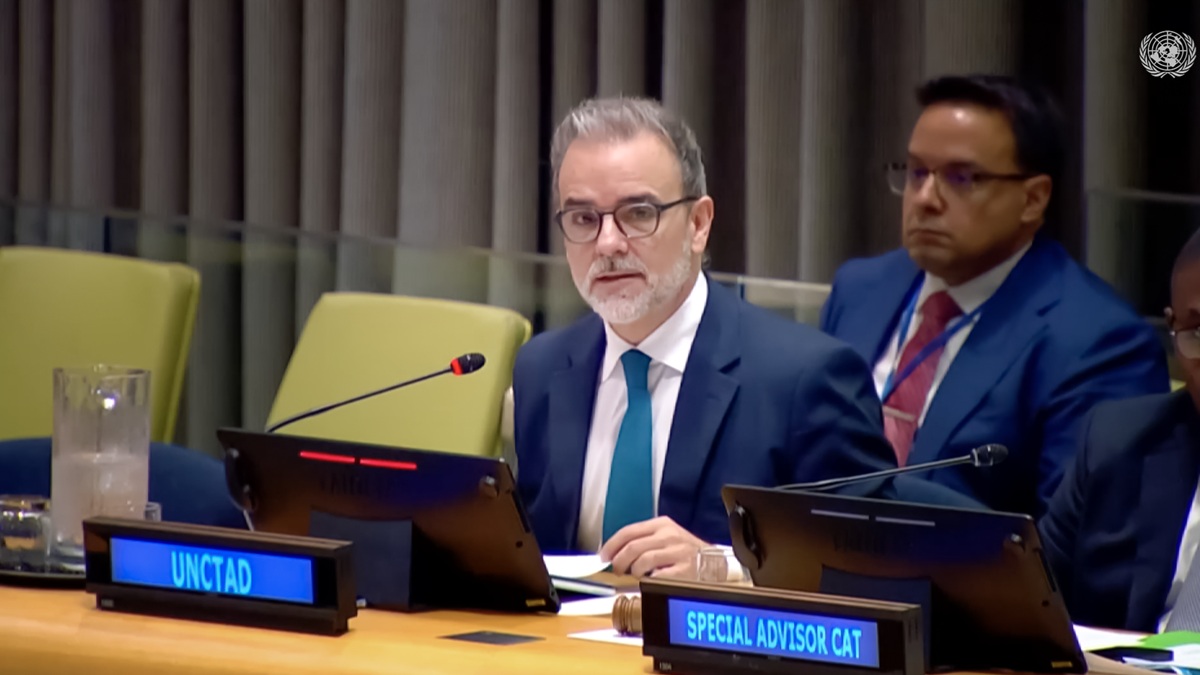
© UNCTAD Photo | Acting Secretary-General Moreno spoke at a high-level meeting on critical minerals held at UN Headquarters in New York on 14 July.
In his address to the United Nations High-Level Meeting on Critical Energy Transition Minerals on behalf of the co-chairs of the UN Task Force on Critical Energy Transition Minerals, UNCTAD's Acting Secretary-General Pedro Manuel Moreno stressed that rising demand for minerals such as copper, lithium and cobalt must translate into greater added value, economic diversification and shared prosperity for mineral producing countries and communities.
As investment in clean energy technologies accelerates, he noted that producing countries face growing challenges due to volatile markets, concentrated supply chains and the environmental and social impacts of extraction. Addressing these challenges requires stronger international cooperation and greater support for countries.
The Acting Secretary-General also highlighted progress under the Task Force, including technical work on value addition, traceability, artisanal and small-scale mining, mining legacies and circularity, alongside new global research and the rollout of a Country Support Mechanism to help translate international commitments into action on the ground.
Two knowledge products will be released by the end of 2026: a global assessment of trade policies affecting critical mineral value chains, and a study on circularity approaches in critical mineral value chains.
He concluded that the success of the energy transition will ultimately be measured not only by emissions reductions, but by stronger institutions, healthier ecosystems and improved livelihoods in the countries and communities that supply the minerals underpinning the clean energy economy.