


Market access to the United States could further deteriorate for many African countries if the African Growth and Opportunity Act (AGOA) is not renewed before its expiration on 30 September 2025.
The African Growth and Opportunity Act (AGOA) is a non-reciprocal US trade preference programme introduced in May 2000 to support sub-Saharan African economies. The programme grants duty-free access to the US market to over 1,800 products from many African economies.
Currently, 32 countries are eligible for preferential treatment under AGOA, of which 21 “lesser developed countries”, as defined by the US, also receive special textiles/apparel preferential treatment.
In 2023, US imports under AGOA totalled nearly $10 billion. While this accounted for only a small fraction of overall US merchandise imports, it represented a substantial share of exports from eligible countries, such as Lesotho and Madagascar.
African economies and the US have both benefited
AGOA preferences have boosted the competitiveness of African exporters and their importance has been substantial for certain countries and sectors, notably apparel. However, not all African countries have managed to successfully harness AGOA to diversify their exports away from primary commodities, and the rate of utilization of AGOA preferences remains uneven across beneficiaries and products.
With most US imports under AGOA consisting of fuels, metals and apparel products, US firms enjoyed greater choice and lower prices on imported raw material and intermediates, which enhances competitiveness in downstream industries.
The programme has also been instrumental in fostering US foreign direct investment in the African region, contributing to the establishment of more resilient supply chains.
Without renewal, many African economies will lose export competitiveness in US market
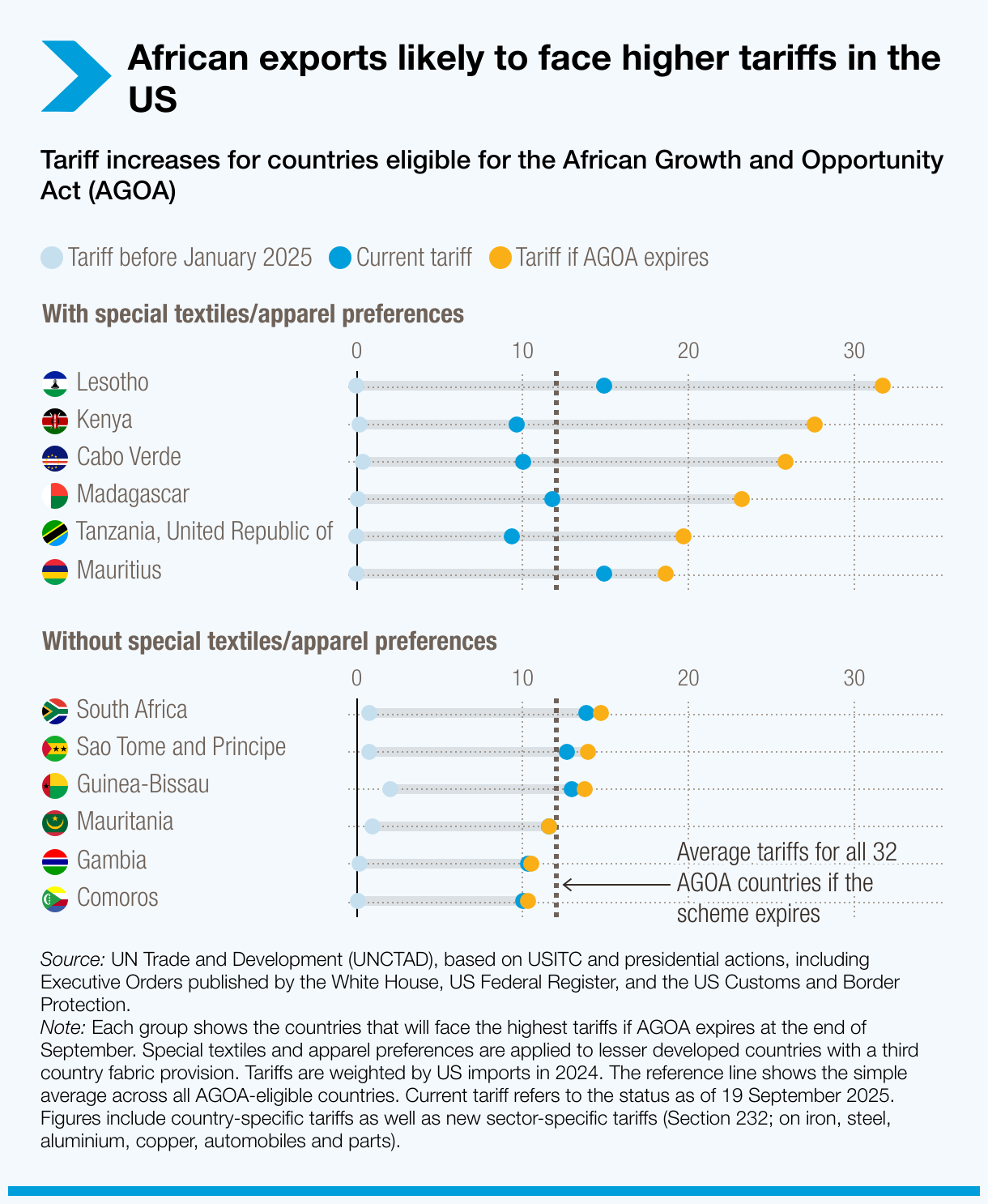
Since April 2025, rising US tariffs – especially country-specific tariffs implemented on 7 August 2025 and new sectoral trade measures – have increased duties on a wide range of products, regardless of AGOA preferences.
With AGOA set to expire at the end of September, eligible economies would face a compounded impact. Country-specific and sectoral tariffs would apply on top of most-favoured-nation rates (applied equally to all World Trade Organization members), instead of the current preferential treatment.
This sudden jump in tariffs could disrupt long-standing trade relations and severely disadvantage African exporters, particularly in highly protected sectors like textiles and apparel, where AGOA has so far provided critical market access. For example, Kenya would see its trade-weighted average US tariff nearly triple, jumping from 10% to 28%. For Madagascar, it would double to 23%.
Without AGOA’s renewal, Africa’s export competitiveness in the US market could quickly erode at a time when competition for alternative export markets intensifies globally. Accelerating the implementation of the African Continental Free Trade Area could help mitigate this situation, but such a readjustment would be challenging and require considerable time.