



Seaweed is gaining attention as a versatile resource for sustainable development. It is used in food, agriculture, pharmaceuticals, cosmetics and new bio-based materials. It grows quickly, requires few inputs and can support jobs, food security and climate goals.
But the sector faces clear limits. Production and trade are concentrated in a few countries, rules are fragmented and many developing countries struggle to access markets or move up the value chain.
Production is growing fast but remains highly concentrated
Global seaweed production tripled from 11.9 to 36.3 million tonnes between 2002 and 2022, while exports quadrupled to $3.9 billion.
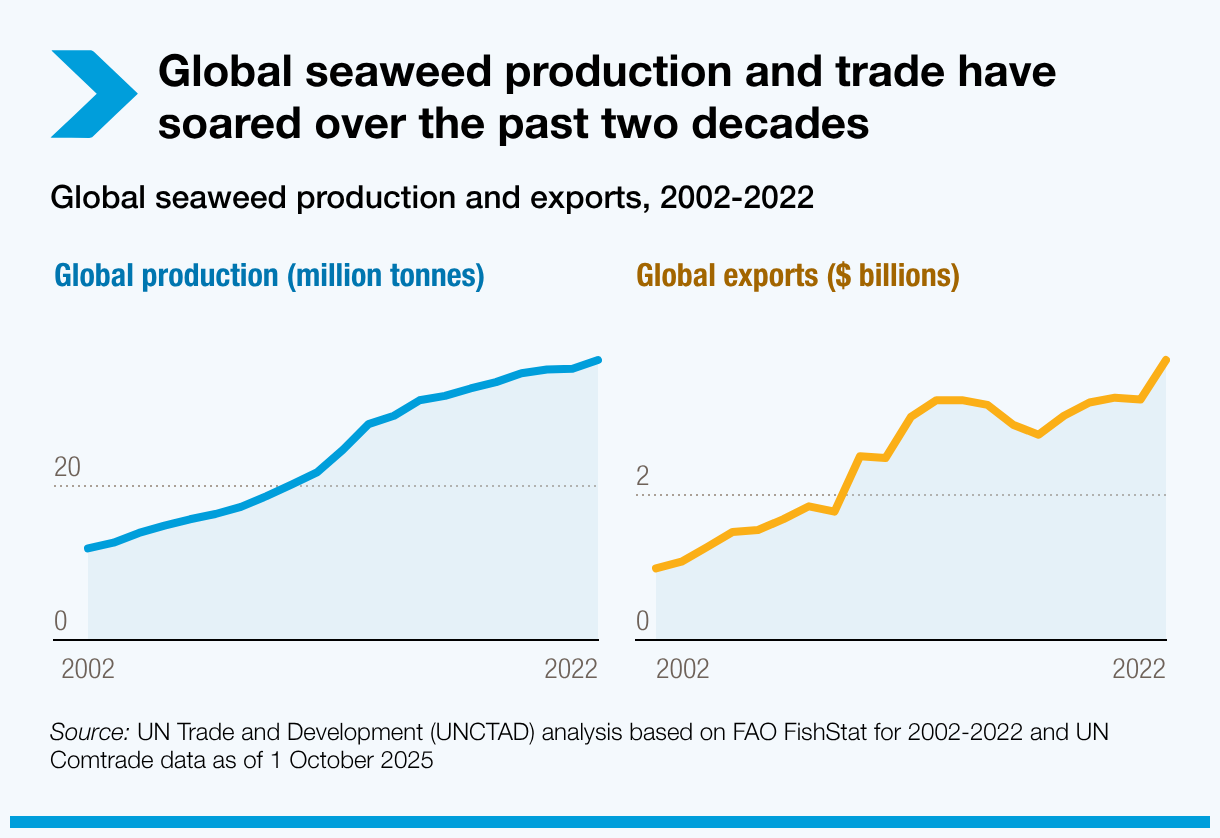
Most of this growth comes from farming, not wild harvesting. Aquaculture now accounts for 97% of production, driven by rising demand for seaweed-based products.
But production is heavily concentrated. Asia produces 98% of global output, led by China, Indonesia and the Republic of Korea. This limits resilience and leaves many countries on the sidelines.
Most seaweed is consumed locally, not traded globally
Despite strong demand, only 0.75 million tonnes were traded internationally in 2022. This shows that most seaweed is used in domestic markets.
For many producers, entering global trade remains difficult. Barriers include high compliance costs, limited certification and weak processing capacity.
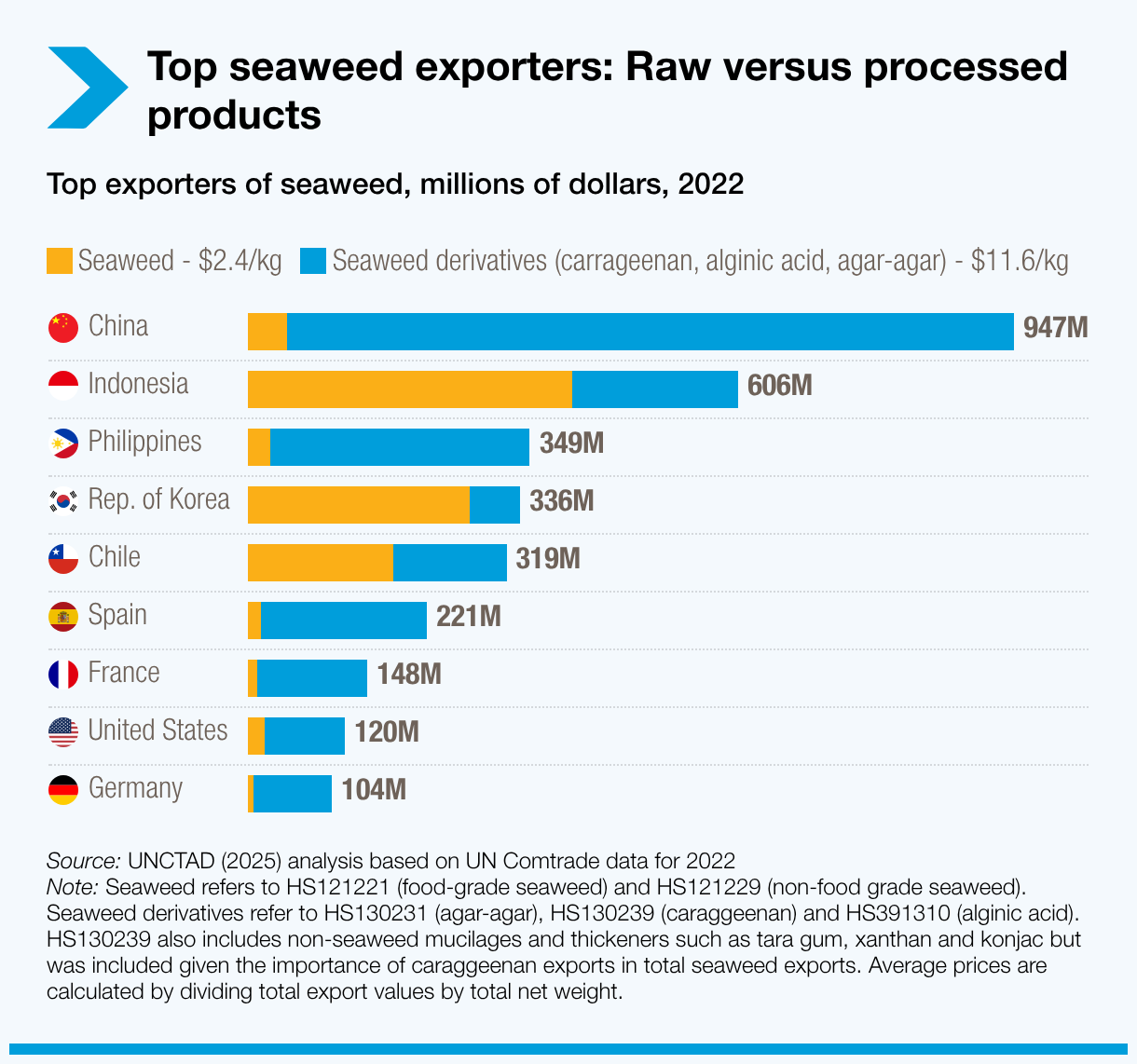
Countries need to process seaweed locally to capture more value. Products such as carrageenan, agar and alginic acid generate higher returns than raw seaweed.
In 2022, for example, agar – a gelling and thickening agent widely used in food and pharmaceutical products – traded at around $18.7 per kilogram, compared with $1.4 for unprocessed seaweed used in non-food applications.
Among the top exporters, China dominates seaweed derivatives, which account for about 95% of its exports. Most high-income exporters also specialise in derivatives. This shows that investing in processing can increase export value.
Regulatory gaps create uncertainty and slow growth
Rules have not kept pace with the sector’s rapid expansion. Regulatory frameworks remain incomplete and fragmented, especially for new uses of seaweed.
Seaweed is also not clearly defined in international trading systems. This creates confusion and makes it harder for exporters to comply with requirements.
Only 18 seaweed-specific technical measures have been identified globally. Most focus on food safety, while areas like environmental standards and non-food uses remain underdeveloped.
Fragmented standards make trade harder and more costly
Standards differ widely across countries. Most national rules are not aligned with international standards, creating inconsistent requirements.
This raises costs for producers, especially small businesses, and limits their ability to export. It also affects trust in product quality and safety.
Greater alignment is needed. Harmonised, science-based standards can reduce barriers while protecting consumers and ecosystems.
Investment and coordination are key to unlocking value
The report highlights the need for coordinated action. This includes investment in infrastructure, research and access to finance, especially for small producers.
Better data is also needed. Improving how seaweed is classified and tracked can help policymakers design more effective strategies.
International cooperation will be important. Global initiatives can help align rules, build capacity and support more inclusive growth across the sector.
A fast-growing sector with untapped potential
Seaweed has strong potential to support sustainable growth and diversify economies. Its uses are expanding and demand is rising.
But without clearer rules, better standards and more investment, this potential will not be fully realised. Addressing these gaps can help more countries benefit and build a more resilient blue economy.
This report was produced as a contribution to the UN Global Seaweed Initiative, launched following a recommendation from the 5th UN Ocean Forum.