
Key points
- UNCTAD convened an informal Working Group on Trade and Biodiversity Statistics, bringing together experts from more than 50 institutions worldwide.
- Enhanced biodiversity and trade data can support evidence-based policymaking that strengthens economic, social and environmental sustainability across value chains.
- The proposed statistical scope traces products back to ecosystems and the harvesting, farming, production and processing activities before trade.
- There is a shortage of indicators with available data on social dimensions of trade in biodiversity-based products.
- Biodiversity provides food, medicine and materials. It also supports services such as climate regulation and water filtration.
More than half of the world’s population depends on biodiversity for their livelihoods. This includes 70% of the world’s poor and vulnerable people living in rural areas.
Trade statistics do not show whether products are sustainable.
Trade can be associated with overexploitation, habitat destruction and the spread of invasive species. But when social and environmental considerations are taken into account, trade can support employment, resilient livelihoods and incentives for conservation. This is evidenced by the implementation of the BioTrade Principles and Criteria developed by UN Trade and Development (UNCTAD) in over 80 countries.
UNCTAD’s Trade and Biodiversity (TraBio) statistical tool provides data on trade in biodiversity-based products since 2010 for 193 economies. Under the UNCTAD Trade and Biodiversity (TraBio) product classification, the database covers trade in 1,814 distinct biodiversity-based products (HS subheadings).
Better statistics covering the full supply chain
To address this issue, UNCTAD convened an informal Working Group on Trade and Biodiversity Statistics, bringing together over 80 experts from more than 50 institutions.
Drawing on those exchanges, the report recommends extending data coverage across products’ supply chains. This includes the ecosystems where products are sourced, through harvesting, cultivation, farming, production, transformation and trade. Consumption can be included where relevant. Biodiversity-based services are currently excluded.
Definitions and data collection are leading priorities
Among experts surveyed, 30% selected terminology and definitions as the highest priority. Data collection followed at 23%, with types of biodiversity-based products at 21%.
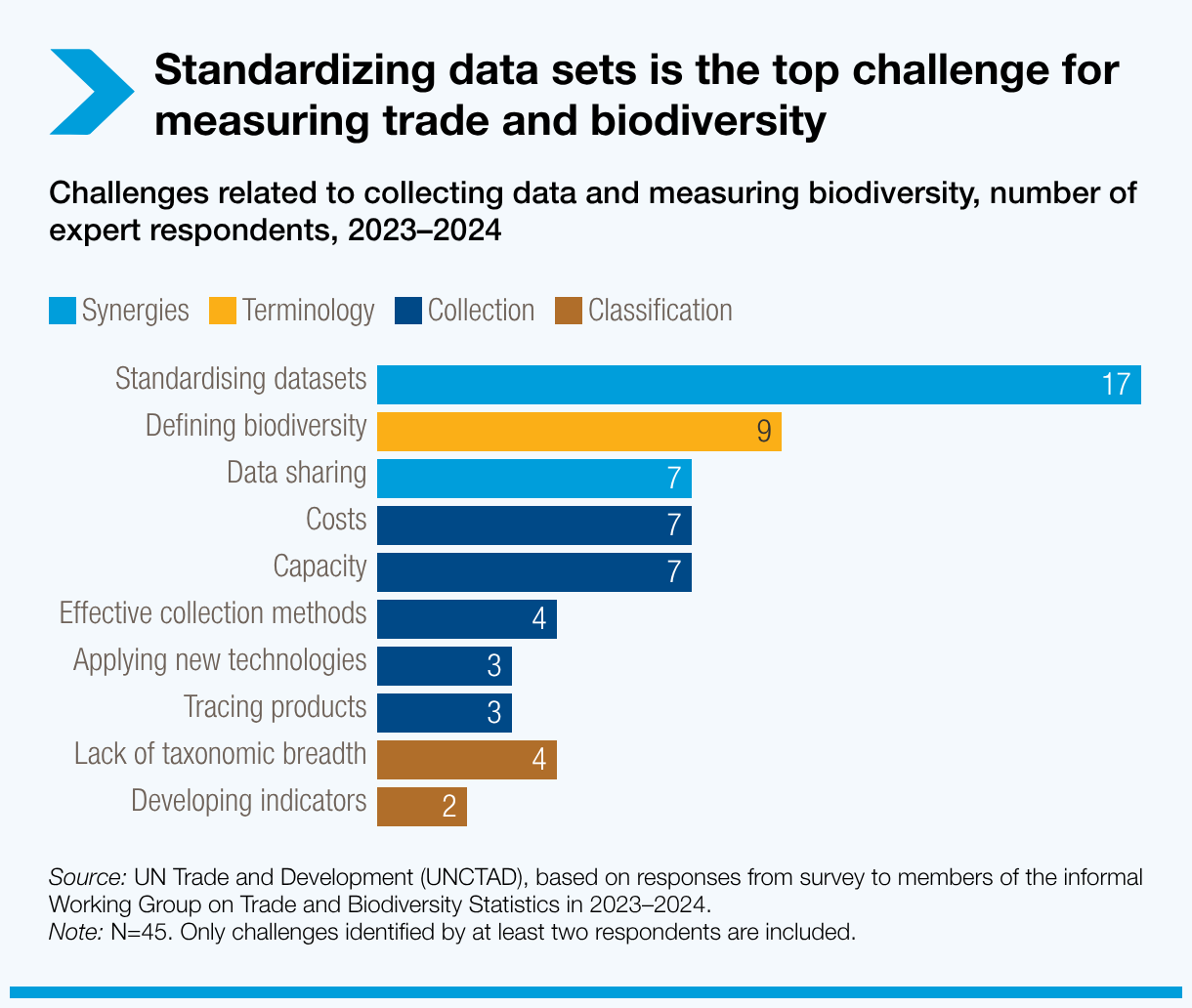
Experts also identified several challenges. These include standardizing data sets, defining what a biodiversity-based product is, facilitating data sharing and improving collection methods. The report recommends aligning definitions and classifications, connecting existing databases and strengthening data capacity, particularly in developing countries.
Social sustainability remains the largest indicator gap
The report shortlists 49 priority existing indicators based on 8 criteria, including a 70% scoring weight for data availability and interoperability (whether data can be linked to trade statistics). Of the 49 indicators, 19 are environmental, 17 economic and 12 policy, while only one relates to social sustainability.
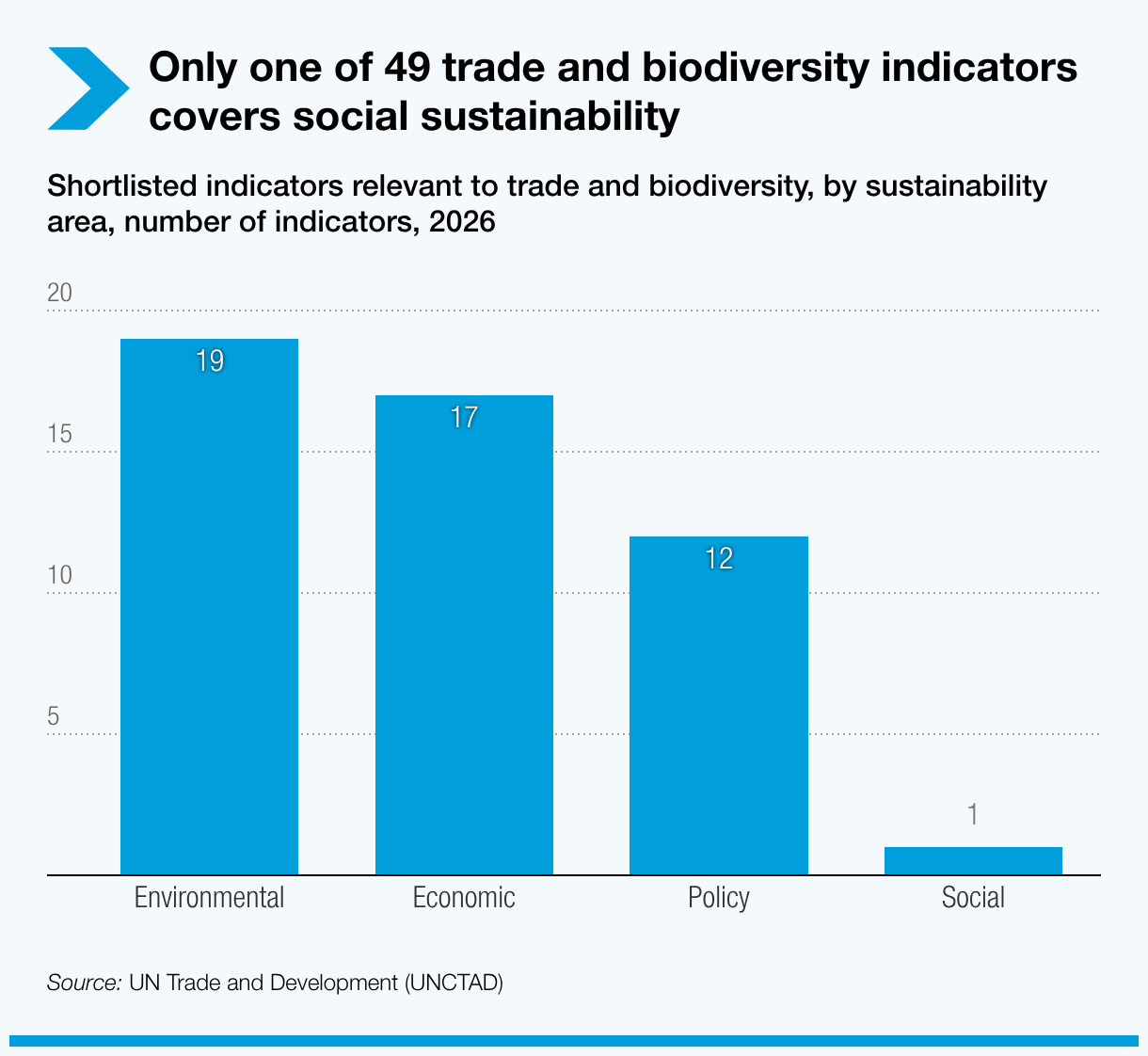
This imbalance shows that the social dimensions of trade in biodiversity-based products remain insufficiently measured.
The report also compiles 40 databases relevant to the trade-biodiversity interface. It identifies several areas for further work. These include:
- Decent work and fair wages
- Gender equality
- Land use and rights
- Food equity
- Indigenous Peoples
Building a shared statistical system
In the short term, the report calls for better-integrated data, updated indicators and stronger cooperation. Over three to five years, it recommends developing new sustainability indicators and harmonizing standards. It also proposes greater use of geospatial tools, satellite data, big data and artificial intelligence.
Beyond five years, the report proposes a unified, open-source biodiversity and trade database. It also calls for greater supply-chain transparency to track the impact of trade on ecosystems.