
Key points
- Services are essential to preventing and mitigating plastic pollution, from eco-design, engineering and R&D to waste collection, recycling, remediation and clean-up.
- The study identifies 19 service types and 71 UN CPC 2.1 service codes relevant to plastic pollution prevention and mitigation.
- These services are spread across broad categories such as business, engineering, construction, ICT, education, environmental and waste-management services, making them difficult to identify in trade statistics.
- Better classification can help governments measure trade flows, identify bottlenecks and target trade, regulatory and investment policies more effectively.
- Access to relevant services is uneven, with countries that have weaker plastic management capacity often facing more restrictive services import regimes.
- Financing remains concentrated in downstream waste management, while upstream services such as eco-design, R&D and demand reduction receive less support.
Services are a missing link in the fight against plastic pollution
Plastic pollution is often discussed as a problem of products, materials, and waste. This study highlights a less visible but essential part of the solution: services.
Across the plastics value chain, services help determine whether pollution is prevented before it occurs, managed once products become waste, or left to accumulate in ecosystems. They support better product design, safer material choices, efficient production processes, collection and sorting systems, recycling, reuse models, waste treatment and environmental recovery.
Yet many of these services remain invisible in trade data. They are not grouped under a single “plastic pollution services” category. Instead, they are dispersed across broader classifications, making it difficult for governments to measure them, negotiate commitments, remove barriers or mobilize investment with precision.
A practical classification for trade policymakers
The report proposes a cluster-based classification of services relevant to plastic pollution prevention and mitigation. It identifies 19 service types and 71 individual UN CPC 2.1 codes, covering both core and auxiliary services.
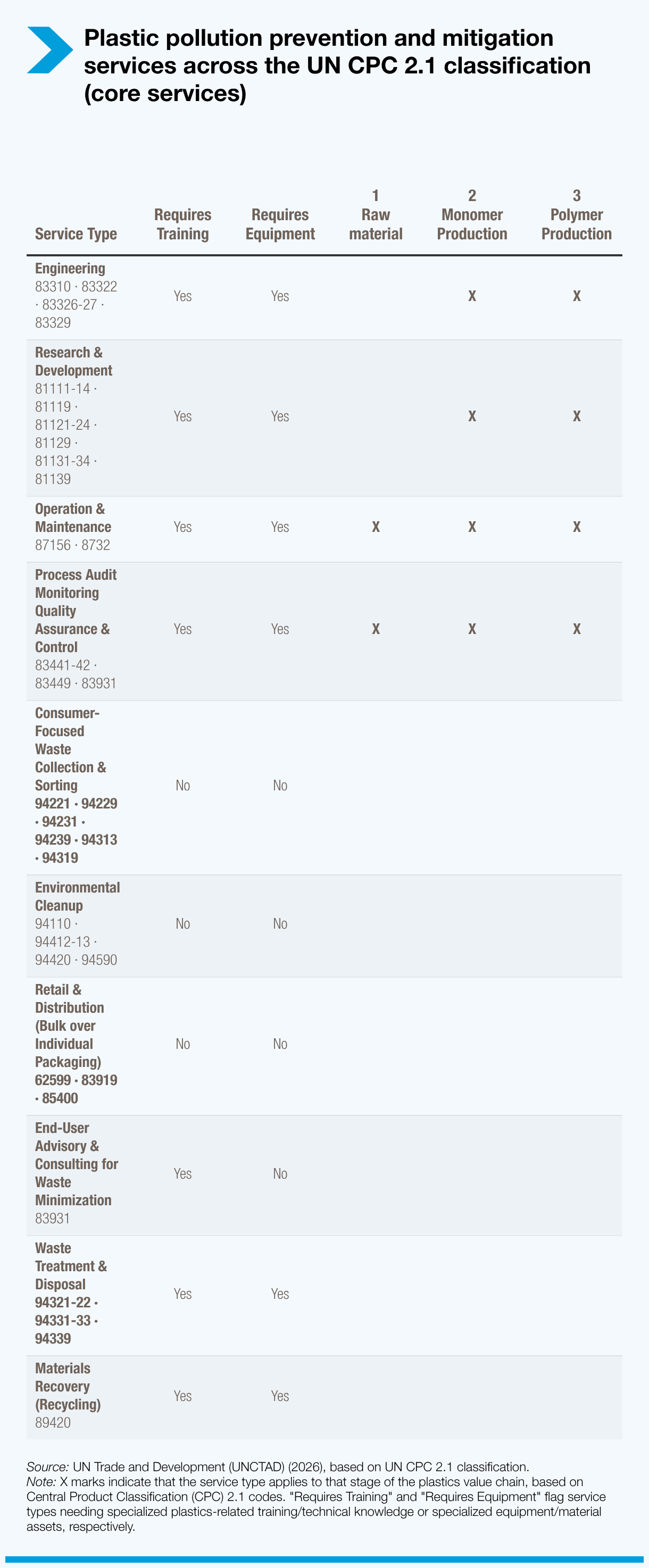
These include engineering, research and development, construction, operation and maintenance, information technology, education and outreach, environmental consulting, waste collection, materials recovery, recycling, waste treatment and remediation services.
The approach does not require changes to existing international classification systems. Instead, it gives governments a practical way to identify relevant services within existing frameworks used for statistics, trade negotiations and policy design.
Services matter across the entire plastics value chain
The study maps services across eight stages of the plastics value chain: raw material acquisition, monomer production, polymer production, product design and manufacture, end use, waste management, reuse or upcycling, and end-of-life treatment including recycling or disposal.
Upstream services can help prevent pollution at source. These include R&D for alternative materials, engineering services for cleaner production, environmental consulting, eco-design, testing and analysis, and business services that support more circular production models.
Downstream services help manage pollution once plastic products become waste. These include collection, sorting, storage, transport, recycling, landfill, incineration, wastewater treatment, remediation and clean-up services.
The report stresses that both sets of services are needed. Focusing only on waste management risks missing opportunities to reduce plastic pollution before it is created.
Access to services is uneven
Demand for plastic pollution prevention and mitigation services is likely to be highest where plastics production, processing, consumption and waste generation are concentrated. The Asia-Pacific region accounts for 50 per cent of global plastic production, 60 per cent of processing and 46 per cent of plastic waste by volume.
But access to relevant services is not evenly distributed. The study finds that countries with weaker plastic management capacity often have more restrictive services import regimes, limiting access to the expertise, technologies and business models needed to address plastic pollution.
This matters especially for developing countries, where domestic capacity may be limited and imported services can be important for building waste-management systems, recycling capacity, technical expertise and regulatory implementation.
Trade barriers and financing gaps limit progress
The report identifies regulatory fragmentation as a major constraint on trade in relevant services. Divergent licensing requirements, qualification procedures, technical standards, conformity assessment rules and restrictions on the movement of professionals can raise costs and limit access.
Market-access restrictions, including foreign equity limits, public monopolies, joint venture requirements and constraints on commercial presence, can also affect the availability of services. These barriers often matter most in countries where demand for technical assistance and service imports is greatest.
Financing is another challenge. Official development assistance directed to plastic pollution reached about $1.46 billion in 2022, more than double the 2019 level. Most of this support went to sewage and waste-management infrastructure, while funding explicitly targeting plastic waste management, reduction, recycling and clean-up reached about $270 million.
The report calls for more attention to upstream services, including eco-design, R&D, demand reduction, alternative materials and professional capacity-building.
A tool for better policy and cooperation
By making relevant services more visible, the study offers policymakers a practical tool to strengthen action on plastic pollution. It recommends that governments:
- Identify priority services based on national needs and value-chain stages.
- Improve data on trade and financing flows for relevant services.
- Reduce regulatory and market-access barriers where appropriate.
- Strengthen regulatory cooperation, mutual recognition and transparency.
- Use trade agreements and targeted commitments to facilitate access to priority services.
- Leverage public procurement to support circular and low-plastic solutions.
- Scale up financing, especially for upstream prevention services.
The study contributes to ongoing discussions on plastic pollution, including negotiations for an international legally binding instrument on plastic pollution and the WTO Dialogue on Plastics Pollution and Environmentally Sustainable Plastics Trade.