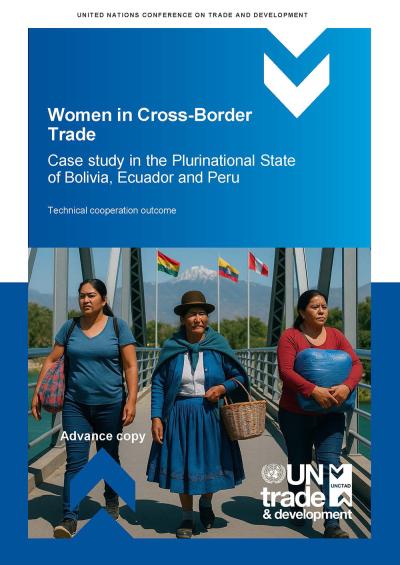
Women living in border regions often rely on small-scale cross-border trade for their livelihoods, but this dependence presents significant challenges. The experiences of women in Huaquillas (Ecuador-Peru border) and Desaguadero (Bolivia-Peru border) not only highlight individual struggles but also reveal broader systemic issues that persist at borders in developing countries around the world.
These challenges include incomplete information about border procedures, lack of simplified trade regimes, digital challenges, limited access to finance, safety and security concerns at border posts, and the burdens of unpaid care work, which often compel women to engage in informal trading.
Long-standing issues and systemic barriers
These challenges are not new. Previous work by UN Trade and Development (UNCTAD), such as "Borderline: Women in Informal Cross-Border Trade in Malawi, the United Republic of Tanzania, and Zambia", and "Gender Perspectives in Trade Facilitation Reforms", has documented the barriers faced by women traders and the ways in which trade policy often neglects a more inclusive approach. This study marks the first time UNCTAD has applied the same methodology in Latin American countries.
The findings from this research are striking. Women traders frequently find themselves excluded from formal trade channels, not due to a lack of capacity but because of systemic barriers – such as burdensome regulatory requirements, unclear procedures, financial exclusion, safety concerns and digital illiteracy, among others.
These obstacles not only limit women’s economic opportunities but also undermine the resilience and prosperity of entire border communities.
Addressing these gaps requires more than just simplifying regulations. It necessitates a concerted effort to incorporate women’s perspectives into trade facilitation reforms. National Trade Facilitation Committees, convening public and private stakeholders, are ideal platforms to bridge those gaps.
Integrating gender perspectives in trade facilitation
UNCTAD has actively promoted the integration of gender perspectives in trade facilitation through initiatives such as e-learning courses on mainstreaming gender in trade facilitation, support for National Trade Facilitation Committees via the Empowerment Programme for Trade Facilitation and the Reform Tracker, as well as the UN Global Survey on Digital and Sustainable Trade Facilitation.
These efforts have generated valuable evidence and raised awareness of women’s experiences at borders. Additionally, UNCTAD collaborates with governments and stakeholders to design gender-sensitive initiatives in trade facilitation reforms and track their progress.
These initiatives demonstrate that inclusive trade facilitation can lower costs, enhance efficiency, and promote gender equality simultaneously.
A replicable approach
The methodology used and experiences gained in this study can be replicated in other parts of the world and tailored to their specific contexts. While each country and border has unique characteristics, the challenges identified and the recommendations formulated in this report reflect common patterns affecting women cross-border traders and women officials in various regions.
National and international actors are encouraged to use this methodology as a foundation for similar assessments to promote more inclusive and sustainable policies in trade facilitation.