
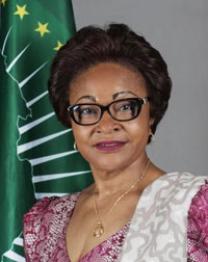
H.E. Madam Josefa Leonel Correia Sacko, an Angolan national, is a leading African Agronomist. She was elected as the new Commissioner for Rural Economy and Agriculture of the African Union Commission during the AU Summit of Head State on January 2017.
Prior to that, She was a Special Adviser to two Ministers in Angola, her home country: the Angolan Minister of Environment where she also served as Ambassador responsible for Climate Change. In the Ministry of Agriculture of the Republic of Angola Amb Sacko oversaw Food Security, Eradication of Hunger and Poverty Reduction.
The former Secretary General of the Inter African Coffee Organization (IACO) for 13 years in Cote D’Ivoire where she represented Coffee economy for 25 African Coffee producing countries. During her tenure, she successfully advocated for the empowerment of small scale coffee farmers across the continent by setting up Regional Centres of Excellence for Capacity Building of Member States, on Genetic Material Conservation, Coffee Quality Improvement and Cup Tasting Liquor in Cote d’Ivoire, Uganda, Cameroon and Zambia.
Amb Sacko is one of the African Women Africa should be proud of, and she has built up her international profile and reputation by working with Regional, Global Institutional on Agriculture and many other sectors supported by World Trade Organization (WTO), African Union (AU), International Coffee Organization (ICO), African Development Bank (AFDB), African Bank for Export and Import (AFREXIMBANK), (FAO), UNECA, NEPAD etc.
The other notable cooperation/partnerships she has worked with include the Regional Economic Communities (RECS), namely, SADC, COMESA, ECOWAS and EAC, where she has actively participated to address the challenges encountered by small scale farmers in Africa, ensuring that they remain a central focus in regional and national policy making for development. Amb Sacko became a Champion 12.3 on reducing food losses and waste in 2018 and in June 2019, she was nominated by António Guterres, Secretary-General of the United Nations, to serve as a member of the Scaling Up Nutrition (SUN) Movement Lead Group. Amb. Sacko speaks fluently Portuguese, French, English, Spanish and Lingala.
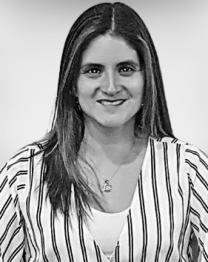
Roxana is a Peruvian lawyer specialized in international law. She collaborates with the UNCTAD Trade Facilitation Section since 2021, assisting countries in Latin America, Africa, and Asia in the implementation of trade facilitation reforms and the empowerment of National Trade Facilitation Committees.
She holds an LL.M. (Master of Laws) degree from Columbia Law School and an executive master’s degree in international law in armed conflict from the Geneva Academy of International Humanitarian Law and Human Rights. She also holds a Juris Doctor degree from Pontificia Universidad Católica del Perú and has studied Political Science in the Institut d’études politiques de Paris (Sciences Po).
She is fluent in English, French and Spanish.
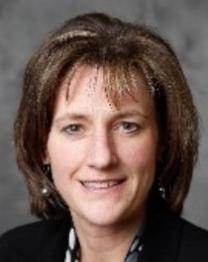
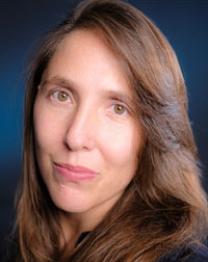
Camila supports the creation and execution of effective policies that promote sustainable consumption. She represents CI at One Planet Network and supports the development and implementation of the CI Sustainable Consumption Strategy. She is the head of delegation in negotiations on an international legally binding instrument to combat plastic pollution and at COP16.
Previously, Camila worked with UNEP on the Consumer Information Programme and supported projects on eco-labeling and policy for member States. Before that, she was project manager for the 20th International Congress on education and sustainable development of the World Association for Educational Research and served two terms as a Professor Assistant at Albert-Ludwigs-University, Germany. She also conducted research on policy architectures at the IIEP-UNESCO and served as a project manager for the U.S.-based educational program International Studies Abroad Inc.
Camila holds an MSc in Environmental Governance and is dedicated to the conservation of biodiversity and mitigating the impact of human-environment interactions and consumption on ecosystems and wildlife.
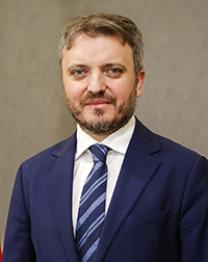
Zekeriya Çostu was appointed Deputy Minister of Industry and Technology of Türkiye on 22 June 2023.
Before that, he served as the Director General for National Technology at the Ministry of Industry and Technology.
In 2018, he was appointed Director of the Project Management Office at the Ministry of Industry and Technology. As part of the National Technology Move, he participated in processes and projects to support R&D and innovation activities in Türkiye and develop the technology ecosystem.
In his professional career, he has worked as a commercial unit manager and strategic planning consultant in organisations such as Turkish Airlines and TRT.
Zekeriya Çostu graduated from Bogaziçi University, Department of Industrial Engineering in 2008.
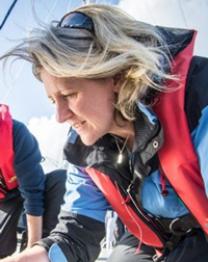
Elizabeth Cottier-Cook is Professor in Marine Biology, specialising in Seaweed Biosecurity, Protection and Restoration at the Scottish Association for Marine Science and a Fellow of the Royal Society of Biology (FRSB).
She has published over 120 peer-reviewed papers and has led seaweed-related, multi-national initiatives with partners globally for the last 10 years. She is currently leading a large-scale research programme “GlobalSeaweed-SUPERSTAR” funded by the UK Department for the Environment, Food and Rural Affairs (DEFRA), which aims to produce a 2030 Seaweed Breakthrough by 2026.
She is also the co-lead for a new £3M programme “GlobalSeaweed-PROTECT” funded by UK Research and Innovation working to improve resilience in the seaweed aquaculture industry in Malaysia, the Philippines, Thailand, Indonesia and Vietnam. She has previously led a £6M research programme “GlobalSeaweedSTAR” funded by UK Research and Innovation – Global Challenges Research Fund (GCRF) involving DAC-list countries from around the world, which worked closely with UN FAO to implement a Progressive Management Pathway for Improving Aquaculture Biosecurity.
Elizabeth is also a member of the Scientific Advisory Council for the Global Seaweed Coalition, the ICES Working Group on Introductions and Transfers of Marine Organisms (WGITMO), the Scottish Government Working Group on Marine Non-Native Species and is a lead chapter author for the 3rd UN World Ocean Assessment.
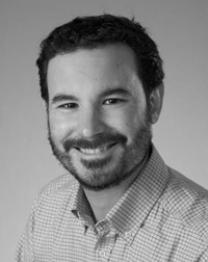
Lorenzo Cotula is the Head of the Law, Economies and Justice Programme at the International Institute for Environment and Development (IIED), a policy research institute based in the United Kingdom. Lorenzo’s research and policy work cuts across international economic law, natural resource law, environmental law, human rights law and sustainable development. Alongside his role at IIED, Lorenzo was a Visiting Professor at Strathclyde Law School in 2017-2023 and, prior to that, he held visiting affiliations with Warwick and Dundee universities. Before joining IIED in 2002, Lorenzo worked as a research consultant to the Legal Office of the Food and Agriculture Organization of the United Nations (FAO). Lorenzo holds a degree in law (Sapienza University of Rome), an MSc in Development Studies (London School of Economics), a PhD in law (University of Edinburgh) and a PgCert in Sustainable Business (University of Cambridge).
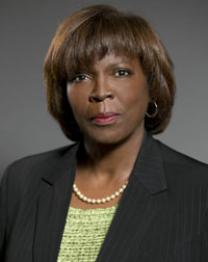
Ertharin Cousin is the Founder, President, and CEO of Food Systems for the Future. She also serves as a Distinguished Fellow at the Chicago Council on Global Affairs and a Visiting Scholar at Stanford University. As Executive Director of the UN World Food Programme (2012–2017), Cousin led operations in 80 countries, providing food assistance to over 80 million people annually and promoting sustainable solutions to global food insecurity.
Previously, Cousin served as U.S. Ambassador to the UN Agencies for Food and Agriculture and held executive roles at Feeding America and Albertsons. She currently sits on several boards, including Bayer AG, Royal DSM, and Heifer International. Ms. Cousin is a graduate of the University of Illinois at Chicago; the University of Georgia Law School and the University of Chicago Executive Management Program-Finance for Non-Financial Executives. She has been listed numerous times on the Forbes 100 Most Powerful Women List, as the Fortune Most Powerful Woman in Food and Drink, on Time’s 100 Most Influential People list, and as one of the 500 Most Powerful People on the Planet by Foreign Policy magazine.
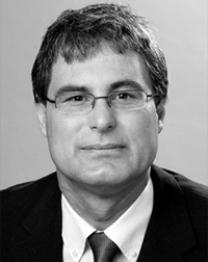
David Cowan is a Managing Director and Economist at Citi Research, covering Africa (excluding South Africa).
Prior to this he worked at the Economist Intelligence Unit for a total of eight years as Senior Economist for Africa and the Director of the Middle East and North Africa team.
Before joining the Economist Intelligence Unit, he worked for six years as the Principal Research Officer at the Bank of Botswana, the country’s central bank. He also worked for three years for the Economic Research Unit of the Saudi Arabian Ministry of Foreign Affairs.
He has a first degree in economics from the University of Bath and a PhD from the University of London that examined the impact of Tanzania’s structural adjustment programs from the mid-1980s to the early 1990s.
During his working career, David has built up has a wide-ranging knowledge of financial and foreign exchange markets in Africa and the problems of maximizing the benefits of natural resources in African countries.
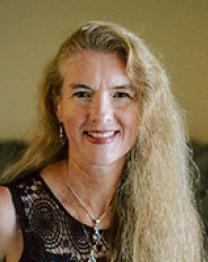
Heidi has worked in the textile manufacturing industry since 1988, many years of which have been in new product development. In recent years, she has trained in all areas of expertise and application in the textile industry, from academia, textile manufacturers, retail and clothing to non-profit organisations and community groups.
Heidi consults on technical aspects of textiles and is involved with several international environmental projects as a textile technical advisor with the UK-based Sustainable Manufacturing Environmental Pollution Prevention Programme (or “SMEP”).
Heidi is on the board of directors of a waste beneficiation NPO called Use-It and the Durban Textile and Leather Incubator. She is chairperson of the South African Dyers’ and Finishers’ Association.