

Multi-year expert meeting on transport, trade logistics and trade facilitation, 12th session
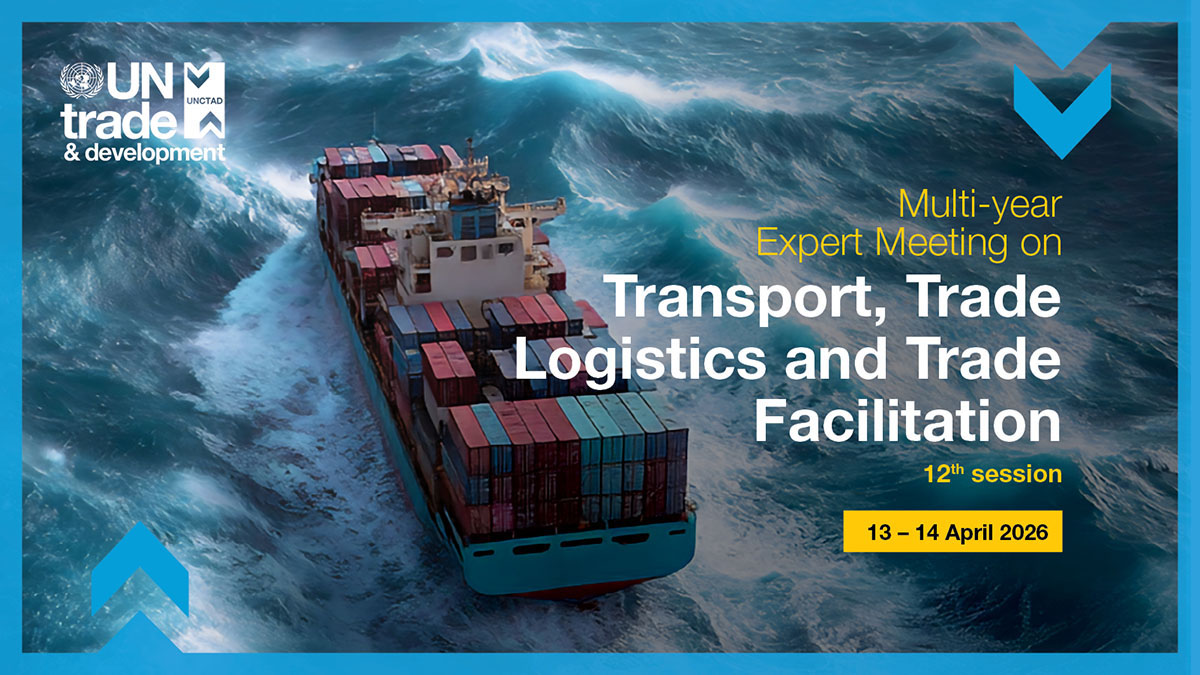
Global maritime transport: Staying the course in turbulent waters
Global supply chain disruptions have become more frequent and complex, with shocks converging and compounding, to create unprecedented volatility.
Maritime transport, which carries over 80% of world merchandise trade by volume and underpins global supply chains, has been particularly affected. Since 2020, shipping, ports and hinterland connections have weathered overlapping disruptions linked to the coronavirus disease (COVID-19) pandemic and its legacies, geopolitical tensions and climate-related constraints.
Recent chokepoint disruptions in the Red Sea and the Suez Canal, security risks in the Black Sea, and drought-induced draught limits in the Panama Canal have reshaped routes and schedules. Beginning in 2025, shifts in trade policy have added regulatory uncertainty and operational complexity. These pressures are transmitted across supply chains, with landlocked developing countries, the least developed countries and small island developing States often the most affected due to capacity constraints, connectivity gaps, infrastructure deficits and higher transport costs.
Drawing on insights from Review of Maritime Transport 2025: Staying the Course in Turbulent Waters, discussions at the 12th session will explore key developments affecting global maritime transport and trade and provide expert insights into challenges and opportunities for the maritime transport industry and its stakeholders, as well as policymakers.
The session will provide an opportunity to share experience and good practices and provide recommendations on the best way forward, with a particular focus on developing countries, landlocked developing countries, the least developed countries and small island developing States.
Participants
Experts in their personal capacities (nominated by member states) and government representatives.
Contributed papers
Experts are encouraged to prepare and submit brief papers (maximum 10 pages) related to their studies, findings and/or national experiences. These papers will be made available at the meeting in the form and language in which they are received.
Papers should be submitted by 6 April 2026 to wendy.juan@unctad.org.
Logistics
The session will be held with physical participation, in the room Tempus of the Palais des Nations. Those who cannot attend the meeting in person will be able to listen to the live audio stream in the six official languages of the United Nations.
The link to listen live will be sent to registered participants at the email address used for registration, one day in advance of the start of the session.
