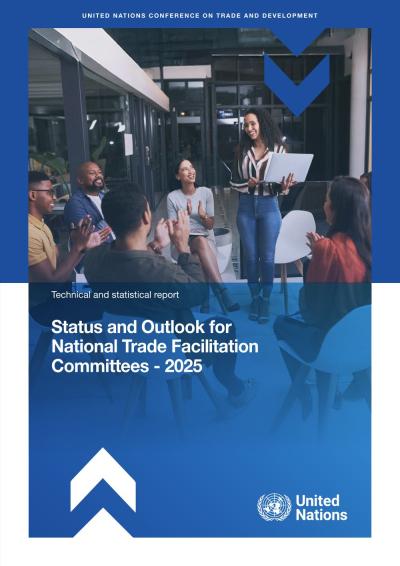
The report shows that National Trade Facilitation Committees are becoming more important as countries work to make cross-border trade faster, cheaper and more predictable.
These committees bring together public and private actors to coordinate trade facilitation reforms. Their role is growing as trade systems become more digital, more exposed to shocks and more dependent on strong coordination across ports, borders and trade corridors.
The report’s core message is clear: reported progress doesn’t always match reality on the ground. Stronger monitoring is needed to know whether reforms are working where they matter most.
Reported progress can overstate actual implementation
Implementation of the World Trade Organization (WTO) Trade Facilitation Agreement continues to move forward. According to the WTO database, the reported global implementation rate rose from 83.6% at the start of 2025 to 87.3% by year end.
But the report says these figures don’t always reflect national realities. Its analysis compares WTO data with national implementation assessments from the UN Trade and Development (UNCTAD) Reform Tracker in 26 developing and least developed countries. It found that 89% of the data reviewed didn’t accurately reflect the situation on the ground.
In 77% of cases, countries had implemented less than the database indicated. This matters because notification-based data alone can make it harder to identify bottlenecks, target support and assess real progress.
Monitoring remains a major gap
Many committees are already tracking reform. In 2025, 67% monitored trade facilitation progress, while 30 countries used UNCTAD’s Reform Tracker to follow implementation.
But monitoring and evaluation remain a major weakness. The report says 65% of committees identified the need to strengthen monitoring and evaluation capacity, making it the most critical need reported in 2025.
The report recommends stronger systems to track implementation, identify bottlenecks and adjust priorities. It also calls for more field missions, diagnostics and evaluation visits to assess how reforms are working at borders and ports.
Committees are taking on a stronger resilience role
Trade facilitation is no longer only about efficiency. The report shows that committees are increasingly being asked to help countries respond to disruptions.
In 2025, 50% of committees discussed supply chain disruptions, including congestion at ports or borders and pandemic preparedness. This points to a wider role for committees in resilience and crisis response.
Kenya offers a concrete example. The report says coordination through the Working Group on Ports and Transit Trade helped reduce cargo dwell time at ports from about 11 days to between 3 and 4 days in recent years. Vessel waiting times and turnaround times also improved.
Strong institutions are needed to make reforms last
Most committees remained active in 2025.
- 83% met at least once
- 78% engaged with the private sector
- 70% organized or joined training and capacity-building activities
Yet many still face operational, financial and technical constraints. The report says 41% didn’t carry out any resource mobilization activities, even as many committees continued to report shortages of financial and human resources.
The report recommends stronger governance, updated mandates, better secretariats, regular public-private dialogue and sustained capacity building. It also calls on committees to move beyond a narrow focus on the WTO agreement and address emerging priorities such as supply chain resilience, digital trade, climate-smart trade facilitation and inclusive trade.
Trade facilitation reforms need more than formal commitments. With stronger support, National Trade Facilitation Committees can help countries turn reforms into faster clearance, fewer delays, more resilient supply chains and more inclusive gains from trade.