


Uncertainty around import, export and transit rules raises trade costs, delays trade procedures and restricts market access, especially for smaller and informal businesses and entrepreneurs. Under the World Trade Organization’s Trade Facilitation Agreement, enquiry points are meant to close this gap. Three out of four WTO members have established one.
The report examines how enquiry points performed in 2024. UN Trade and Development (UNCTAD) tested their accessibility and responsiveness – through a mystery client assessment, using a standard trade query. The assessment reveals a clear and recurring gap between formal establishment and how enquiry points function in practice.
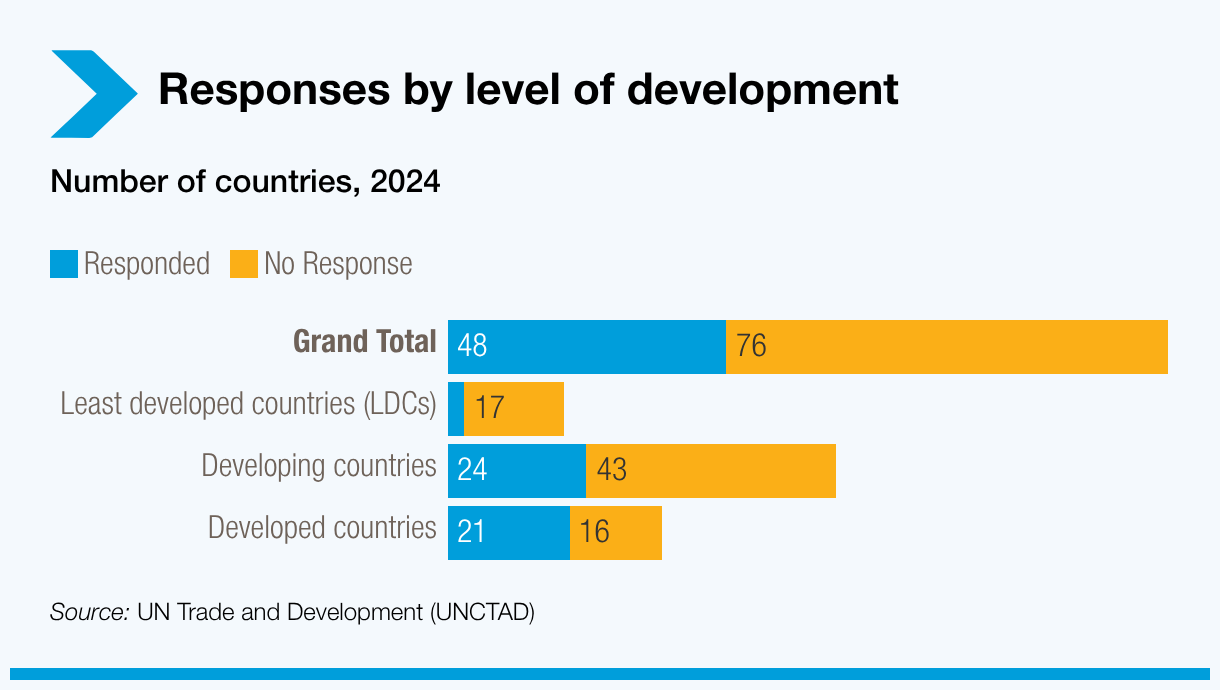
Only 39% of the 124 enquiry points assessed responded to a standard trade query pointing to the fact that formal compliance alone does not ensure that enquiry points provide timely and usable information to traders.
While response rates differ across country groupings, enquiry points in countries at all levels of development face similar challenges in translating formal compliance into effective operational performance. Taken together, the findings emphasize the importance of consistent focus on operational arrangements to ensure enquiry points remain functional and effective over time.
Overall, the results highlight the need for targeted capacity-building and sustained technical support and cooperation. The following sections highlight key operational lessons and policy recommendations from the assessment.
Centralized enquiry points respond faster and better
Enquiry points housed within a single authority – commonly customs or revenue administrations – accounted for 71% of responses received in the assessment. They were also more likely to provide timely replies, often within one week. And centralized structures reduced confusion over responsibility.
By contrast, responses from countries with multiple enquiry points across agencies were more likely to be delayed or fragmented. The findings point to the importance of clear institutional anchoring and coordination mechanisms to support consistent enquiry point performance.
Generic email addresses outperform individual contacts
How enquiry points are contacted matters. Those using generic or departmental email addresses tend to respond faster and more consistently, averaging 19 days, compared with 27 days for individual staff emails.
Staff turnover and outdated contact information were among the causes of non-response. The report recommends institutionalized contact channels, supported by basic technical checks, to ensure continuity and reliability of enquiry point services over time.
Speed matters – but so does accuracy and substance
Most replies were received within five days, though response times varied widely. More complete and useful answers often required additional time for internal coordination and verification.
Based on the results, the report identifies 23 calendar days as a practical benchmark – fast enough to retain practical value for traders, while allowing enquiry points to provide accurate and tailored information. Simple tools such as automated response acknowledgements can help manage expectations, signal responsiveness and support trust in enquiry point services.
Trade information portals strengthen enquiry points
Countries operating trade information portals – official online platforms that publish import, export and transit procedures in one place – were more likely to provide clearer and more precise responses to traders’ queries. Enquiry points linked to these portals responded more precisely and performed better overall than those operating in isolation.
The report highlights the value of embedding enquiry points directly within trade portals and exploring automation, including AI-based tools, to handle routine queries and free up staff capacity.
Not just administrative add-ons
The report shows that enquiry points can be powerful trade facilitation tools – but only if they are accessible, responsive and embedded in broader transparency systems. Moving from compliance to impact requires centralization, basic service standards and smarter use of digital tools.
To support this transition, the findings point to the value of having an enquiry point roadmap, which can help countries assess current performance, address priority gaps and progressively strengthen enquiry point functions over time. Such a roadmap can guide improvements in institutional arrangements, service delivery practices and digital integration, while remaining flexible to reflect national contexts and capacities.
The message is clear: functional enquiry points are not an administrative add-on. They are a frontline service that can lower trade costs, improve predictability and expand access to international markets, especially for smaller and more vulnerable traders.