With a population of 36,7 million, the Republic of Angola's gross domestic product (GDP) was USD 107.2 billion in current prices in 2023, which put it in the top ten economies in sub–Saharan Africa (SSA).
There has been a steady growth in GDP per capita, rising from 556 USD in 2000 to approximately 2,916 USD in 2023 (current prices). However, despite the growth in GDP per capita over time, the most recent trend remained negative (-0.2%), due to a high population growth (3%). On the other hand, the exports of non-oil products from Angola grew by 6.7% from 2016 to 2023, after a dip due to the COVID-19 pandemic. Importantly, progress is visible also when measured as non-oil exports’ share of total exports, which increased from 2016 to 2023 by 2 percentage points. This was accomplished through broader national efforts to boost development and diversification, especially in agriculture and fisheries, supported through the EU-UNCTAD Joint Programme for Angola: Train for Trade II. If the trend is sustained, it can have impacts on the economic and export diversification drive of Angola.
While the trend is positive, the country remains heavily dependent on the exports of crude oil, accounting for 90 % of the nation's total merchandise exports (2023) and making it necessary to continue reinforcing efforts towards sustainable economic diversification. Overdependence on a single export item (oil) has also discouraged the country from incorporating into global value chains and participating more fully in the export of manufactured goods and value-added services. The national poverty rate continues to be high at over 30%, and inequality is a major issue. These challenges remain daunting, and urge the country to continue efforts towards the strengthening of economy-wide productive capacities.
The EU–UNCTAD Joint Programme for Angola: Train for Trade II, contributed to these efforts by building capacities to support the diversification of the Angolan economy and exports and its linking to GVCs.
Concerning the level of productive capacities, Angola performs below LDC averages in seven out of eight components as measured by the Productive Capacities Index. Nonetheless, it positions itself ahead of African LDCs. Angola is in a better position than most of its peers in scaling up investment, specifically sustainability-linked investments, to support the fostering of productive capacities and structural transformation.
As such, Angola’s current and future policies and strategies must continue to place productive capacities and structural economic transformation, including export diversification and value addition, at the centre of its key policies and programmes in view of facilitating a smooth transition from the LDC category and beyond.
In 2022, the Train for Trade II Programme received major recognition when it was selected as a global success story for SDG good practices implementation, as a result of a peer-review process by an inter-agency team of UN experts that reviewed over 700 submissions. The Programme was featured among 21 success stories identified globally and among the four selected for Africa.
In 2023, based on the impactful results of the Programme, the UN Secretary General’s High Impact Initiative (HII) on Transforming4Trade: Paradigm Shift to Boost Economic Development was launched to accelerate the implementation of SDGs. The Transforming4Trade HII has helped to raise awareness and mobilize UN-wide support for a narrative change in economic development programmes, advocating comprehensive Holistic Productive Capacities Development Programmes, based on evidence from National Productive Capacities Gap Assessments produced with the help of the Productive Capacities Index (PCI).
- Objectives of the Programme
The objective of the EU-UNCTAD Joint Programme for Angola: Train for Trade II is to improve human and institutional capacities to foster appropriate economic diversification policies in Angola, and to help the country build a more resilient economy capable of eradicating poverty. UNCTAD's intervention will focus on key problems previously identified by the Angolan Government. These problems are pervasive challenges that undermine efforts to achieve accelerated, inclusive and sustainable economic growth and development.
The key areas identified are:
- Trade policy and negotiations
- Trade facilitation
- Transport and trade logistics
- SME development
- Investment
- Scoping non-oil trade opportunities and diversification (including in selected agricultural products and creative industries)
- Holistic support to the creative economy
- Components
- Angola National Green Export Review: Scoping non-oil trade opportunities/diversification
- Commercial Diplomacy: Capacity building in trade policy making, negotiations and analysis for Angola
- Trade facilitation: Support for the implementation of the WTO Trade Facilitation Agreement in Angola, UNCTAD Empowerment Programme for National Trade Facilitation Committees
- Transport and Trade Logistics: Promoting sustainable transport and trade logistics systems, corridor and cluster-based approaches
- EMPRETEC: SME development and support to the creation of an Entrepreneurship Policy Framework
- Investment: Investment Policy Review of Angola (IPR)
- Creative Economy: Support for the creation of a stronger creative economy in Angola, including through a coherent dedicated strategy, and focused training to public and private sector agents
- Expected accomplishments
- Enhanced technical skills of Angolan officials and other interested parties through training and advisory services, as well as policy and regulatory support;
- Increased knowledge embedded in national institutions and officials trained;
- Enhanced Angolan policies and practices to foster and manage both global and regional trade and investment flows – see further in the section Policy Development;
- Legal and regulatory frameworks modernized, through technical assistance supporting the drafting, review, and adoption of new and updated legislation – see further in the section Policy Development;
- SMEs and business people trained in entrepreneurial and growth techniques by EMPRETEC;
- Strengthened National Trade Facilitation Committee (NTFC), with certified national trainers, and increased public–private sector collaboration to implement trade facilitation reforms;
- Improved transport, logistics, and PPP institutional frameworks, strengthening national capacity to develop and manage sustainable infrastructure and freight systems;
- Increased capacities through opportunities for regional and international knowledge and experience sharing for government officials and stakeholders;
- Analysis of green (non-oil) economic sectors with potential, value chain mapping and development, and national institutions strengthened to sustain green exports development;
- Development of course curricula for academic or vocational training on trade and green sectors;
- Cross-cutting national productive capacities enhanced.
- Key results achieved
The Train for Trade II Programme’s holistic approach to the sustainable development of the economy and trade brought significant added value through its processes. In particular, the cross-sectoral nature of the Programme brought together most Angolan Government ministries and agencies, together with stakeholders from the private sector, universities, and NGOs, and thereby stimulated coordination and broadly consultative processes within the Government.
By December 2023, the Programme built the capacities of 3,301 individuals. Out of these, 48.6% came from the public sector, taking the number of Government officials trained through the Programme to 1604 individuals. As such, the overall Programme target of 500–700 Government Officials trained exceeded both the lower and the higher target levels by 321%. The share of private sector participants was 39.1%, representing 1292 individuals. As such, the original target of 100–150 SMEs trained was greatly exceeded by 1292%. Even when looking at the number of entrepreneurs trained through the Empretec Entrepreneurship Training Programme, the figure stands at 500 individuals trained by the end of the Programme in 2023. Furthermore, the Programme trained 167 members of academia and 135 individuals coming from NGOs.
Furthermore, the share of individuals trained multiple times, from two to up to 30 times, stands at 23%. As such, the development of human resources was often built on previous training, leading to further consolidation of knowledge, which is seen through changes in policies and working methods.
The share of female participants in trainings stood at 34.11% at the end of the Programme, nearing the target of 40%. The final share of female trainees achieved also represents important progress vis-à-vis earlier years. Considering the overall economic structure, where certain sectors and occupations are heavily male-dominated, especially at the provincial level and in the countryside, this is a significant result. UNCTAD made continuous efforts to improve the share of female participants in its activities as well as to make women’s voices heard in policy development processes. Furthermore, all policy analysis and recommendations provided included a careful consideration of gender equality objectives, including through gender transformative approaches.
Another overall target relates to persons trained as trainers. This was the case for 73 persons, as such exceeding the Programme target of at least 50 persons trained as trainers. The share of female trainers trained reached 36% at the end of the Programme. The individuals trained as trainers include 26 people trained through a Training of Trainers (ToT) on Non-Tariff Measures (NTMs); six persons who underwent an export diversification ToT and 25 who were trained as trainers in the apiculture sector development under the NGER/Green Exports component; four trained and certified Empretec trainers, out of which two are also master trainers, able to train additional trainers for the country; as well as 12 trained as trainers in trade facilitation.
Results achieved at the output level
Output 1 focused on: Potential green non-oil growth sectors identified, their value chains mapped, and action plans produced for their further development, corresponding to the NGER component. The key results achieved include:
- 890 participants trained through altogether 13 trainings; nine (9) inter-ministerial policy development meetings; four (4) study visits and international conferences for experience sharing; and two (2) trainings focused on National Quality Policy and National Quality Infrastructure; 31 persons trained as trainers (25 in apiculture development; 6 in export diversification).
- Publications:
- National Green Export Review of Angola - Baseline Report, published in 2018.
- Report on Harnessing fishery resources for socioeconomic development: Lessons for Angola and Haiti, published in 2021 and translated into Portuguese.
- Conceptual Guide: Key elements for the development of the national plan for the honey sector and the national honey residue monitoring plan in Angola, published in 2023 in Portuguese
- Eight (8) sectors/product value chains mapped, and action plans developed (honey, timber, coffee, avocado, banana, pineapple, orange, fisheries products).
Output 2 focused on: Public sector stakeholders with enhanced and sustainable capacities engaged in trade policy making, corresponding to the Commercial Diplomacy component. The key results achieved include:
- 559 participants trained through 20 trainings; 26 persons trained as trainers on Non-Tariff Measures (NTMs).
- Publications:
- Manual for trade negotiations on agriculture, published in 2020 and translated into Portuguese.
- Manual for trade negotiations on services, published in 2020 and translated into Portuguese.
- Guidebook on Trade Impact Assessment, published in 2022 and translated into Portuguese.
- Trade Policy Frameworks for Developing Countries: A Manual of Best Practices was published in 2023 and translated into Portuguese.
Output 3 focused on: Capacities of the National Trade Facilitation Committee strengthened to develop and implement a national Trade Facilitation Strategy, corresponding to the Trade Facilitation component.
- 107 participants trained through a total of 9 trainings.
- 12 persons trained and certified as trainers on Trade Facilitation under the UNCTAD Empowerment Programme for National Trade Facilitation Committees.
- National Trade Facilitation Roadmap developed.
Output 4 focused on: Trade logistics stakeholders and relevant institutions capacitated and better equipped to support sustainable trade development, corresponding to the Transport and Logistics component.
- 459 participants trained through 6 fully-fledged trainings.
- Technical support to the development of the PPP Law and Decree, and a comprehensive review assessing the performance of key transport corridors in Angola.
- Technical support to PPP project development, leading to the successful launch of tenders by the responsible national entity (ARCCLA), contributing to key transport infrastructure development to support economic diversification.
Output 5 focused on: Angola's investment environment strengthened, as per the Investment Policy Review of Angola, in line with a more open, sustainable, highly attractive, and market-oriented economy, corresponding to the IPR component.
- 243 participants trained through a total of 11 trainings. Most of them represented the public sector (184) and were trained multiple times.
- Publications:
- Investment Policy Review of Angola, published in 2019 and translated into Portuguese.
- Review of International Investment Agreements developed in 2020.
- A Sustainability Integration Framework for Institutional Investors, published in 2023 and produced in the context of Train for Trade: Angola
Output 6 focused on Entrepreneurial skills and trade-related capacity of Micro, Small and Medium Sized Enterprises (MSMEs) upgraded, consistently with the National Entrepreneurship Strategy and Action Plan deployment corresponding to the Empretec component.
- 1136 participants trained through a total of 28 trainings.
- Of the total number of participants, 725 came from the private sector, and 298 from the public sector.
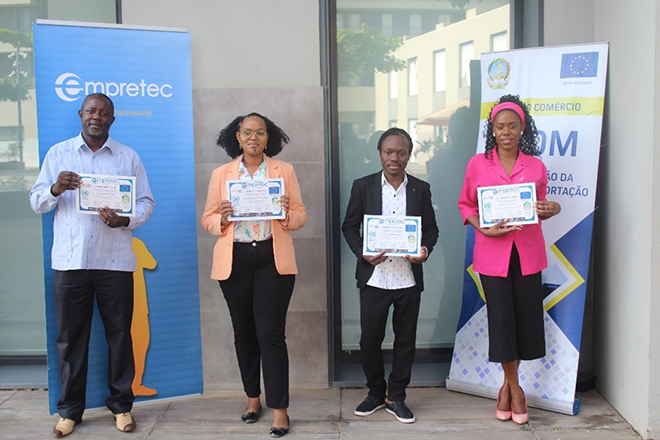
- Four (4) persons trained as Trainers (ToT), and two (2) of them trained persons are Master Trainers.
- Empretec Entrepreneurship Training: 500 persons trained.
Output 7 focused on: Enhanced and sustainable capacities of the public and private sector stakeholders engaged in the creative economy supported by a conducive policy environment, corresponding to the Creative Economy component.
- 247 participants trained through 13 trainings.
- Publications:
- Report Mapping the cultural and creative industries in Angola, published in 2023 and translated into Portuguese.
Cross-cutting support is considered capacity-building across various components, support and management-related activities and outputs.
- 168 participants trained through 3 trainings.
- Publictions:
- Angola's route to economic transformation: Small businesses drive economic growth, published in 2024 and translated into Portuguese.
Results achieved at the outcome level
Under the Specific Objective (SO) Enhanced Angolan policies and practices to foster and manage both global and regional trade and investment flows, four separate indicators measured outcome level progress.
SO indicator 1.1 focused on the Status of laws, regulations and programmes aimed at modernising and strengthening the Angolan economy.
- By the end of the Programme, contributions were made to altogether 15 policy processes directly supporting the development or review of policies and legislation, exceeding the initial target of 10.
- Refer to the interactive infographic under the section Policy development.
SO indicator 1.2 focused on the Status of Angola's investment policy.
- Investment Policy Review of Angola was published in December 2019. Technical support for the implementation of its recommendations was provided.
SO indicator 1.3 focused on the Status of Angola’s trade policy from a regional and global perspective.
- Support for the development of a Trade Policy Strategy, Commercial Diplomacy component was provided.
- Support to negotiations in the Economic Partnership Agreement (EPA), SADC, and AfCFTA, including Rules of Origin, WTO was provided.
SO indicator 1.4 focused on the Status of Angola's Entrepreneurship Policy Framework.
- The National Entrepreneurship Strategy (NES) was completed, with the leadership of INAPEM, under the Empretec component.
Results achieved at the impact level
The Programme’s impact level objective was to increase Angola’s participation in the regional and international economy and value chains.
Impact indicator 1 measured the Share of non-oil exports to the world. Whereas non-oil exports constituted 7.3% of total exports in 2016, the situation in 2023 was at a 9.7% level.
Impact indicator 2 focused on the Value of total exports to SADC countries. With the total exports to SADC at 1,438 million USD in 2016 and 509 million USD in 2023, a decrease in value by 929 million USD can be observed.
The drop was largely due to a dip in crude oil exports to South Africa as compared to 2016, as well as the impacts of the COVID-19 pandemic. However, during the same period, non-oil exports to SADC increased from 163,5 million USD to 182,5 million USD, or from 11% of total exports to SADC in 2016 to 36% in 2023.
Impact indicator 3 measured the Level of investment inflows. The inflows were at -180 million USD in 2016 and -2 billion USD in 2023. It should be noted, however, that FDI flows to non-oil sectors had positive values over 2018- 2023, and that they more than doubled between 2020 and 2021. The drop in inflows was thus linked to the oil sector only.
- Progress on policy development
Angola's route to economic transformation: Small businesses drive economic growth
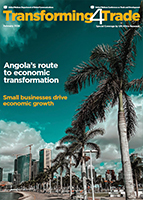
Transforming4Trade: Special coverage by UN Africa Renewal
The UN has acknowledged the Angolan programme as a best practice for achieving the Sustainable Development Goals (SDGs).
This publication by Africa Renewal focuses on the programme’s impact, drawing on beneficiaries’ first-hand accounts.
*Source for figures and estimates: UNCTADStat.
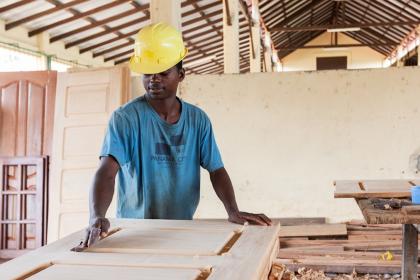
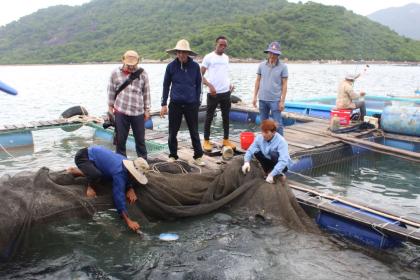
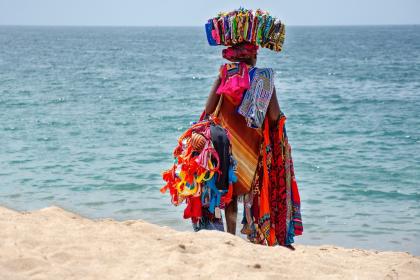
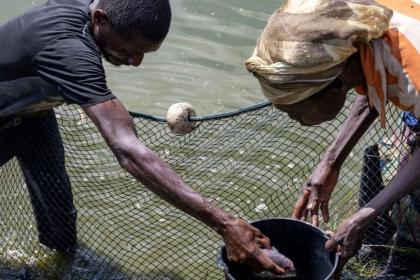

Supporting export diversification through training and by building productive capacities...

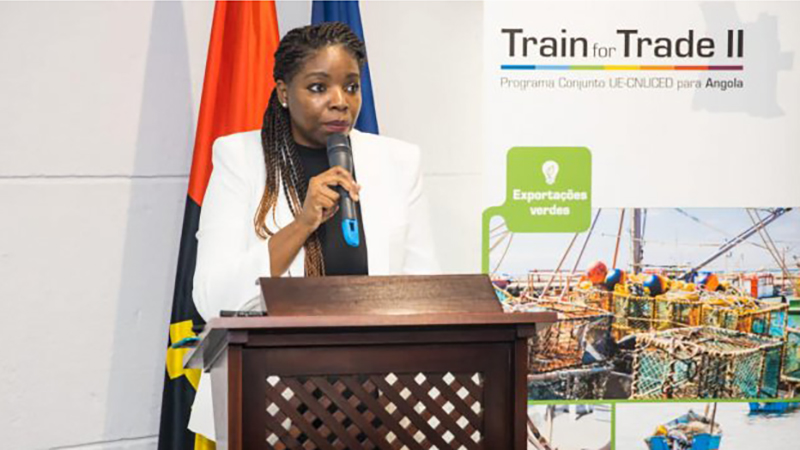
National Green Export Review workshop facilitating the identification and prioritization of green products with export potential in June 2018
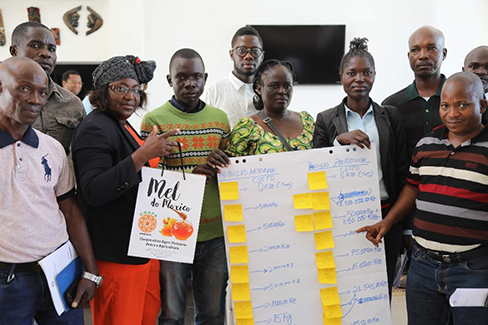
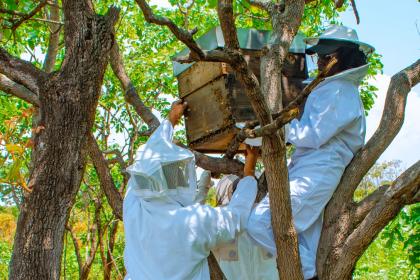
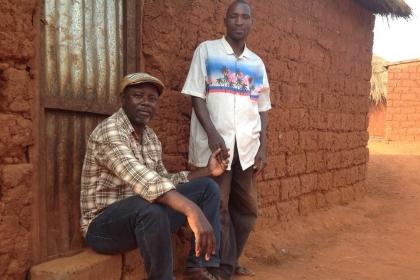
Capacity building training for honey producers and traders in the Moxico province in June 2019
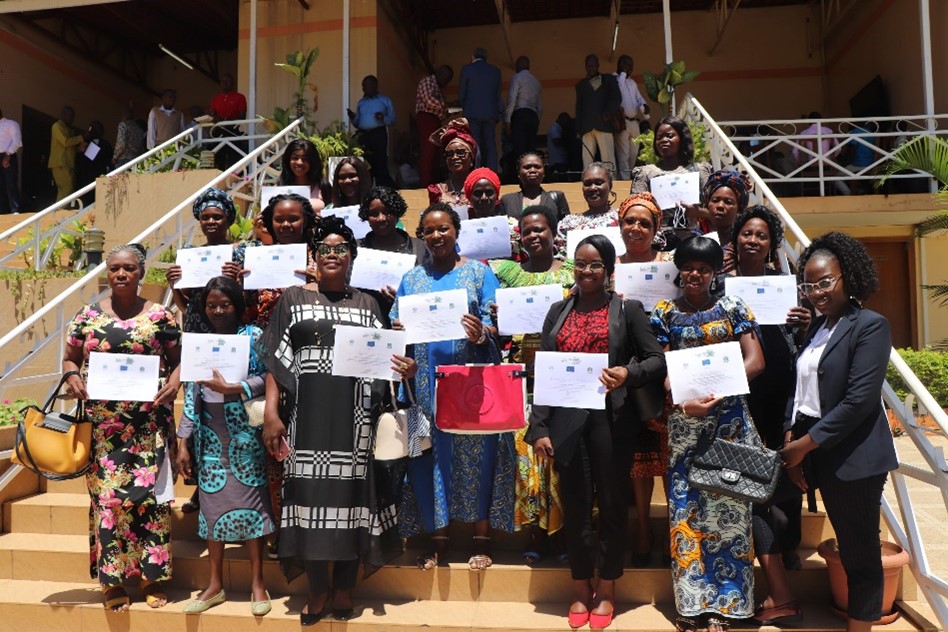
Women producers of coffee and tropical fruits certified in a capacity building training in the Uíge province of Angola in November 2019
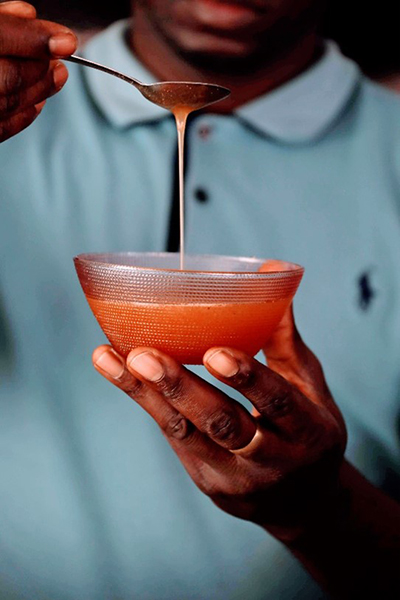
Quality honey from Moxico, Angola
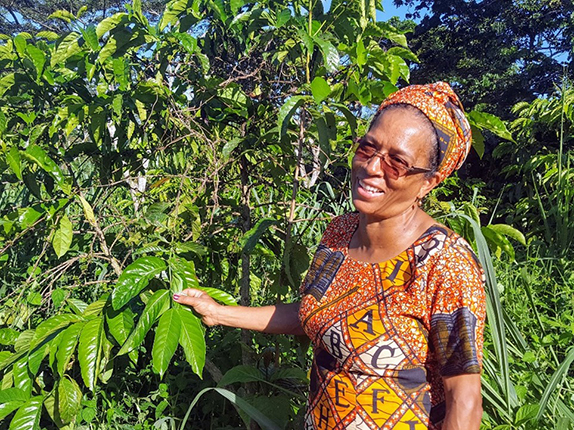
Training beneficiary Dona Isabel Menezes at her coffee plantation in the Uíge province of Angola
Helping to train a vibrant entrepreneurial base ...
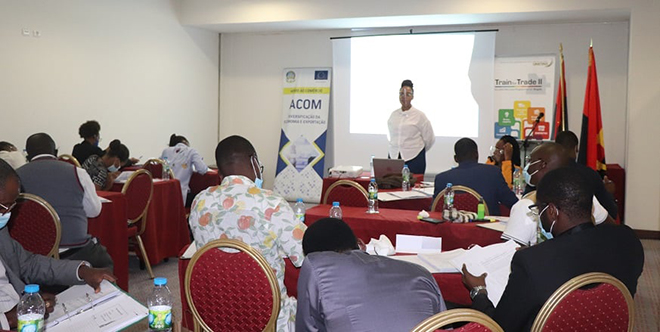
14th Empretec training workshop in Luanda, Angola, in April 2021
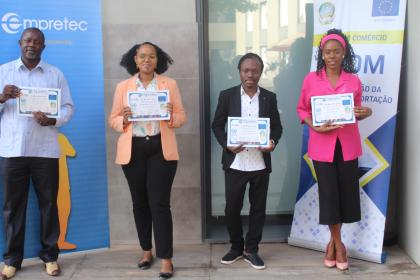
Four certified national Empretec trainers and two master trainers: Geraldo Basilua, Rosenayde Gomes, Wilson Kitth and Tunísia Sebastião
Encouraging sustainable investments ...
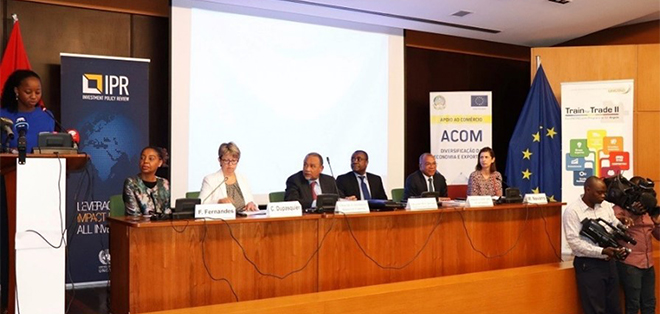
National workshop to discuss and validate the Investment Policy Review of Angola in September 2019
... and a conducive transport infrastructure for trade.
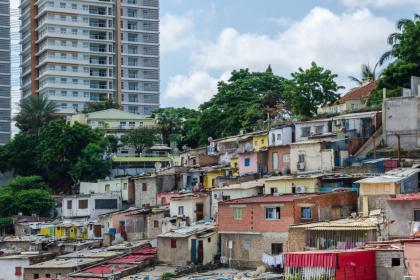
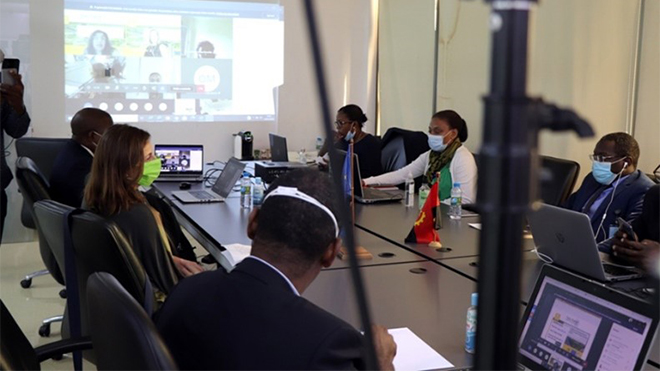
Hybrid workshop to showcase good practices on Public Private Partnerships for transport infrastructure development and help prepare PPP projects in July 2020
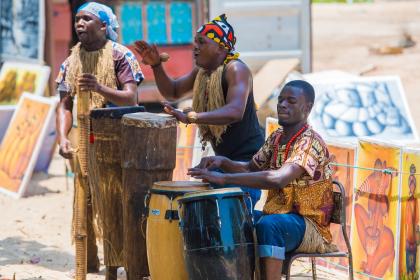
Promoting a national brand through developing the cultural and creative industries ...

Photo: © Dralton Máquina
Facilitating trade and helping to develop trade policies that assist in achieving national development priorities.

Participants in the training workshop for Module 2 of the UNCTAD Empowerment Programme for National Trade Facilitation Committees in March 2020
... with funding by the European Union

Project Code
TFBK
Donors
European Union
Beneficiaries
Republic of Angola

Duration
2017-2023